Posted in #Confessions, #Teaching

WWJD

            It was April, nearing the end of school, and the air hung low while the tensions ran high.  The humidity outside made sweat bead up on my top lip and my clothes feel like I was wearing a wet diaper.  And while I tried to start each day fresh and dressed to the 9’s, I ended these muggy days as barely a 3.8.

            Lunchtime is always hectic at a large urban high school, and on this day at Crockett High School, as an Assistant Principal, I was outside patrolling the back of the school.  Only seniors were allowed to leave for lunch, but of course we knew that was a rule followed by few.  Complaints had come in from teachers hearing cars spinning out from that back parking area by the tennis courts, along with loud music and the occasional waft of smoke; cigarettes and other smokables.

            Crockett high school is a beautiful campus and backs up to Garrison Park, a neighborhood park with baseball fields and a swimming pool.  Unfortunately, some students liked to take long lunches or skip classes and hang out in the park where nothing, but no-good shenanigans would take place.

            On this particular day, the SRO, School Resource Officer, had suggested that two AP’s be on the lookout for a late model, rusty blue chevy, with three male, non-students, inside.  It had been reported that these guys were trying to pick up girls from that parking area behind the school.  It had also been reported that they were blasting their music with loud, low bass thump, thump, thumps, disturbing classes while they waited for the girls to come out.

            Another female AP, Ms. Wilson, and I were positioned in that back area by the park.  We walked around, turning under-classmen back toward the school, while keeping an eye out for our rusty blue chevy.  As we circled around, we spotted our three guys, parked under some trees, music thumping and a faint smell of marijuana floating through the air.  They didn’t see us as we lurked behind the dumpster.

            “Officer Smith, we spotted the blue chevy,” I whispered over the radio.

            “10-4.  I’ll be right there,” the SRO answered.

            When he arrived at the dumpster, the SRO, Ms. Wilson, and I made our plan of attack.

            “The bell rings in 4 minutes, we should wait until the bell rings then nab them just as the girls are approaching the car,” Ms. Wilson said.

            “No, it might be too crowded with kids coming out for lunch.  Besides, they’re smoking joints right here on school property.  We should call for back up,” I suggested.

            And before we could finalize a plan, all hell broke loose.

            Two girls came out of the back door of the school three minutes before the bell rang and were looking left and right for the car.  The blue chevy boys saw the girls and turned up the thump, thump music and put the car in drive.

            Without a real plan, the SRO, Ms. Wilson, and I sprang into action.  The SRO took off toward the opposite end of the drive to set up a road block.  Ms. Wilson and I waited by the dumpster because the car had to come down that way to turn around and get out of the driveway.  As the car approached, we stepped out yelling for the car to stop.

            “Hey guys, stop right there,” I yelled, and I saw out of the corner of my eye, the girls start running toward the park.  I heard Ms. Wilson say, “Well s!*#”,  and take off running after them. Now, Ms. Wilson was a tall, big boned woman, dressed in a smart looking, purple colored knee-length shift, wearing mid-heeled espadrille sandals, so this was no track star chasing the students, but her commitment to the challenge was unmatched.

I knew I had to get this car to stop, so I stepped in front of it.

            “Are you crazy lady?  Get out of the way,” one of the boys yelled.

            “Hey man, let me see your school ID,” I told the driver, knowing full well these three hooligans were not students.

            “We’re just picking up my sister,” he said as he started to turn the car away from me.

            In a reflex action, I grabbed his arm, which was hanging out of the smoke filled, thump, thump, rusted blue chevy.  “Stop!” I yelled and for some unknown reason, he did.

            I still had my hand on his arm even as the car slowed and finally stopped, and as I glanced down at his arm I saw a yellow band on his wrist with “WWJD?”  And I lost it!

            “What would Jesus do?,” I hollered at him.  “What would Jesus do?  Not smoke pot and pick up underage girls!!!” I hissed.  “Jesus would definitely not do that.”

            “Let go of my arm, lady, you’re crazy!” And the car started to go.

            In a split second, I knew I had a decision to make. I couldn’t hold on to his arm and run beside a speeding car, but for some reason I didn’t let go of his arm.  I started to jog beside the car and then finally let go as he tried to roll the window up.  When I suddenly looked up I saw a police car parked, blocking their exit.  (Not a minute too soon.) 

I don’t know how she did it, but Ms. Wilson brought the girls back to campus and we called their parents.  The boys went with the police, and the smoke filled, rusted, thump, thump blue chevy got towed.  April turned into May and school was finally out, but not before I had a little time to reflect on that yellow wrist band.

            Maybe our wanna be thug/pot smoker had a devil and an angel sitting on his shoulders.  On one hand he wondered, what would Jesus do, and on the other he just wanted to live his best life out on the streets.  It’s definitely a conundrum as old as the ages, and it was definitely one day in my life as an assistant principal that I will never forget.

Posted in #Confessions, #Teaching

The Healing Power of Marvin Gaye

            In the 1970’s, education experts decided we needed to insert a values curriculum into our daily course work.  Through the years there were various curriculum packages, but one I remember was called, “Values Clarification.”

            Within the school day, usually homeroom period, teachers would use certain guided lessons to help students broach tough topics or situations, and moral dilemmas.  We were encouraged to help students get to know each other on a more personal level, building relationships and creating community.

            The year was 1982, and I was teaching high school Home Economics.  My classes were filled half with students wanting to learn to cook and hoping to sample what was made, and the other half were football players needing an ‘easy’ credit.

            It was the beginning of the semester, and as part of my Values Clarification curriculum, I had asked the students, one at a time, to stand beside their desk, introduce themselves, and tell one special thing about themselves that nobody else knew.

            “My name is Alicia, and I can say the alphabet backwards.  Z, W, X, V, U, T…..”  And the class politely clapped.

            “I’m D’Madre, and I can bench press one hundred pounds.”  And he flexed his muscles while attempting to pick up an empty desk and push it into the air.

            “Whoa, D’Madre,” I said.  “We believe you!” 

            “My name is Celeste, and I can speak English, Spanish, and Portuguese.  Mi ombre es Celeste.  Meu nome e’ Celeste.”  And everyone applauded.

            As we neared the end of the class period I said, “We have time for one more.  Bobby, will you make your introduction and tell us something special about yourself?”

            Bobby Smith stood up.  He was tall, with an athletic build and dark brown eyes.  He had the kind of personality that attracted friends like an ant to a picnic sandwich.

            “My name is Bobby Smith, and I know all the words to the song, ‘Sexual Healing,” by Marvin Gaye.  Do you want me to sing it?”

            And before I could take a breath, the class erupted into cheers.  He started to dance and hold his ink pen like a microphone.

            “Oh baby, let’s get down tonight.”

            “Oooh baby, I’m hot just like an oven.   I need some lovin.”

            “Bobby!” I said.  “I think…..”

            “Oh Miss, let him finish!  We l o v e this song!”  And two girls jumped up to chime in as backup singers, “wake up, wake up, wake up…”

            “Class!  Stop!  This is really …”

            “I can’t hold it much longer….It’s getting stronger…”

            And just when the class broke into the chorus,  “And when I get that feeling…I want sexual healing.”       

            The bell rang.

            The class filed out of the doorway, and I motioned for Bobby to stay back.

            “Bobby, I think that song was inappropriate for the classroom, don’t you?”

            “Ah, Miss, I understand.  I won’t do it again, but you have to admit, everyone liked it.” And he gave me a winning smile as he left the room.

            I did have to admit, to myself, that it was original, but I silently prayed no one went home saying, “Guess what we learned in Home Economics today?”  And I’m sure I wasn’t the only one who silently played that song over and over in my mind for the rest of the day.

Posted in #Confessions, #Teaching, Relationships

Tsunami

            My illustrious teaching career began in August of 1975, at Fairway Junior High School in Killeen, Texas.  I was barely twenty-two years old, fresh out of Baylor University with a degree in Home Economics, married, and had a daughter.  I was ‘adulting’ big time.  My then husband was still in law school, so it was imperative that I find a teaching position as soon as possible.  Two weeks before school started, I felt lucky that the junior high school would have an opening for an 8th grade Homemaking teacher.  In all of my false bravado and rose-colored glasses ideals, I never thought my first year of teaching would be anything other than magical.

Fairway had been the only high school in Killeen until a new campus was built and then it became a junior high school.  So, Fairway had seen better days, but it held wonderful memories for the Killeen community and the students it served. Most of the junior high students were from military families whose parents were stationed at Fort Hood Army Base.

The day I was hired, the principal’s secretary handed me a gradebook and a large wooden paddle. “In case you need to give swats,” she said.

I followed her into the storage closet, and she handed me a stapler, a box of staples, and two number two red pencils for grading, a box of chalk and two chalkboard erasers.  I felt so official.  Never did it occur to me to be apprehensive.  At no point did I get a sick feeling in my stomach.  I was the breadwinner of our little family now, and I was in ‘full steam ahead,’ mode. I was going to make this happen. How hard could this teaching thing be?

Truthfully, I do not remember my first day of teaching.  By the time I made breakfast, my lunch, took my daughter to the babysitter, drove to school and met twenty-five new students each period for seven periods in a day, I was somewhere between hyperventilation and zombie land.

By the third day of school, I was beginning to see that because I was teaching Home Economics, and it was considered an elective course, the counselors would sometimes use elective classes as an opportunity to ‘place’ students who might not otherwise fit into the regular stream of academic classes.  Also, in 1975, homemaking classes were only for girls.  Five days a week, seven periods a day, twenty-five girls per period comes out to an amount of estrogen that perhaps is impossible to calculate.  Imagine, if you will, approximately one hundred seventy-five girls in various stages of their menstrual cycles.

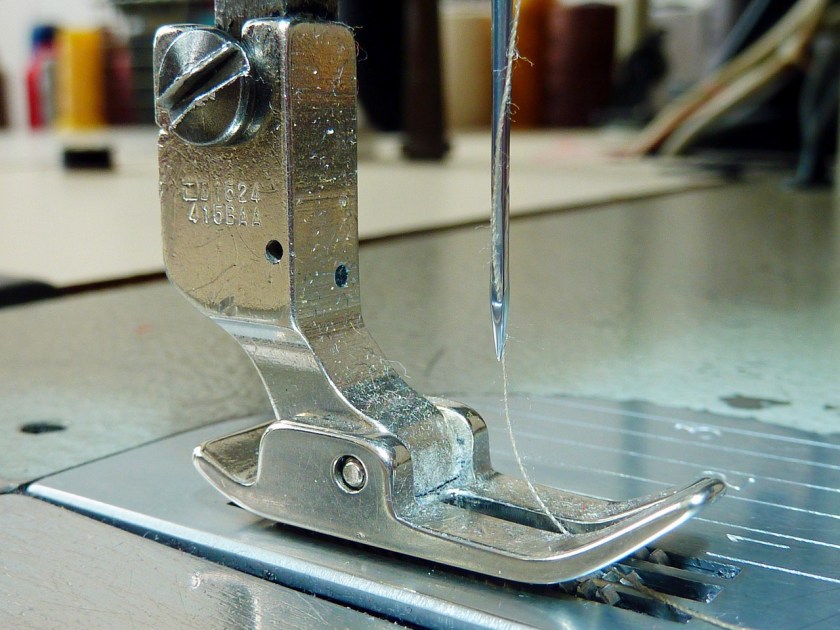
My two classrooms consisted of a sewing room with twenty sewing machines in various stages of repair, large tables to lay out fabric and patterns; and a huge room with five separate little kitchens, each with a kitchen table, stove, and cabinets filled with all kitchen utensils and dishware.   So, while some may say homemaking is an easy class to teach, there is a certain level of safety and training that comes with using sewing machines, sharp scissors, hot stoves, butcher knives, open flames, and electrical appliances.

The sewing project for that first semester was a simple, pull over blouse called The Poppet.  This easy Simplicity pattern took nearly all semester for my beginning seamstresses, and still, some did not finish.  As far as safety was concerned, we talked for days about pointing scissors down and away from the body (yours or anyone else’s).  We talked about the sewing machine and its parts, and the importance of keeping your fingers away from the needle while it is engaged.  The iron was another problem as I strived to remind students to turn it off and try not to burn any fingers, fabric, much less burn the building down.

Elective courses were seen as a safe and fun way to expand the day for students with special needs.  The Monday morning of my second week of school, I received a new roster for my second period.  Four new special education students were added to the role and began arriving mid class.  We had introductions and I assigned each of the four girls a buddy. As utterly horrible as having a classroom of pre-teen girls was, I must admit they were kind and helpful to our new classmates.   I did not know then that one of those new students would be a child I would remember for the rest of my life.

Tsunami Martinez had a beautiful light brown complexion with large, dark, slanted eyes.  She wore her hair down, pulled back by a plastic headband or sometimes in a long ponytail that reached halfway down her back.  She had a tentative smile that never showed her teeth and from the first day we met, she and I shared a bond that was hard to describe.  Our smiles and our eyes melted into each other, and I felt I had known her before, maybe in another life.  She wore plain blouses and polyester knit pants, always clean but often too big, and there was one more thing…   

  Tsunami did not speak.  Only her eyes told the story.

Sometimes Tsunami would be absent for two or three days in a row.  I would greet her when she returned and ask, “Were you sick, Tsunami?  We missed you.”

She would smile and her eyes would be searching mine, like they wanted to tell me, but she never uttered a word.  The most I would get would be a slight nod of her head, and even then I wondered if she understood me.

After several more absences, I spoke with the special education teacher about Tsunami’s attendance.  She said, “Tsunami’s mother  keeps her home when she needs help with the younger children.  There are four younger siblings.  Also, just so you know, Tsunami’s mother only speaks Korean, so you won’t be able to call unless her dad is home.” 

I continued to speak to Tsunami and include her in our learning process. As is protocol for any school in a military community, asking for students to have supplies of any kind must be correlated with military payday. Still, Tsunami was two- and one-half weeks later than the other students in bringing in her fabric and patterns.  Her face lit up when she walked in with her bag from the PX Post Exchange, and I knew she felt so proud that she had her own supplies.  I wondered if this extra expense was a hardship for the family or if maybe her mother did not drive, but I never knew the reason.

When it was time for Tsunami to begin using the sewing machine, I sat beside her and demonstrated exactly what she should do.  My fingers would hold the fabric and guide it through the machine.  Then I would put her fingers in the same place and help her guide the fabric through.  It was slow going.  When we would finish a row of stitches, she would smile, and her eyes practically danced as they crinkled upward. Of course, with twenty-four other students, I was not always able to just focus on Tsunami, but it was clear that someone needed to sit beside her in order to move forward.

One day, in the middle of class, a student started to yell, “Miss, Miss, come quick!  Tsunami got her finger caught in the sewing machine!”

Practically the whole class gathered around Tsunami’s table, and I pushed my way through the girls to sit down beside her.  She never uttered a word, but her eyes were large and overflowing with tears.  In one motion I turned the wheel to raise the needle up out of her left index finger and instantly blood began to spurt.  She held her finger up and looked at me with such a wide-eyed, almost surprised look.  From the crowd, a student handed us two rough, brown paper towels and I wrapped her finger tightly to stop the bleeding.  “You’re going to be ok, Tsunami.  We’ll go to the nurse’s office.”  And I immediately dispatched another student to escort her to the nurse. 

The next day Tsunami returned to class with a large bandage on her finger, but she did not want to work the sewing machine herself.  The other students took turns helping and encouraging her as they did most of the work on her blouse.  After a few days, things got back to a normal rhythm and Tsunami began to try sewing on her own.

But in two weeks, Tsunami was absent again.  Days later, when she had not returned, I received a note from the office that she had been withdrawn from school. And just like that, Tsunami Martinez, who had won a classroom full of hearts, was gone from our protective love and guidance.

The students and I speculated about the many reasons why she might have gone.

“Maybe she’s sick,” one girl said.

“I bet her dad got orders, and they have to move,” another one said.

“Her parents are probably getting a divorce.  That’s what happened to me,” a student offered.

Finally, I got confirmation that her father had been transferred to Germany.  No one came for her sewing supplies or her blouse which was half way through completion.  She seemed to have disappeared over night, and our class was quiet that next day as we separately thought about our friend.

I carefully took all of Tsunami’s sewing supplies and fabric and put them in a plastic bag labeled, Tsunami Martinez.  I then put it on the top shelf of my supply cabinet, just in case.

Of all the things I learned from my first year of teaching, perhaps the most important thing was that sometimes my heart would break, and there would be nothing I could do about it.  My heart would break because I dared to connect or ventured to care a little more than I should.  But as I look back on my thirty-six years of teaching, I have never regretted the connections or heart break, and I have always remembered a student whose eyes said it all.