Posted in #Confessions, #Teaching

A Teacher’s Lunch

            I have been retired from education for almost fifteen years, yet there are many things about teaching school that seem like it was yesterday.  One such sensory memory is walking into the school, early before the students arrive, and smelling a combination of floor wax, chalk dust and those delicious, fluffy, melt-in-your-mouth, stick-to-your-hips yeast rolls baking in the cafeteria kitchen.  Balm for the soul.

            The last two years I taught kindergarten; our lunch was scheduled for 10:20 a.m.  Imagine going through that cafeteria line smelling some semblance of tacos or pressed chicken patty on a day-old bun.  In reality, I had been smelling this aroma since 7:15 a.m. when I arrived at school.  The cafeteria staff was already busy at work prepping for a sumptuous day of school breakfast and lunch.

            In late August when school began, the children would not be hungry at 10:20 and would often leave half of what their mothers packed or what was on their lunch tray.  By September 15th, we were all hungry by 10:20 a.m. and then practically starving when snack time rolled around mid-afternoon.  Somehow, we all adjusted.

            In 1978, I was pregnant with my youngest daughter, and teaching middle schoolers on Fort Hood, Texas.  Everyday I packed the same lunch.  Everyday I ate the same things:  tuna salad, cup o’noodles soup (aka sodium explosion), and a naval orange.  Oh, and I drank a TAB.  No variations.  It was the ‘70’s, what can I say?  The combination of lead from the canned tuna, sodium from the soup, and chemicals from the TAB were what kept me going!

            As a side note, this was also the year one of my middle school students brought a set of handcuffs to school and tried to cuff my ankle to his.  But that’s a story for another day.

            One year, I ate a package of peanut butter crackers and drank a Diet Coke for lunch every day, both from the school vending machine.  I’m not proud of it, but it was easy.

            The first year I was an administrator at a high school, there were three lunches scheduled to accommodate the nearly 2,500 students. I had lunch duty starting at 11:00 a.m. until 1:55 p.m.  In the beginning of the year, I would bring my lunch, but I soon tired of the soggy turkey sandwiches forgotten from the day before.  My secretary made it her mission to find us something we could eat from the cafeteria and professed that the pressed chicken patty sandwich was the most nutritious and easiest to digest on the go.  So, you guessed it, that year my lunch was chicken patty sandwich and a Diet Coke.

            As an educator, your lunch hour is never an hour.  It is often 30 minutes with the potential for many interruptions.  You learn to eat your sandwich while xeroxing papers.  You drink the same cup of coffee or bottle of water for hours.  You sometimes gulp down your lunch so fast you don’t even remember what you ate, and often you eat your lunch under the prying and sometimes teary eye of a student. 

            As a high school teacher, lunch periods were notoriously times for skirmishes, fights, and less-than-ideal behaviors, so the concept of an uninterrupted lunch seemed foreign. Students wanted to come into your classroom on their lunch period, which was your lunch period, and make up work.

            At middle school, a teacher’s lunch is never her own.  There is always a student who needs extra help or simply needs to talk.  There is always lunch duty.  There is always a meeting to go to.  There is always something else to do besides eat…always.

            And elementary teachers?  Well, they sometimes run on fumes.  Once, when I was teaching kindergarten, my students had just gone to PE, so I was going to eat my lunch in the quietness of the classroom.  I had just opened my lunch sack when I looked up to see a little face peeking in the door.

            “I fell down,” she said, and promptly took a step inside the door to show her bloody knee.

            I opened my arms and said, “Come here, let me look at it,” and she fake hobbled over to my desk.

            “I was just about to eat my lunch,” I said, “but I can wait until I find a Band-Aid for you.  Did you eat all of your lunch?” I asked.

            With tears in her eyes, she nodded yes.  “But I sure do like chips,” she said.

            I slid my baggie of Lays potato chips over to the edge of my desk and a faint smile appeared on her tear-stained face.

            I wiped off her scraped knee and placed a star covered Band-Aid over the hurt.  Tiny fingers inched open the baggie of chips while I got her a cup of water.  I sighed a little as I glanced up to the clock on the wall telling me my thirty minutes was just about up.  “Maybe I can eat my sandwich on the way home this afternoon,” I thought, and just before the bell rang, my little student looked straight up into my eyes and said, “I love you, teacher.”

            “I love you, too.”  I said.

Posted in #Confessions, #Teaching, Relationships

Tsunami

            My illustrious teaching career began in August of 1975, at Fairway Junior High School in Killeen, Texas.  I was barely twenty-two years old, fresh out of Baylor University with a degree in Home Economics, married, and had a daughter.  I was ‘adulting’ big time.  My then husband was still in law school, so it was imperative that I find a teaching position as soon as possible.  Two weeks before school started, I felt lucky that the junior high school would have an opening for an 8th grade Homemaking teacher.  In all of my false bravado and rose-colored glasses ideals, I never thought my first year of teaching would be anything other than magical.

Fairway had been the only high school in Killeen until a new campus was built and then it became a junior high school.  So, Fairway had seen better days, but it held wonderful memories for the Killeen community and the students it served. Most of the junior high students were from military families whose parents were stationed at Fort Hood Army Base.

The day I was hired, the principal’s secretary handed me a gradebook and a large wooden paddle. “In case you need to give swats,” she said.

I followed her into the storage closet, and she handed me a stapler, a box of staples, and two number two red pencils for grading, a box of chalk and two chalkboard erasers.  I felt so official.  Never did it occur to me to be apprehensive.  At no point did I get a sick feeling in my stomach.  I was the breadwinner of our little family now, and I was in ‘full steam ahead,’ mode. I was going to make this happen. How hard could this teaching thing be?

Truthfully, I do not remember my first day of teaching.  By the time I made breakfast, my lunch, took my daughter to the babysitter, drove to school and met twenty-five new students each period for seven periods in a day, I was somewhere between hyperventilation and zombie land.

By the third day of school, I was beginning to see that because I was teaching Home Economics, and it was considered an elective course, the counselors would sometimes use elective classes as an opportunity to ‘place’ students who might not otherwise fit into the regular stream of academic classes.  Also, in 1975, homemaking classes were only for girls.  Five days a week, seven periods a day, twenty-five girls per period comes out to an amount of estrogen that perhaps is impossible to calculate.  Imagine, if you will, approximately one hundred seventy-five girls in various stages of their menstrual cycles.

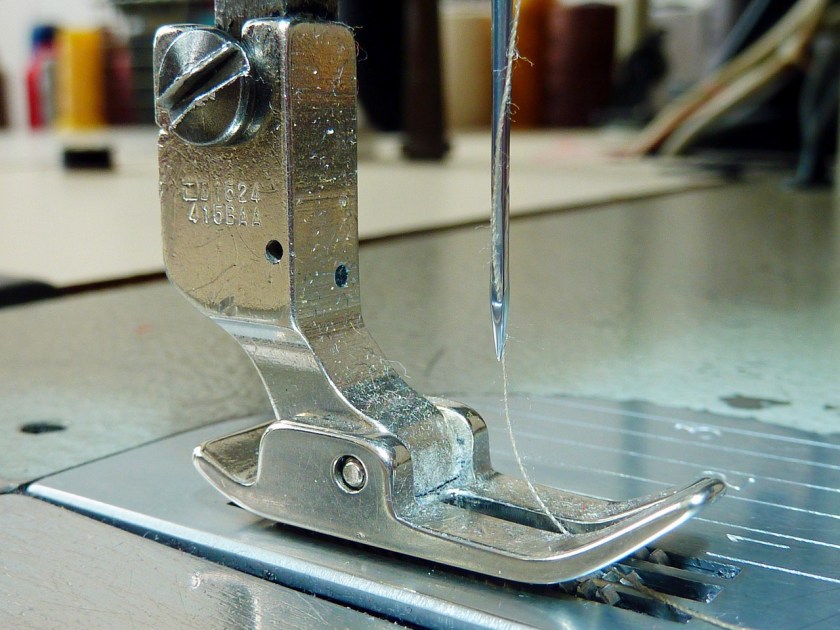
My two classrooms consisted of a sewing room with twenty sewing machines in various stages of repair, large tables to lay out fabric and patterns; and a huge room with five separate little kitchens, each with a kitchen table, stove, and cabinets filled with all kitchen utensils and dishware.   So, while some may say homemaking is an easy class to teach, there is a certain level of safety and training that comes with using sewing machines, sharp scissors, hot stoves, butcher knives, open flames, and electrical appliances.

The sewing project for that first semester was a simple, pull over blouse called The Poppet.  This easy Simplicity pattern took nearly all semester for my beginning seamstresses, and still, some did not finish.  As far as safety was concerned, we talked for days about pointing scissors down and away from the body (yours or anyone else’s).  We talked about the sewing machine and its parts, and the importance of keeping your fingers away from the needle while it is engaged.  The iron was another problem as I strived to remind students to turn it off and try not to burn any fingers, fabric, much less burn the building down.

Elective courses were seen as a safe and fun way to expand the day for students with special needs.  The Monday morning of my second week of school, I received a new roster for my second period.  Four new special education students were added to the role and began arriving mid class.  We had introductions and I assigned each of the four girls a buddy. As utterly horrible as having a classroom of pre-teen girls was, I must admit they were kind and helpful to our new classmates.   I did not know then that one of those new students would be a child I would remember for the rest of my life.

Tsunami Martinez had a beautiful light brown complexion with large, dark, slanted eyes.  She wore her hair down, pulled back by a plastic headband or sometimes in a long ponytail that reached halfway down her back.  She had a tentative smile that never showed her teeth and from the first day we met, she and I shared a bond that was hard to describe.  Our smiles and our eyes melted into each other, and I felt I had known her before, maybe in another life.  She wore plain blouses and polyester knit pants, always clean but often too big, and there was one more thing…   

  Tsunami did not speak.  Only her eyes told the story.

Sometimes Tsunami would be absent for two or three days in a row.  I would greet her when she returned and ask, “Were you sick, Tsunami?  We missed you.”

She would smile and her eyes would be searching mine, like they wanted to tell me, but she never uttered a word.  The most I would get would be a slight nod of her head, and even then I wondered if she understood me.

After several more absences, I spoke with the special education teacher about Tsunami’s attendance.  She said, “Tsunami’s mother  keeps her home when she needs help with the younger children.  There are four younger siblings.  Also, just so you know, Tsunami’s mother only speaks Korean, so you won’t be able to call unless her dad is home.” 

I continued to speak to Tsunami and include her in our learning process. As is protocol for any school in a military community, asking for students to have supplies of any kind must be correlated with military payday. Still, Tsunami was two- and one-half weeks later than the other students in bringing in her fabric and patterns.  Her face lit up when she walked in with her bag from the PX Post Exchange, and I knew she felt so proud that she had her own supplies.  I wondered if this extra expense was a hardship for the family or if maybe her mother did not drive, but I never knew the reason.

When it was time for Tsunami to begin using the sewing machine, I sat beside her and demonstrated exactly what she should do.  My fingers would hold the fabric and guide it through the machine.  Then I would put her fingers in the same place and help her guide the fabric through.  It was slow going.  When we would finish a row of stitches, she would smile, and her eyes practically danced as they crinkled upward. Of course, with twenty-four other students, I was not always able to just focus on Tsunami, but it was clear that someone needed to sit beside her in order to move forward.

One day, in the middle of class, a student started to yell, “Miss, Miss, come quick!  Tsunami got her finger caught in the sewing machine!”

Practically the whole class gathered around Tsunami’s table, and I pushed my way through the girls to sit down beside her.  She never uttered a word, but her eyes were large and overflowing with tears.  In one motion I turned the wheel to raise the needle up out of her left index finger and instantly blood began to spurt.  She held her finger up and looked at me with such a wide-eyed, almost surprised look.  From the crowd, a student handed us two rough, brown paper towels and I wrapped her finger tightly to stop the bleeding.  “You’re going to be ok, Tsunami.  We’ll go to the nurse’s office.”  And I immediately dispatched another student to escort her to the nurse. 

The next day Tsunami returned to class with a large bandage on her finger, but she did not want to work the sewing machine herself.  The other students took turns helping and encouraging her as they did most of the work on her blouse.  After a few days, things got back to a normal rhythm and Tsunami began to try sewing on her own.

But in two weeks, Tsunami was absent again.  Days later, when she had not returned, I received a note from the office that she had been withdrawn from school. And just like that, Tsunami Martinez, who had won a classroom full of hearts, was gone from our protective love and guidance.

The students and I speculated about the many reasons why she might have gone.

“Maybe she’s sick,” one girl said.

“I bet her dad got orders, and they have to move,” another one said.

“Her parents are probably getting a divorce.  That’s what happened to me,” a student offered.

Finally, I got confirmation that her father had been transferred to Germany.  No one came for her sewing supplies or her blouse which was half way through completion.  She seemed to have disappeared over night, and our class was quiet that next day as we separately thought about our friend.

I carefully took all of Tsunami’s sewing supplies and fabric and put them in a plastic bag labeled, Tsunami Martinez.  I then put it on the top shelf of my supply cabinet, just in case.

Of all the things I learned from my first year of teaching, perhaps the most important thing was that sometimes my heart would break, and there would be nothing I could do about it.  My heart would break because I dared to connect or ventured to care a little more than I should.  But as I look back on my thirty-six years of teaching, I have never regretted the connections or heart break, and I have always remembered a student whose eyes said it all.

Posted in #Confessions, #Teaching

Rock Paper Scissors

          “Repite, por favor.”

            “Senorita?”

            “Senorita?”

            I heard my professor tap into the headset asking me to repeat the phrase that was just spoken on the tape we were listening to.

            “Senorita, verme despues de clase.”

            See me after class.

            For some unknown reason, I advanced placed out of two Spanish classes from high school and landed in a second year Novella class in which I did not belong. Because I had sailed through high school with little studying, I was ill-prepared to keep up with this high-level Spanish class at Baylor University.

            I slithered into the Professor’s office after class, and he wasted no time:

            “Senorita?  I will let you withdraw passing if you will just get out of my class.  You simply cannot continue.”

            His chair-side manner would never win a compassion award.  He offered no remediation or helpful guidance, as I was evidently slowing him down.

            “But my major. What about my major?  I wanted to be a Spanish interpreter and travel the world.”

            “Oh, Dios mio!  No Miss.  You must not continue.”

            “Ok.”  I said, “But, what do I need to do now?”

            “Just go.  I’ll take care of the withdrawal.”

And so, I went back to my dorm room to pour over the curriculum courses trying to find a new major.  Becoming a Spanish interpreter and traveling the world was no longer an option.  How do you say, ‘end of the line,’ in Spanish?

            Because I had learned to sew with my grandma growing up, I thought I could be a fashion designer, which sounded as exotic as a Spanish interpreter.  I did love fashion and as far as I knew I would not have to take any foreign language, so it seemed the perfect fit.  I called my daddy that next weekend to tell him my news and shockingly it did not go the way I predicted.  I explained the Spanish class situation and that I withdrew with a passing and not a failure.  Then I told him my grand plan to become a fashion designer and see the world.

            “No, you will absolutely not become a fashion designer,”  he said.

            “But Daddy…” I interrupted.

            “No buts.  The only acceptable majors are teaching, or nursing.  That way, if your husband dies later in life, you will have a career to fall back on.”

            “But, Daddy, a fashion designer is a career.”

“Nancy Lynn, you need to become a teacher or a nurse, marry a nice, educated man when you graduate, be a stay-at-home mom and live happily ever after.  That’s what you need to do unless you want to start paying your own tuition and then you can waste your own money on fashion designing.  Comprende’?”

            “Yes, Daddy.”

            “O.K. honey, get this taken care of as soon as possible.  Love you.”

            “Love you, too, Daddy.”

            My exciting idea about fashion designing morphed into a Bachelor of Science degree in Home Economics.  My certificate would allow me to teach grades 8-12 Home Economics and Science: and also, Kindergarten.  And although I had never ever, even once thought about being a teacher, it seemed that was my best option. 

            In my junior year at Baylor I met and fell in love with a law school student who was also a widower, ten years my senior and had a six-year-old daughter. We fell for each other in lightning speed and got married six months after our first date. “We got married in a fever, hotter than a pepper sprout!” as Johnny Cash would have said.

            His mother had been a teacher, so he was as happy about my teaching certificate as Daddy was.  We got married before my senior year, and Daddy even agreed to finish paying my tuition as long as I graduated at the end of the year, and that is exactly what I did.

             After my graduation, my ‘then’ husband still had two more semesters of law school, so we decided that our daughter, Lee, and I would move back to his hometown of Killeen, Texas and I would apply for teaching jobs.  My interview with the Killeen Independent School District happened to be the same day we drove from Waco pulling a U-Haul trailer.  Sixty-one miles of pulling a trailer and entertaining a six-year-old left me a little less than fresh as I pulled up to the Human Resources building,(trailer and all) and after a short introduction, I was told to head straight over to the junior high school.

            “Go on over to the junior high and I’ll call the Principal to expect you.  This could be your lucky day,” the Human Resource Director said.

            When we arrived at the junior high, Lee and I went into the front office, and I introduced myself to the secretary.

            “Mr. Lawson is expecting you.  Your daughter can wait out here with me if you like,” she said.

            The school was old and definitely across the railroad tracks.  I just didn’t know if it was on the right or wrong side of those tracks.  And since Killeen, Texas was near Fort Hood army base, I knew there would be a large population of military children attending the school.

            Before I knew it, Mr. Lawson came out and introduced himself to me and Lee. 

            “Be good, sweetie, and I will be back soon,” I said to Lee and sat her in a chair by the counter in the front office.

            Mr. Lawson and I had polite chit chat and he asked questions about my teaching philosophy.  I had no philosophy about teaching or anything else, really.  I was barely twenty-two years old and well, quite frankly, I thought this teaching gig would be a breeze.

Five minutes into our interview we heard ‘click click, likity tickity, click, click.’  We continued talking but when the clicking sound kept on he said, “Maybe we better check on your little one.”  Opening his office door we saw Lee, singing softly to herself and tap dancing on the freshly waxed office floor.  The secretary clapped and cheered, “Bravo!” and Mr. Lawson turned to me saying, “Well, I have to offer you the job now after a performance like that!  School starts in two weeks, what do you say?”

            “Yes,” I said hugging Lee.  And just like that I moved to a new city, with a new family and a new career.

            I became a teacher, something I never aspired to be or dreamed of being.  It was by default from a Spanish Professor who wanted me out of his class as much as I wanted to be out.  It was a life decision I fell into by sheer chance and because my daddy had a vision of what a woman should and should not do. Was it luck?  Would you call it fate?  Both sound too romantic for what it really was, happenstance.

            I became a teacher, averaging way more than the “forty hours a week and summers off,” that a few foolish people believe is true.  My heart was captivated by the sometimes hopeful, sometimes hopeless faces I would meet each year.   Come August, I planned to do better than the year before and create an atmosphere of learning and respect, and each May I looked forward to time away from the constant responsibility and work, which is teaching.  It was a rhythm I would repeat for thirty-six years.

            In 1990-91 I taught Kindergarten at Clear Creek Elementary School on Fort Hood army base in Killeen, Texas.  The Gulf War had just started when we began school that year and what I remember most are the children and mothers crying each morning as they separated for the day.  In my classroom, our main windows faced the highway, and right next to the highway were the railroad tracks.  The trains ran all day and all-night loading and unloading equipment, tanks, and personnel and often my twenty-five little charges would be gathered three deep looking out the window hoping to see their mothers or daddies.

            “Come away from the window now,” I would say.  “Let’s read a book.”

            “But I think I see my daddy,” one child would say, and the rest would press close, hoping for a glimpse.

            Our school was on high alert and the MP’s (Military Police) were positioned by the doors while nearly every day a young mother would come to check out her children in hopes of moving back home where they could be near family.  It was a chaotic year, yet one I felt most honored to be a part of.  I felt my calling to not only teach these children but also to love and nurture them, providing a safe, calm oasis during their otherwise stressful days.

            As time went on, I became the kind of teacher I could be proud of.  I became a teacher with a heart.  A heart for students from all walks of life, backgrounds, and nationalities.  A heart for loving the hard to love and a heart to bring discipline to a troubled spirit.  I enjoyed each grade level, each school, and each role I played from Kindergarten teacher to Assistant Principal of a large high school.  The job requirements might change but the essence of a teacher stays the same.  Connection.

This connection changed my life in a million different ways, all better than I could have ever imagined.  My heart learned when to be tough and when to be tender.  My patience grew by leaps and bounds as eventually, I became exactly what I was always meant to be.

 A teacher.