After I secured my MA in English at LSU in 1980, I took a teaching position at an un-air-conditioned elementary school north of Baton Rouge. As a Language Development teacher I was part of a state program that helped children who were “culturally deprived.” I gave no grades and used puppets and a small record player to sing songs as we worked on vocabulary building, letter recognition, and basic reading skills. I worked with small groups of kids between 5-7 years old who came to me for 30-minute classes each day.
My Elementary School Kids
The school was a long building in the countryside with one classroom for each grade (K thru 8). Recess time for kindergarteners was in a small field next to a fenced area of cows. The mooing of our bovine neighbors mixed with the whirr of electric fans. The population was 98.9% African-American. I remember an extra tall kindergarten boy who was “mixed” and one pale, blonde second grader.
My students spent most of their lives in the rural area they called home. When we took the kindergarteners for a field trip to Baton Rouge, the biggest Wow! was the escalator at the mall where we had lunch. A few five-year-olds needed help getting on and off the moving stairs, but others wanted to ride up and down more times than they could count.
I became friends with Molly, the kindergarten teacher, because I worked with her whole class, and we shared lunch while her kids napped on dark blue mats. I helped her color 3-foot high cardboard cut-outs of the Alphabet Kids. I loved coloring as we chatted. I knew the kindergarten class best since I only worked with a few first and second graders.
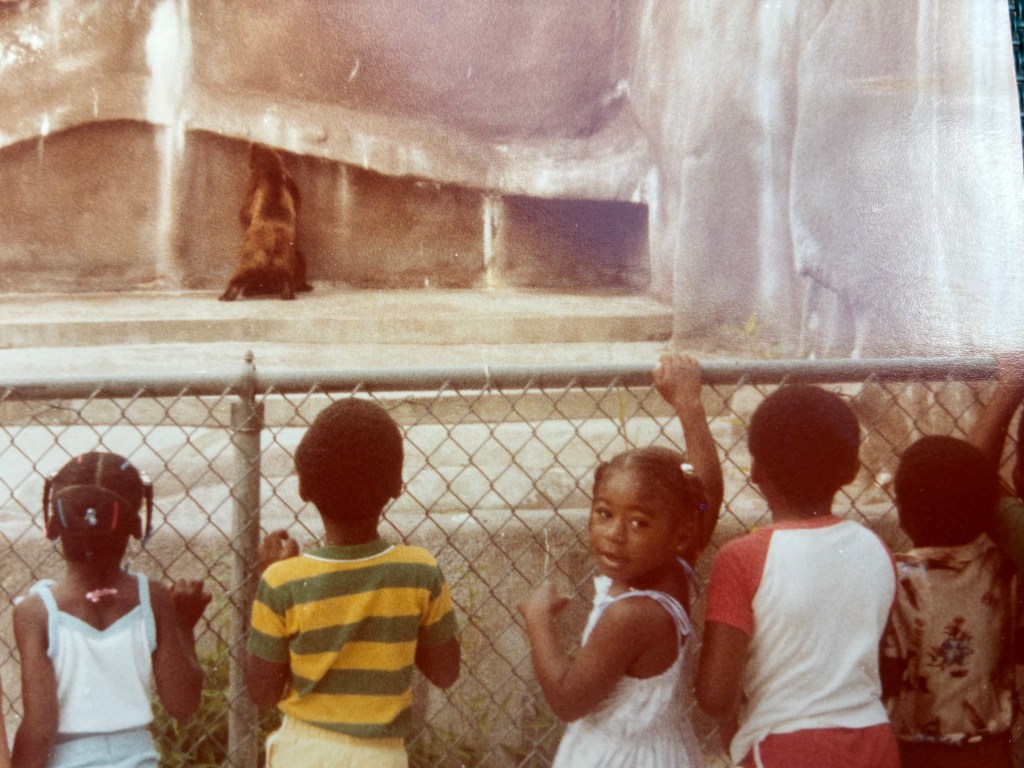
Our zoo field trip
I remember David who rarely slept on his blue mat. He stayed quiet while squirming and searching the room for another wakeful peer; however, all the other kids had entered the Land of Nod. I smiled often at Sammy, a chubby boy who was first to fall asleep flat on his back with his mouth half- open to make him appear more vulnerable than those who curled into balls or hugged a treasured stuffed animal from home. Sammy was a cute, yet tough bundle of energy when he wasn’t napping. He had a husky laugh and lots of friends. When I had Sammy in my class he sang confidently during the puppet songs and I believed we got along like cheese and crackers.
One humid afternoon I helped Molly with a line of five-year-olds as they waited for the school bus or a parent to take them home. (Kindergarten got out an hour earlier than the rest of the school). Each child had a note pinned to his/her shirt with details about our upcoming field trip. Sammy was kicking up gravel as he waited. I smiled at him and squatted to be eye-level. “Sammy, you excited about going to Baton Rouge next week?”
He continued kicking pebbles and surprised me with, “Momma told me don’t trust a white person farther than I can throw ‘em.”
Maybe he had seen his mother’s car pull up and didn’t want to be caught talking to me. Maybe I had corrected his pronunciation in my class earlier that day. In a moment Sammy went from being a student I felt comfortable with to someone I didn’t know.
For the first time I felt a smidgen of judgement based on the color of my skin. I never had a run-in with any parent that school year. I got only positive feedback from my principal. I thought I was a decent elementary teacher, even if my diploma said “Secondary School English.” But Sammy made me face the separation of races in Louisiana in the 1980s. I did not think I held prejudice in my heart. However, I grew up around racism in my hometown. Sammy’s mother’s beliefs came from her own experiences, and she was teaching her son how to navigate the world she lived in.
Back then no one used the triggering term “woke,” but Sammy opened me to living Atticus Finch’s advice in To Kill a Mockingbird– “You never really understand another person until you consider things from his point of view…until you climb into his skin and walk around in it.”
I had a sheltered upbringing when it came to other cultures. My segregated hometown and a Catholic school education kept me ignorant in some ways. I thought I trusted, accepted, and understood people from different races. But teaching in several schools with diverse populations, I got “schooled” by my students and their families. And teaching teens with lives so unlike my own made me a better person.
The quote “Be a person on whom nothing is lost” by Henry James helps me seek new ways to understand other people and to accept our differences. I will never understand prejudice the way those who lived it have, yet I can be open-minded to their ideas and accept them for who they are…..even if they don’t trust me.
I have been retired from education for almost fifteen years, yet there are many things about teaching school that seem like it was yesterday. One such sensory memory is walking into the school, early before the students arrive, and smelling a combination of floor wax, chalk dust and those delicious, fluffy, melt-in-your-mouth, stick-to-your-hips yeast rolls baking in the cafeteria kitchen. Balm for the soul.
The last two years I taught kindergarten; our lunch was scheduled for 10:20 a.m. Imagine going through that cafeteria line smelling some semblance of tacos or pressed chicken patty on a day-old bun. In reality, I had been smelling this aroma since 7:15 a.m. when I arrived at school. The cafeteria staff was already busy at work prepping for a sumptuous day of school breakfast and lunch.
In late August when school began, the children would not be hungry at 10:20 and would often leave half of what their mothers packed or what was on their lunch tray. By September 15th, we were all hungry by 10:20 a.m. and then practically starving when snack time rolled around mid-afternoon. Somehow, we all adjusted.
In 1978, I was pregnant with my youngest daughter, and teaching middle schoolers on Fort Hood, Texas. Everyday I packed the same lunch. Everyday I ate the same things: tuna salad, cup o’noodles soup (aka sodium explosion), and a naval orange. Oh, and I drank a TAB. No variations. It was the ‘70’s, what can I say? The combination of lead from the canned tuna, sodium from the soup, and chemicals from the TAB were what kept me going!
As a side note, this was also the year one of my middle school students brought a set of handcuffs to school and tried to cuff my ankle to his. But that’s a story for another day.
One year, I ate a package of peanut butter crackers and drank a Diet Coke for lunch every day, both from the school vending machine. I’m not proud of it, but it was easy.
The first year I was an administrator at a high school, there were three lunches scheduled to accommodate the nearly 2,500 students. I had lunch duty starting at 11:00 a.m. until 1:55 p.m. In the beginning of the year, I would bring my lunch, but I soon tired of the soggy turkey sandwiches forgotten from the day before. My secretary made it her mission to find us something we could eat from the cafeteria and professed that the pressed chicken patty sandwich was the most nutritious and easiest to digest on the go. So, you guessed it, that year my lunch was chicken patty sandwich and a Diet Coke.
As an educator, your lunch hour is never an hour. It is often 30 minutes with the potential for many interruptions. You learn to eat your sandwich while xeroxing papers. You drink the same cup of coffee or bottle of water for hours. You sometimes gulp down your lunch so fast you don’t even remember what you ate, and often you eat your lunch under the prying and sometimes teary eye of a student.
As a high school teacher, lunch periods were notoriously times for skirmishes, fights, and less-than-ideal behaviors, so the concept of an uninterrupted lunch seemed foreign. Students wanted to come into your classroom on their lunch period, which was your lunch period, and make up work.
At middle school, a teacher’s lunch is never her own. There is always a student who needs extra help or simply needs to talk. There is always lunch duty. There is always a meeting to go to. There is always something else to do besides eat…always.
And elementary teachers? Well, they sometimes run on fumes. Once, when I was teaching kindergarten, my students had just gone to PE, so I was going to eat my lunch in the quietness of the classroom. I had just opened my lunch sack when I looked up to see a little face peeking in the door.
“I fell down,” she said, and promptly took a step inside the door to show her bloody knee.
I opened my arms and said, “Come here, let me look at it,” and she fake hobbled over to my desk.
“I was just about to eat my lunch,” I said, “but I can wait until I find a Band-Aid for you. Did you eat all of your lunch?” I asked.
With tears in her eyes, she nodded yes. “But I sure do like chips,” she said.
I slid my baggie of Lays potato chips over to the edge of my desk and a faint smile appeared on her tear-stained face.
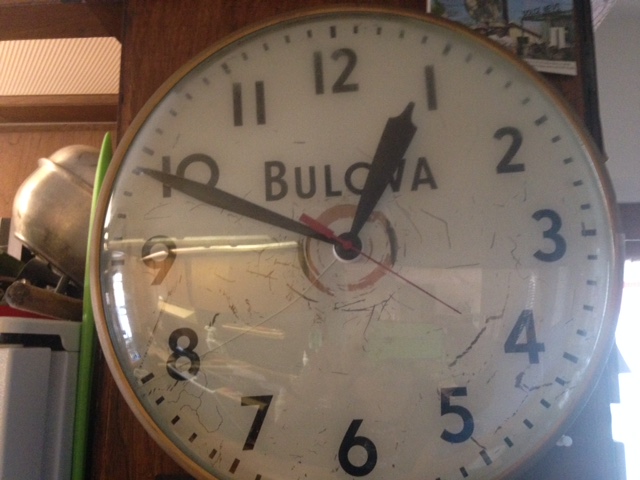
I wiped off her scraped knee and placed a star covered Band-Aid over the hurt. Tiny fingers inched open the baggie of chips while I got her a cup of water. I sighed a little as I glanced up to the clock on the wall telling me my thirty minutes was just about up. “Maybe I can eat my sandwich on the way home this afternoon,” I thought, and just before the bell rang, my little student looked straight up into my eyes and said, “I love you, teacher.”
When I consider my 34 years of teaching, I think one of my most important challenges was understanding and supporting each of my teen-aged readers and writers. As an English teacher, I see the task of “getting to know your students” as a Herculean job since we also have to grade and give useful feedback on their essays and research reports.
My students often shared things in their personal narratives that shocked, saddened, or confused me. (And I’m NOT talking about the handwritten scribbles without punctuation or capitalization or the cursive that is so tiny I needed either direct sunlight or a magnifying glass to figure it out). I’m referring to the loneliness, the trauma, the heartaches, and the stress they routinely shared in their essays. I’m remembering the stories that made me cringe, laugh aloud, and cry. I’m remembering the ones that called for an after-class conference or a visit to the school counselor.
I felt both honored and burdened by their honesty. Since high school teachers often have rosters with 180-plus students, how do we learn their names before back-to-school night? How do we handle so much angst, joy, depression, immaturity, intelligence, and cynicism without giving up every second of our home lives? And how do I separate each school day’s drama from my family responsibilities? How do I focus on my own children’s needs and forget my students’ issues?
Like the tv series Severance where Lumon employees sever the connection between their work lives and their private lives. A worker’s “innie” doesn’t remember anything about his/her “outie” home life (and vice/versa). Maybe a teacher could cope better if her “outie” forgot all the details of her “innie” life.
I’ve taught over 6,000 students, and I confess I don’t remember every single kid. But so, so many smiles, smirks, glares, and empathetic nods remain. The ones who shared their wisdom and laughter stay with me as much as the ones who made me cry and rush to another teacher or an assistant principal for help. The faces, of course, linger longer than the names.
Here is a short account of one of my students. Using a different name, this is a brief remembrance of an unforgettable freshman at Crockett High School.
Thomas
Three weeks into the school year I noticed a freshman’s black and white marbled composition book on my desk atop fat folders of ungraded quizzes – a writing journal without a name and not returned to second period’s designated shelf where even stacks of non-spiral notebooks gave the illusion of order.
I finished writing next period’s agenda on the streaked white board before I flipped through pages of black ink scrawls that made the lined paper curl like those paper-thin red plastic fish that move in your palm and predict the future. The last few pages had more cursive than print and less punctuation. “i sit on the roof & wonder why im even here” made me sit down. I scanned previous lines about “a heart of hurt,” a girl’s “soulful eyes,” a “silence that slices” and a “cold colorless world.”
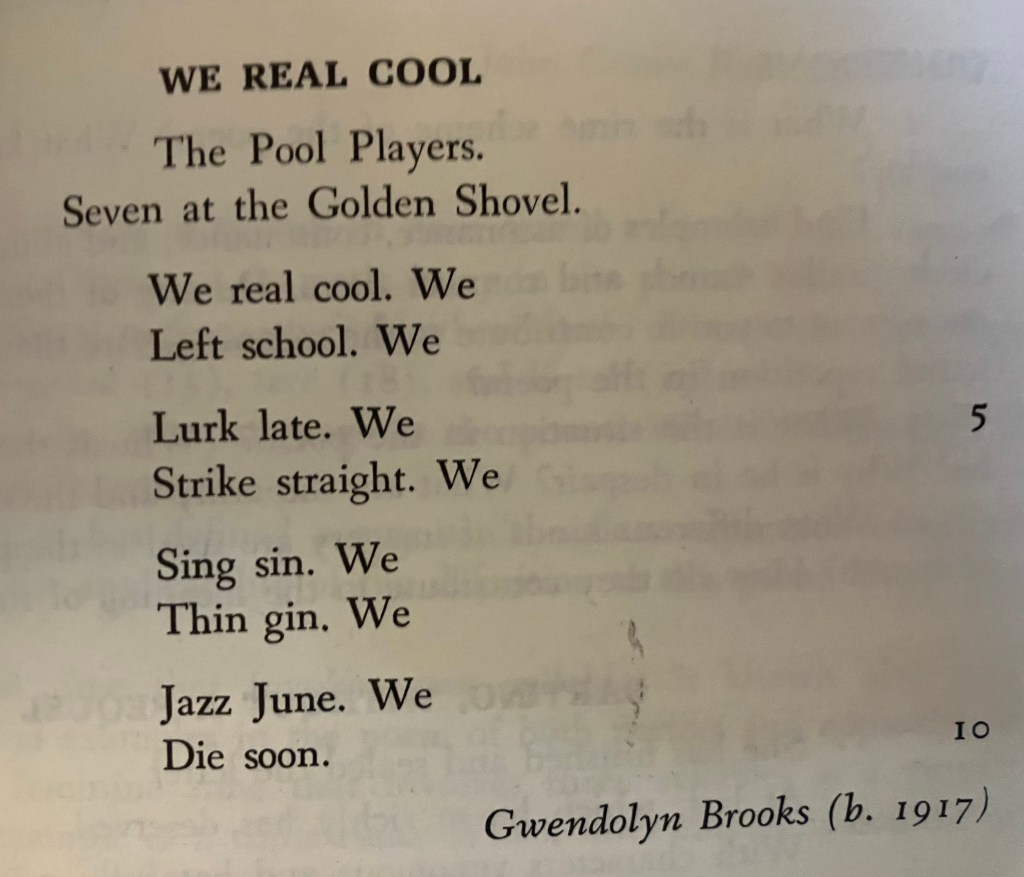
I reread the notebook searching for a specific name. Nothing. I flipped through second period’s quizzes searching for that same hard-pressed ink, minimal punctuation, print/cursive mix, and the lowercase i’s until I held Thomas’s quiz about Gwendolyn Brook’s poem “We Real Cool.” He’d circled the poet’s use of alliteration and underlined “We die soon” six times.
I referred back to Thomas’s journal and touched the words “on the roof” before having the sense to seek help. I rushed downstairs to my favorite counselor’s office. The woman who focused on class schedules and state mandated testing switched to doing what she was trained to do. We compared the journal with the quiz paper and agreed Thomas was the author. A slim boy with wild blond curls and a skateboard stuck out of his backpack. He wore over-sized, faded 80’s rock concert t-shirts and loose black jeans. A mix of grunge and emo. Withdrawn yet observant. Someone who sat in the back row, stared out the window, and usually avoided his 31 classmates. Someone a teacher with 184 students could fail to notice.
My vague answers to the counselor’s specific questions made me squirm. We labeled Thomas a smart student with a “B” average, neither a joiner nor a trouble maker. He melded into crowds of teens struggling to be seen and ignored at the same time.
I thought about next week’s Back-to-School Night when tired parents would come to Crockett High School to trudge up and down stairs and visit eight teachers who might remember half of their students’ names, so the question “How’s my son doing?” was as pointless as “What’s my kid’s blood type?”
By now I had missed my lunch duty and had eight minutes before third period began. The counselor kept the journal and nodded to me while reading details about Thomas’s classes and his family on her computer.
I left her office, walked through the school’s open-air courtyard, and looked up past the massive oaks and concrete steps that led to my second floor classroom. Could Thomas be on the school roof? Or across the street atop the flat tops of the strip mall businesses? Had he gone to the neighboring city park’s rec. center next to an empty swimming pool with a peeling, cracked blue bottom?
At my desk I ate broken Pringles from a plastic baggy. I thought of the one time Thomas had spoken up in class telling a peer to “quit stereotyping the story’s protagonist.” My teacher heart had danced a jig then, but I couldn’t remember the rest of the literary discussion. I thought of Thomas’s extra dark eyes beneath long bleached curls and how he responded to my morning greetings with eye contact and head nods.
The assault of third period’s buzzer-bell sent me to my door to greet 33 teens. My after-lunch sophomores came in loud and messy. Conspiratorial laughs from two girls preceded a running Sam who tossed a bag of Flamin’ Hot Cheetos to Carlos who tugged on a cheerleader’s backpack which made her yell, “Loser!” before swatting at the runner who headed toward a window past short, short Cici who wore headphones and slipped into her desk before putting her head down while a new girl taller than me stopped at my door. New girl’s thin hand with chipped black nail polish held a printout from the attendance office. I gave her a smile and a “Hey there,” took the paper, and pointed to my last empty desk. When Gabriella began passing out the black and white journals, I forgot which chapter of Animal Farm we were on because all my head could do was scan rooftops for a fourteen-year-old boy I hardly knew.
Note to readers: The school counselor did locate Thomas off-campus that day. He was hanging out in Garrison Park and despite his broken heart he was fine. She talked with him, but I never confronted him about the “sitting on the roof” drama. He passed freshman English and graduated a few years later. I have no further info. but I hope he remembers some of the literature we talked about like I’ll always remember the panic I felt about the journal he had left on my desk and my flawed attempt at “getting to know my students.”
I never dreamed of being a teacher. In 1965, at age nine, reading was my favorite pastime, and I wanted to be a writer. After seeing Funny Girl in 1968, I wanted to be an actress. As I endured my high school years, my cerebral palsied limitations (a mostly useless left hand and a limping leg) I changed my dreams of being on stage with Barbra Streisand to being her best friend. In college I decided writing was my best option, so I majored in journalism. I switched to creative writing when I realized there was a typing requirement for the compulsory news reporting class. After I spent one thrilling semester as a Creative Writing major Dad said, “English major? You need to switch to Education. Get a job as a teacher.” Since he paid for my education, I followed his demand.
So I endured Statistics, Fundamentals of Education, and Testing Measurements. My eyes glazed over as I watched male professors wearing dark suits and frowns explain a female-dominated profession. I struggled to solve basic math problems as I yearned for poetry and short stories. My student teacher semester was my one worthwhile education class because the supervising teacher was a white-haired angel named Dr. Hair whose sage opinions included “Everyone deserves a year living in New York City.”
Dr. Hair made guiding fifteen-year-olds through literary analysis as natural as eating popcorn at the movies. She gave me the perfect balance of praise and pressure. I guided reluctant teens through recognition of the eight parts of speech and examples of figurative language. I thought I could be a strong teacher who handled any educational challenge that came my way—until my first day of teaching at Anderson Junior High.
The school was in a small south Louisiana town set literally “on the wrong side of the tracks.” On my first day of work, the principal handed me a wooden paddle – “for discipline.” The English Department chair did not tell me how happy she was to have me at Anderson Junior High when she gave me a key to my classroom. Nor did she ever smile.
In theory the schools in Louisiana parishes in 1978 were integrated; in reality Anderson was 90 percent black, and its faculty included only four white teachers. Most other teachers ignored me, maybe because my pale face looked as soft as my disciplinary skills, and they believed I wouldn’t stay there long enough for them to bother learning my name. Their assumptions were as right-on as fried catfish specials on Fridays in our predominantly Catholic state.
My miscalculations began when I missed the obvious warning sign connected to a teaching job starting in January: a teacher had quit in December! My first day of teaching a class without Dr. Hair nearby was as bad as stepping barefoot into a bed of fire ants. The seventh graders had run off their last teacher the week before Christmas break; in January they took one look at the remnants of my bad perm and my plaid wool skirt with its matching vest and recognized new teacher inexperience.
I’d gotten to school early enough to write the day’s agenda on the blackboard below the day’s date and next to my name in white powdery cursive. The front of the room was cluttered with heavy cardboard boxes filled with that semester’s new grammar workbooks. My department chair, who had looked at and spoken to me as little as possible the day before, said, “Distribute these,” after she concluded our thirteen-minute new teacher orientation.
I straightened the rows of battered wooden desks and the stack of my “Welcome to Seventh Grade Language Arts!” packets. I reviewed the names of the 172 students I would meet that day, and I went over the index cards for my first-day-of-school welcome speech. I said a fast Hail Mary and made the sign of the cross when the first bell rang.
In seconds the halls filled with the noise and energy of thirteen-to-sixteen-year-olds. Our school district did not practice “social promotion,” and a few boys with facial hair sat in seats next to boys whose feet did not touch the floor. I mispronounced at least five names that day, but the students did not hold it against me when I changed the roster’s “Edward” to “Eddie” or made pronunciation notations on “Janie” (a short A beginning and a long E at the end). I think they were still uncertain about where I stood on the spectrum of clueless teachers.
The first time I turned my back on the class to list the “Being Verbs” on the board, I heard a four-second belch and watched a wad of paper flying toward the waste basket near the front door. It missed its mark. After I repeated “Be, am, are, is, was, were, being, and been,” I picked up the wadded paper and dropped it in the trash in movements both smooth and confident. I raised my eyebrows when I realized the paper ball was my welcome packet but remembered Dr. Hair’s advice: “Give students your respect and as much eye contact as possible.” Several kids were smirking, and five occupied desks that had nothing on them, so there was no way I knew which student had tossed the welcome packet my way. I suspected a tall black-haired boy with slits for eyes.
I paced in front of the class and moved to my packet’s next bullet point.
“Who knows what an adverb is?” I said and prayed for an answer. The girl in the front row who had answered every other question that period raised her hand. “Let’s give someone else a chance to answer, Trina,” I said as I looked toward the slit-eyed boy. He leaned back in his seat and folded his arms. I decided to call on someone from my seating chart. “Whitney?” I said. “Could you read the definition of an adverb?” I nodded as she complied. Then, walking closer to the middle row of students, I said “Adverbs give verbs and adjectives more flavor.” I scanned the seating chart: “David, can you use the adverb ‘quickly’ in a sentence?”
Slit-Eye snorted, and a thin boy looking lost in what was undoubtedly an older sibling’s pale blue sweater said, “Which one?” I then realized there were two Davids in that class. I chose “David Fontenot.” The slit-eyed David was ready for me, even as Trina raised her hand and wiggled her splayed fingers.
“Stupid bell can’t ring quickly enough to get us out of here,” David F. said.
Most kids laughed, and a girl with bangs that covered the top half of her eyes clapped and smiled at David. I smiled, too, and said, “I totally agree!”
I then ruined my tiny victory by saying, “Good job, David. Our packet also tells us that adverbs can modify adjectives. Can someone give me a sentence using an adverb that describes an adjective?” By this time, eager Trina had given up on me. Looking over my seating chart I saw a name I loved. “Chloe,” I said. “Will you give us a sentence with an adverb describing the adjective ‘happy’?”
From the back of the room the girl with extravagant bangs aimed her chin at me. “Adjective?” she said in a husky voice loaded with disdain.
“Trina, please define adjective for us.”
With a voice like a defeated postal worker, my former ally said, “Adjectives describe nouns and answer the questions what kind, how many, and which one.”
“Chloe, will you give us a sentence with an adverb describing the adjective ‘happy’? Common adverbs are ‘very’ and ‘too’ as in ‘too much.” I gave her the appropriate wait time to answer. Chloe folded her arms and glared at me still grinning.
I took a deep breath. “Anyone have a sentence with an adverb that modifies ‘happy’?” I said as the ticking of the large round school clock seemed to slow down time. I decided to write some examples on the blackboard. I took three steps backwards forgetting about the cardboard boxes of workbooks. My right heel hit the corner of one that was open and half empty, and my left foot turned sideways as I half-fell, half-sat into the box. My only bit of luck was that my plaid skirt was maxi length and I didn’t “bomb” the class with a view of my underwear.
Gayle, me, & Jana (I’m wearing my first day of teaching outfit).
After two seconds of surprise the class erupted into laughter that unified them against the enemy, the outsider, the one they viewed as a temporary teacher. To get out of the box gracefully, I would have needed a helping hand, but no seventh grader would put a teacher ahead of her reputation—not even Trina. As I spread my feet farther apart, I used my good right hand to grab the metal leg of my desk. My first attempt to pull my butt off of a pile of Houghton Mifflin’s Workbooks for the Fundamentals of Grammar and Writing failed to end my humiliation. I needed to push off with my feet and rock backwards a couple of times to get enough momentum to fall forward onto my knees. The laughter gained strength as if a seasoned comic had followed a dynamite joke with the gag that killed it. Staggering, I ripped out a few inches of my skirt’s hem with my right shoe. I took a long breath as I bent down to retrieve my papers and caught my department chair’s tired eyes looking through my door’s narrow window, probably dreading the search for my replacement so soon.
I mustered a close-lipped smile. “That’s enough,” I said and walked towards a girl laughing and slapping her desk with opened palms and I repeated, “Enough!” The girl stopped the slapping and most kids stopped laughing. I had never before wished I could evaporate into a mist and make everyone in the room forget the last several minutes. The laughter paused, and I felt twenty-seven pairs of eyes focused on me. I cleared my throat and looked at the tops of their heads. I opened my mouth, but before I could speak, Chloe said, “Bet you ain’t too happy to be here now, Ms. Keller.”
Despite the fact that she used my name and not the traditional “Hey, miss”; despite her using the adverb “too” correctly with the adjective “happy”; and despite my ability to keep from crying in front of those seventh graders, I could feel nothing but fear in my gut and shame in my soul. How could I ever be a teacher? Why had I not begged my mother to convince my dad to let me major in creative writing? When would be too soon to call in sick to work? What if I quit my job at Anderson and moved back in with my parents?
I did not hate my students that day. I did not blame the principal, my department chair, or Chloe for my disastrous first day. I accepted that day’s failure and used my 22-year old optimism to get me through that spring semester.
I didn’t realize then that there would be thirty-seven years of teaching ahead of me— instructing junior high students, college freshmen, kindergarteners, and high school seniors. I would become as comfortable in front of a classroom of teens as a crawfish is in a flooded rice field. I would even miss teaching when I became a student teacher field supervisor after I retired from full time teaching. Before this first teaching job, I’d never believed teaching would be my profession. I fell into it like I fell into that box of workbooks.
Books I loved to teach
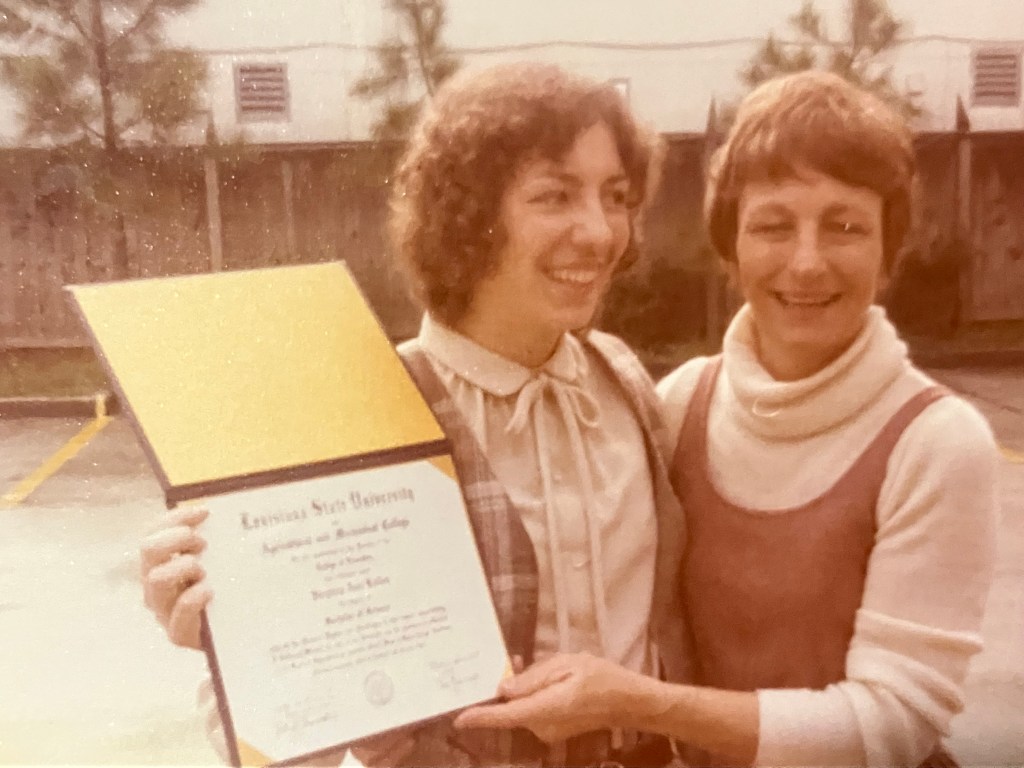
Me and Momma with my LSU diploma
Sometimes, if we’re lucky enough, we improve our talents and learn to like what we do. And maybe we land in a box built just for us.




















 Sittin' Ugly Sistahs