Posted in Friendship

Playing School by Ginger Keller Gannaway

This story is based on my memories of sharing my wisdom with my younger sisters in the 1960s.

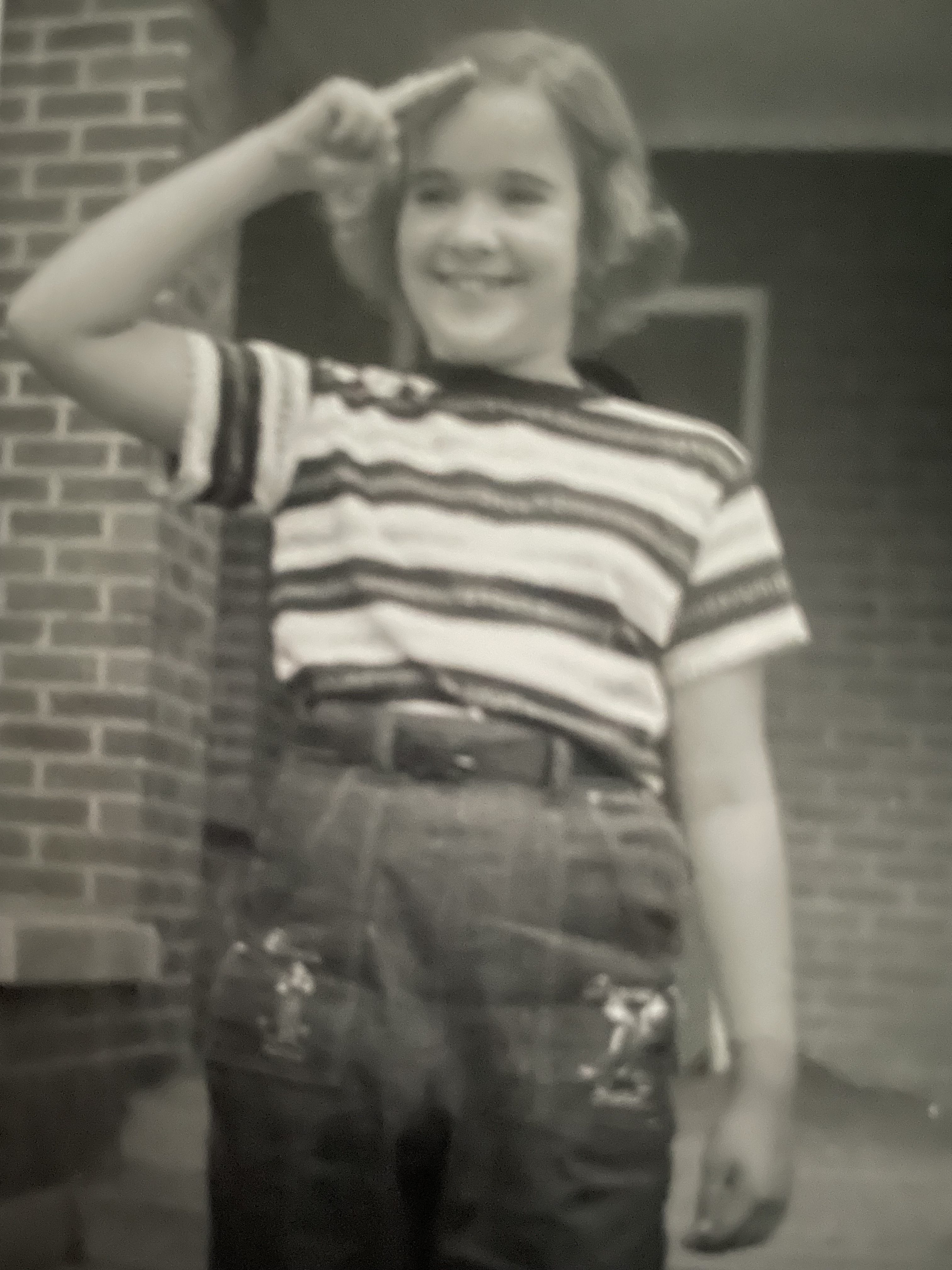
Me, Gayle, and Kelly in 1966

When I was seven years old I tried my hand at what would become my future profession. On a late summer afternoon, I smoothed the front of a stiff red and white church dress, brought my tanned bare feet together, repositioned my white plastic headband, and looked my class over from the white brick fireplace hearth that raised me three inches above those I’d be instructing. Kelly, age three, wearing light blue shorts and a sleeveless white cotton crop top sat crosslegged on the living room carpet. She held a Big Chief tablet and a red crayon. Gayle, age five, wore a faded Tweety bird t-shirt with a never-worn navy school uniform skirt and sat erect on a small wooden chair. She tapped her brand new letter-practicing book with a fat pencil and wriggled her toes as she stretched her feet to touch the legs of a red and yellow plastic chalk board that came with my surprise birthday gift that year: a Suzy Smart Deluxe Doll Set!  

Suzy Smart, dressed in a white blouse under a red plaid jumper and standing two feet tall, completed the class and sat stiffly in her own red and yellow plastic desk. I smiled down at my class of three and held up a piece of chalk to draw a large capital letter “A” on the chalk board. 

My grandson’s chalkboard

“Today we practice our A’s.” I established eye-contact with each student and added, “Y’all gotta draw ten A’s for me. On your mark, get set… go!”
 
Gayle took to the assignment like a Cajun to hot boudin. Having to use her lap was all that kept her from making uniform A’s. Kelly tried her first A, but the slanted lines were uneven and her letter did not look like the one on the chalk board. 

“I’m gonna make little ‘l’s’,” she said and started covering her first page with a letter she liked.

I focused on the obedient ones. “Good job, Gayle,” I said.  Suzy gave me her straight-forward stare. “Nice listening, Suzy.”  

Then I knelt down next to Kelly. “Your ‘l’s’ are good, good, but we’re doing ‘A’s.’  Here. Let me show you how.” I put my hand over her fist and guided the red crayon through a perfect A formation. “Like this.”  

Kelly pushed aside a stray strand from a pigtail and said, “OK,” and continued to drew more l’s. 

“You already made like fifty l’s . You need to learn your A’s.”  

“No A’s in my name.” 

“Good! You know how to spell your name, but I’m teaching ALL the letters today.”

“ ‘A’ is the very first letter,” said Gayle as she completed her tenth “A” and nodded proudly to each of  us, including Suzy. She wrapped a long strand of jet black hair behind right her ear and waited for further instructions.

“How many letters?” asked Kelly.

Getting a bit of teacher inspiration, I said, “We should sing the A-B-C song!”

The human students stood up to belt out “A,B,C,D,E,F,G…”  Susie listened. As Kelly screamed out the final Z, she grabbed Gayle’s hands, and led her in circles for the “Now I know my ABC’s” part.

The dancing pupils added impromptu hip-shaking for their song’s end.

I was losing control of my class.  I erased the “A” and drew a “B” on the chalk board.   “Good job, y’all! Now let’s practice the second letter – B.” My sisters then snapped to like tiny soldiers and for some weird reason saluted.

“Ok, class. Sit down now,” I said. Both obeyed, but first Kelly snatched Gayle’s new pencil gave her the red crayon.

“Hey. Give it back,” said Gayle.

“Just let me borrow it.”

“You suppose to ask.”

“Can I use your pencil?”

“Please.”

“Pleeeease.”

“Say pretty please.”

“Pretty please, ya dumb sneeze.”

“She called me ‘dumb,’ Teacher!”

Kelly stuck her tongue out at the snitch. I clapped my hands together. “Class! Y’all gotta listen.” Gayle grabbed her pencil back and bounced the crayon off Kelly’s pert pug nose. 

Kelly picked up Gayle’s letter practice book and ran behind me. “I’m agonna rip this up,” she said.

Gayle could not wait for help from an inept teacher. She knocked over both Susie’s and her desk as she rushed after Kelly. 

I tried keeping the girls apart as Kelly danced behind me and moved the book in circles around her face.

“Na! Na! Na! You can’t get me,” she chanted right before Gayle got ahold of her right pigtail. The letter book fell, the chalk board collapsed, and Kelly sprang into fight mode. Both girls got fistfuls of hair. For several seconds the hair-pulling tug-of-war was a stalemate. Gayle’s longer arms gave her an advantage, but Kelly’s spicy temper made it a fair fight.

“Stop it! Y’all are wrong, wrong! Stop!” I said as I pushed my way between them. 
Kelly was biting her stuck-out tongue to concentrate. Gayle had both of her sister’s pigtails when Kelly dropped her sister’s hair strands. Her smaller stature lacked the force she needed to make Gayle release the pigtails, so Kelly leaned back and kicked her left foot high enough to get her foe right in her tee-heinie. The taller girl let go of the shorter one’s hair and fell to the carpet. She put both hands over the place of pain and let loose the “OWWWWW’s”

“That’s what you get,” said Kelly.

Gayle moaned like a dying opossum.

I sat on Gayle’s chair in defeat. Kelly tapped a line of dots on the fallen chalkboard as her sister made herself into a ball on the floor. I straightened the bow on the Suzy doll’s ponytail and sighed as if I’d dropped the last bite of the last slice of watermelon into a pile of fire ants.

Being used to sister fights and being relieved that I was above this current argument, I went to the den’s plaid couch and looked out our huge picture window. Our dog Lady was taking her mid-morning nap in the shade of our cement patio. I focused past our yard on the rice fields that surrounded our home. The sun winked at me between oak tree branches. With a sigh that reflected on and accepted my big sister wisdom, I decided that teaching was not for me.
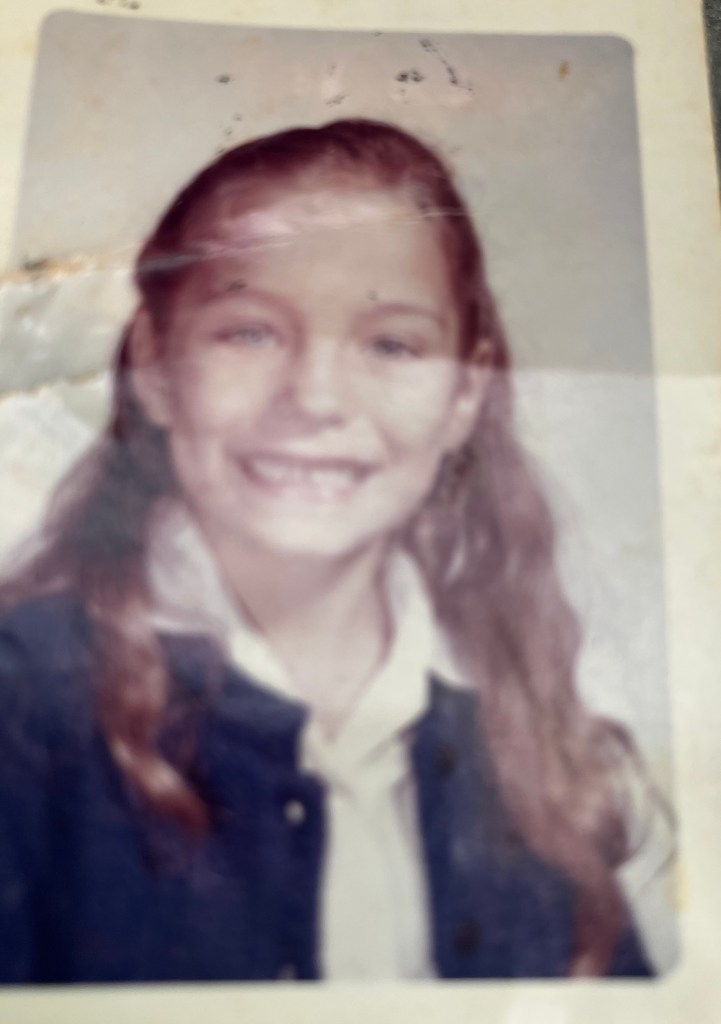
My first grade photo

Posted in #Confessions, #Teaching, Relationships

Tsunami

            My illustrious teaching career began in August of 1975, at Fairway Junior High School in Killeen, Texas.  I was barely twenty-two years old, fresh out of Baylor University with a degree in Home Economics, married, and had a daughter.  I was ‘adulting’ big time.  My then husband was still in law school, so it was imperative that I find a teaching position as soon as possible.  Two weeks before school started, I felt lucky that the junior high school would have an opening for an 8th grade Homemaking teacher.  In all of my false bravado and rose-colored glasses ideals, I never thought my first year of teaching would be anything other than magical.

Fairway had been the only high school in Killeen until a new campus was built and then it became a junior high school.  So, Fairway had seen better days, but it held wonderful memories for the Killeen community and the students it served. Most of the junior high students were from military families whose parents were stationed at Fort Hood Army Base.

The day I was hired, the principal’s secretary handed me a gradebook and a large wooden paddle. “In case you need to give swats,” she said.

I followed her into the storage closet, and she handed me a stapler, a box of staples, and two number two red pencils for grading, a box of chalk and two chalkboard erasers.  I felt so official.  Never did it occur to me to be apprehensive.  At no point did I get a sick feeling in my stomach.  I was the breadwinner of our little family now, and I was in ‘full steam ahead,’ mode. I was going to make this happen. How hard could this teaching thing be?

Truthfully, I do not remember my first day of teaching.  By the time I made breakfast, my lunch, took my daughter to the babysitter, drove to school and met twenty-five new students each period for seven periods in a day, I was somewhere between hyperventilation and zombie land.

By the third day of school, I was beginning to see that because I was teaching Home Economics, and it was considered an elective course, the counselors would sometimes use elective classes as an opportunity to ‘place’ students who might not otherwise fit into the regular stream of academic classes.  Also, in 1975, homemaking classes were only for girls.  Five days a week, seven periods a day, twenty-five girls per period comes out to an amount of estrogen that perhaps is impossible to calculate.  Imagine, if you will, approximately one hundred seventy-five girls in various stages of their menstrual cycles.

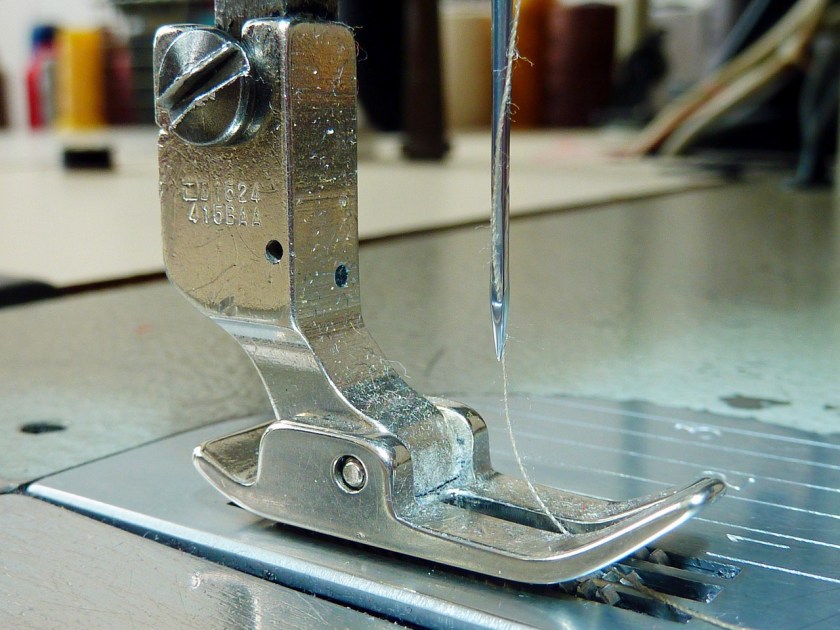
My two classrooms consisted of a sewing room with twenty sewing machines in various stages of repair, large tables to lay out fabric and patterns; and a huge room with five separate little kitchens, each with a kitchen table, stove, and cabinets filled with all kitchen utensils and dishware.   So, while some may say homemaking is an easy class to teach, there is a certain level of safety and training that comes with using sewing machines, sharp scissors, hot stoves, butcher knives, open flames, and electrical appliances.

The sewing project for that first semester was a simple, pull over blouse called The Poppet.  This easy Simplicity pattern took nearly all semester for my beginning seamstresses, and still, some did not finish.  As far as safety was concerned, we talked for days about pointing scissors down and away from the body (yours or anyone else’s).  We talked about the sewing machine and its parts, and the importance of keeping your fingers away from the needle while it is engaged.  The iron was another problem as I strived to remind students to turn it off and try not to burn any fingers, fabric, much less burn the building down.

Elective courses were seen as a safe and fun way to expand the day for students with special needs.  The Monday morning of my second week of school, I received a new roster for my second period.  Four new special education students were added to the role and began arriving mid class.  We had introductions and I assigned each of the four girls a buddy. As utterly horrible as having a classroom of pre-teen girls was, I must admit they were kind and helpful to our new classmates.   I did not know then that one of those new students would be a child I would remember for the rest of my life.

Tsunami Martinez had a beautiful light brown complexion with large, dark, slanted eyes.  She wore her hair down, pulled back by a plastic headband or sometimes in a long ponytail that reached halfway down her back.  She had a tentative smile that never showed her teeth and from the first day we met, she and I shared a bond that was hard to describe.  Our smiles and our eyes melted into each other, and I felt I had known her before, maybe in another life.  She wore plain blouses and polyester knit pants, always clean but often too big, and there was one more thing…   

  Tsunami did not speak.  Only her eyes told the story.

Sometimes Tsunami would be absent for two or three days in a row.  I would greet her when she returned and ask, “Were you sick, Tsunami?  We missed you.”

She would smile and her eyes would be searching mine, like they wanted to tell me, but she never uttered a word.  The most I would get would be a slight nod of her head, and even then I wondered if she understood me.

After several more absences, I spoke with the special education teacher about Tsunami’s attendance.  She said, “Tsunami’s mother  keeps her home when she needs help with the younger children.  There are four younger siblings.  Also, just so you know, Tsunami’s mother only speaks Korean, so you won’t be able to call unless her dad is home.” 

I continued to speak to Tsunami and include her in our learning process. As is protocol for any school in a military community, asking for students to have supplies of any kind must be correlated with military payday. Still, Tsunami was two- and one-half weeks later than the other students in bringing in her fabric and patterns.  Her face lit up when she walked in with her bag from the PX Post Exchange, and I knew she felt so proud that she had her own supplies.  I wondered if this extra expense was a hardship for the family or if maybe her mother did not drive, but I never knew the reason.

When it was time for Tsunami to begin using the sewing machine, I sat beside her and demonstrated exactly what she should do.  My fingers would hold the fabric and guide it through the machine.  Then I would put her fingers in the same place and help her guide the fabric through.  It was slow going.  When we would finish a row of stitches, she would smile, and her eyes practically danced as they crinkled upward. Of course, with twenty-four other students, I was not always able to just focus on Tsunami, but it was clear that someone needed to sit beside her in order to move forward.

One day, in the middle of class, a student started to yell, “Miss, Miss, come quick!  Tsunami got her finger caught in the sewing machine!”

Practically the whole class gathered around Tsunami’s table, and I pushed my way through the girls to sit down beside her.  She never uttered a word, but her eyes were large and overflowing with tears.  In one motion I turned the wheel to raise the needle up out of her left index finger and instantly blood began to spurt.  She held her finger up and looked at me with such a wide-eyed, almost surprised look.  From the crowd, a student handed us two rough, brown paper towels and I wrapped her finger tightly to stop the bleeding.  “You’re going to be ok, Tsunami.  We’ll go to the nurse’s office.”  And I immediately dispatched another student to escort her to the nurse. 

The next day Tsunami returned to class with a large bandage on her finger, but she did not want to work the sewing machine herself.  The other students took turns helping and encouraging her as they did most of the work on her blouse.  After a few days, things got back to a normal rhythm and Tsunami began to try sewing on her own.

But in two weeks, Tsunami was absent again.  Days later, when she had not returned, I received a note from the office that she had been withdrawn from school. And just like that, Tsunami Martinez, who had won a classroom full of hearts, was gone from our protective love and guidance.

The students and I speculated about the many reasons why she might have gone.

“Maybe she’s sick,” one girl said.

“I bet her dad got orders, and they have to move,” another one said.

“Her parents are probably getting a divorce.  That’s what happened to me,” a student offered.

Finally, I got confirmation that her father had been transferred to Germany.  No one came for her sewing supplies or her blouse which was half way through completion.  She seemed to have disappeared over night, and our class was quiet that next day as we separately thought about our friend.

I carefully took all of Tsunami’s sewing supplies and fabric and put them in a plastic bag labeled, Tsunami Martinez.  I then put it on the top shelf of my supply cabinet, just in case.

Of all the things I learned from my first year of teaching, perhaps the most important thing was that sometimes my heart would break, and there would be nothing I could do about it.  My heart would break because I dared to connect or ventured to care a little more than I should.  But as I look back on my thirty-six years of teaching, I have never regretted the connections or heart break, and I have always remembered a student whose eyes said it all.

Posted in #Teaching, Confessions

Falling into a Box

by Ginger Keller Gannaway

I never dreamed of being a teacher. In 1965, at age nine, reading was my favorite pastime, and I wanted to be a writer. After seeing Funny Girl in 1968, I wanted to be an actress. As I endured my high school years, my cerebral palsied limitations (a mostly useless left hand and a limping leg) I changed my dreams of being on stage with Barbra Streisand to being her best friend. In college I decided writing was my best option, so I majored in journalism. I switched to creative writing when I realized there was a typing requirement for the compulsory news reporting class. After I spent one thrilling semester as a Creative Writing major Dad said, “English major? You need to switch to Education. Get a job as a teacher.” Since he paid for my education, I followed his demand.

So I endured Statistics, Fundamentals of Education, and Testing Measurements. My eyes glazed over as I watched male professors wearing dark suits and frowns explain a female-dominated profession. I struggled to solve basic math problems as I yearned for poetry and short stories. My student teacher semester was my one worthwhile education class because the supervising teacher was a white-haired angel named Dr. Hair whose sage opinions included “Everyone deserves a year living in New York City.”

Dr. Hair made guiding fifteen-year-olds through literary analysis as natural as eating popcorn at the movies. She gave me the perfect balance of praise and pressure. I guided reluctant teens through recognition of the eight parts of speech and  examples of figurative language. I thought I could be a strong teacher who handled any educational challenge that came my way—until my first day of teaching at Anderson Junior High.

The school was in a small south Louisiana town set literally “on the wrong side of the tracks.” On my first day of work, the principal handed me a wooden paddle – “for discipline.” The English Department chair did not tell me how happy she was to have me at Anderson Junior High when she gave me a key to my classroom. Nor did she ever smile.

In theory the schools in Louisiana parishes in 1978 were integrated; in reality Anderson was 90 percent black, and its faculty included only four white teachers. Most other teachers ignored me, maybe because my pale face looked as soft as my disciplinary skills, and they believed I wouldn’t stay there long enough for them to bother learning my name. Their assumptions were as right-on as fried catfish specials on Fridays in our predominantly Catholic state.

My miscalculations began when I missed the obvious warning sign connected to a teaching job starting in January: a teacher had quit in December! My first day of teaching a class without Dr. Hair nearby was as bad as stepping barefoot into a bed of fire ants. The seventh graders had run off their last teacher the week before Christmas break; in January they took one look at the remnants of my bad perm and my plaid wool skirt with its matching vest and recognized new teacher inexperience.

I’d gotten to school early enough to write the day’s agenda on the blackboard below the day’s date and next to my name in white powdery cursive. The front of the room was cluttered with heavy cardboard boxes filled with that semester’s new grammar workbooks. My department chair, who had looked at and spoken to me as little as possible the day before, said, “Distribute these,” after she concluded our thirteen-minute new teacher orientation.

I straightened the rows of battered wooden desks and the stack of my “Welcome to Seventh Grade Language Arts!” packets. I reviewed the names of the 172 students I would meet that day, and I went over the index cards for my first-day-of-school welcome speech. I said a fast Hail Mary and made the sign of the cross when the first bell rang.

In seconds the halls filled with the noise and energy of thirteen-to-sixteen-year-olds. Our school district did not practice “social promotion,” and a few boys with facial hair sat in seats next to boys whose feet did not touch the floor. I mispronounced at least five names that day, but the students did not hold it against me when I changed the roster’s “Edward” to “Eddie” or made pronunciation notations on “Janie” (a short A beginning and a long E at the end). I think they were still uncertain about where I stood on the spectrum of clueless teachers.

The first time I turned my back on the class to list the “Being Verbs” on the board, I heard a four-second belch and watched a wad of paper flying toward the waste basket near the front door. It missed its mark. After I repeated “Be, am, are, is, was, were, being, and been,” I picked up the wadded paper and dropped it in the trash in movements both smooth and confident. I raised my eyebrows when I realized the paper ball was my welcome packet but remembered Dr. Hair’s advice: “Give students your respect and as much eye contact as possible.” Several kids were smirking, and five occupied desks that had nothing on them, so there was no way I knew which student had tossed the welcome packet my way. I suspected a tall black-haired boy with slits for eyes.

I paced in front of the class and moved to my packet’s next bullet point.

“Who knows what an adverb is?” I said and prayed for an answer. The girl in the front row who had answered every other question that period raised her hand. “Let’s give someone else a chance to answer, Trina,” I said as I looked toward the slit-eyed boy. He leaned back in his seat and folded his arms. I decided to call on someone from my seating chart. “Whitney?” I said. “Could you read the definition of an adverb?” I nodded as she complied. Then, walking closer to the middle row of students, I said “Adverbs give verbs and adjectives more flavor.”  I scanned the seating chart: “David, can you use the adverb ‘quickly’ in a sentence?” 

Slit-Eye snorted, and a thin boy looking lost in what was undoubtedly an older sibling’s pale blue sweater said, “Which one?” I then realized there were two Davids in that class. I chose  “David Fontenot.” The slit-eyed David was ready for me, even as Trina raised her hand and wiggled her splayed fingers.

“Stupid bell can’t ring quickly enough to get us out of here,” David F. said.

Most kids laughed, and a girl with bangs that covered the top half of her eyes clapped and smiled at David. I smiled, too, and said, “I totally agree!”

I then ruined my tiny victory by saying, “Good job, David. Our packet also tells us that adverbs can modify adjectives. Can someone give me a sentence using an adverb that describes an adjective?” By this time, eager Trina had given up on me. Looking over my seating chart I saw a name I loved. “Chloe,” I said. “Will you give us a sentence with an adverb describing the adjective ‘happy’?”

From the back of the room the girl with extravagant bangs aimed her chin at me.  “Adjective?” she said in a husky voice loaded with disdain.

“Trina, please define adjective for us.” 

 With a voice like a defeated postal worker, my former ally said, “Adjectives describe nouns and answer the questions what kind, how many, and which one.”

“Chloe, will you give us a sentence with an adverb describing the adjective ‘happy’? Common adverbs are ‘very’ and ‘too’ as in ‘too much.” I gave her the appropriate wait time to answer. Chloe folded her arms and glared at me still grinning.

I took a deep breath. “Anyone have a sentence with an adverb that modifies ‘happy’?” I said as the ticking of the large round school clock seemed to slow down time. I decided to write some examples on the blackboard. I took three steps backwards forgetting about the cardboard boxes of workbooks. My right heel hit the corner of one that was open and half empty, and my left foot turned sideways as I half-fell, half-sat into the box. My only bit of luck was that my plaid skirt was maxi length and I didn’t “bomb” the class with a view of my underwear.

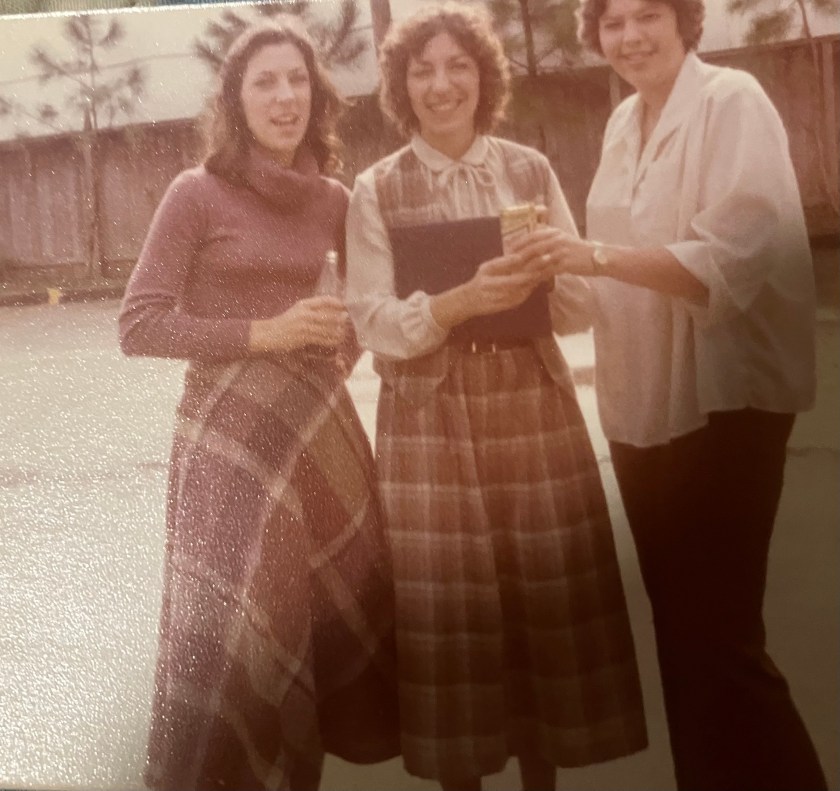
Gayle, me, & Jana
(I’m wearing my first day of teaching outfit).

After two seconds of surprise the class erupted into laughter that unified them against the enemy, the outsider, the one they viewed as a temporary teacher. To get out of the box gracefully, I would have needed a helping hand, but no seventh grader would put a teacher ahead of her reputation—not even Trina. As I spread my feet farther apart, I used my good right hand to grab the metal leg of my desk. My first attempt to pull my butt off of a pile of Houghton Mifflin’s Workbooks for the Fundamentals of Grammar and Writing failed to end my humiliation. I needed to push off with my feet and rock backwards a couple of times to get enough momentum to fall forward onto my knees. The laughter gained strength as if a seasoned comic had followed a dynamite joke with the gag that killed it. Staggering, I ripped out a few inches of my skirt’s hem with my right shoe. I took a long breath as I bent down to retrieve my papers and caught my department chair’s tired eyes looking through my door’s narrow window, probably dreading the search for my replacement so soon.

I mustered a close-lipped smile. “That’s enough,” I said and walked towards a girl laughing and slapping her desk with opened palms and I repeated, “Enough!” The girl stopped the slapping and most kids stopped laughing. I had never before wished I could evaporate into a mist and make everyone in the room forget the last several minutes. The laughter paused, and I felt twenty-seven pairs of eyes focused on me. I cleared my throat and looked at the tops of  their heads. I opened my mouth, but before I could speak, Chloe said, “Bet you ain’t too happy to be here now, Ms. Keller.” 

Despite the fact that she used my name and not the traditional “Hey, miss”; despite her using the adverb “too” correctly with the adjective “happy”; and despite my ability to keep from crying in front of those seventh graders, I could feel nothing but fear in my gut and shame in my soul. How could I ever be a teacher? Why had I not begged my mother to convince my dad to let me major in creative writing? When would be too soon to call in sick to work? What if I quit my job at Anderson and moved back in with my parents? 

I did not hate my students that day. I did not blame the principal, my department chair, or Chloe for my disastrous first day. I accepted that day’s failure and used my 22-year old optimism to get me through that spring semester.

I didn’t realize then that there would be thirty-seven years of teaching ahead of me— instructing junior high students, college freshmen, kindergarteners, and high school seniors. I would become as comfortable in front of a classroom of teens as a crawfish is in a flooded rice field. I would even miss teaching when I became a student teacher field supervisor after I retired from full time teaching. Before this first teaching job, I’d never believed teaching would be my profession. I fell into it like I fell into that box of workbooks.

Books I loved to teach
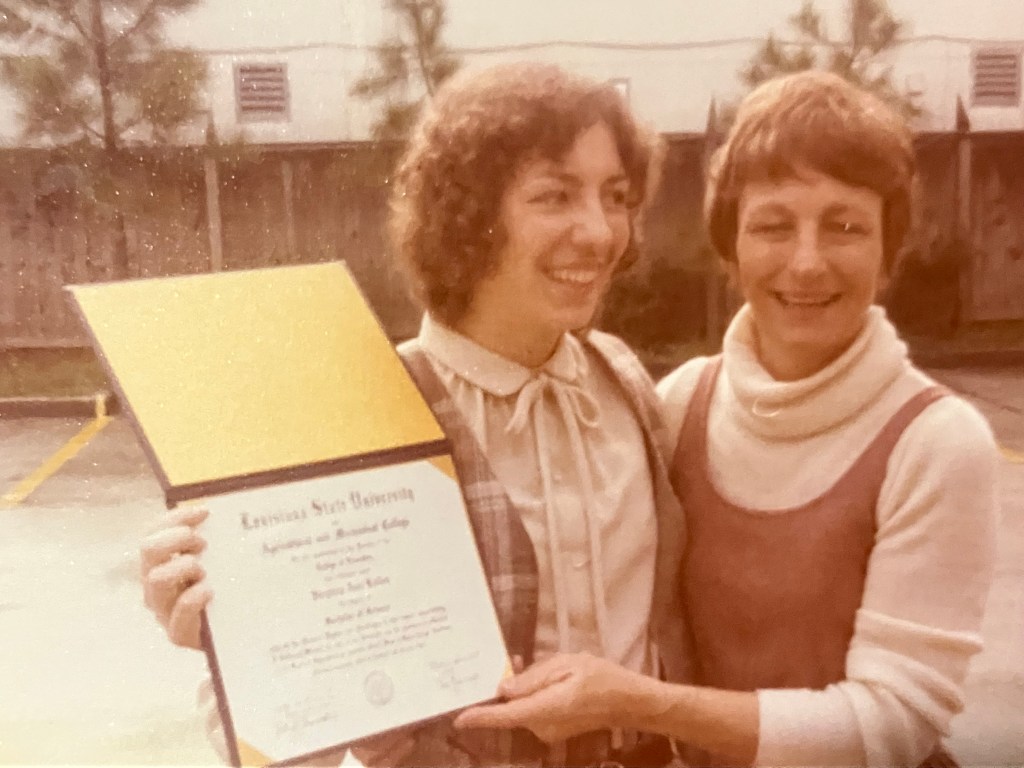
Me and Momma with my LSU diploma

Sometimes, if we’re lucky enough, we improve our talents and learn to like what we do. And maybe we land in a box built just for us. 

Posted in Relationships, Sittin Ugly

Sittin’ Ugly by Nancy Malcolm

coffee-mug-everyday-enviro-spl

Here’s To Auntie Sue!!!!!!!!!!!!!!!!!!!!!!!!!!!!!!!!!!!!!!!!!!!!!!

In the early morning hours, before anyone else is up, while the cat is still stretching languidly in her chair, I begin my day. In this quiet early hour I can hear the thud of the newspaper being thrown on the sidewalks, the coffeemaker finishing the last few drops and I hear the tick of our clock on the mantle. This is my selfish hour. This is my cherished solitude. I must have it!! This is my time to drink my coffee and absolutely, unequivocally “sit ugly”.

Sittin’ Ugly is a family tradition passed on by my 88 year old Auntie Sue. Her mother did it, she does it and now I do it. I’m sure lots of other people on earth are doing it, but to do it correctly is an art. The art of sittin’ ugly is learned and perfected through years of practice. There are rules of course, and above all, one must respect another’s’ right to sit ugly. There should be no judgment about sittin’ ugly. The fact is, one just simply does…..sit ugly. No judgment, no shame.

Everyone has their own way to sit ugly. But there are guidelines that I find very comforting and helpful to follow. Anyone that is new to the art will surely want to comply. The rules are as follows:

1. There must be coffee. Preferably freshly brewed with everything extra that you need, (cream, sugar etc.) and of course the favorite mug. I’ve never known a tea drinker to sit ugly, but I suppose it could be done.

2. No talking!! No one speaks to you-you speak to no one. Sometimes it may be necessary to point or grunt especially if you have small children and they absolutely must encroach on your time. But, the only talking truly allowed is to yourself.

3. You must sit. My favorite spot is an oversized chair by the window. Above all else, you must pick a comfortable, familiar place to sit. It is always good to be able to put up your feet and have a little table nearby. Your sittin’ area should be away from anyone else who might be awake.

4. You may be asking yourself, now what? I have the coffee. I’m sitting quietly. Now what? The “what” to do part is really up to you. Sometimes I just sit and stare while sipping my coffee. Staring is perfectly allowable and even encouraged. I also read my daily devotionals and have long conversations with God. I contemplate my day and my life. I think. I don’t think and then I may stare some more, all the while continuing to drink my coffee. This part may go on for a long as necessary. One hour is perfect for me.

5. Lastly, about this “ugly” part. Sittin ugly simply means that you come as you are, straight from bed. No primping allowed! One must be ones’ self. Tattered nighty? That’s ok! Acne medicine dotted on your face? Beautiful! Scruffy old favorite robe and slippers? The older the better! Sittin’ ugly is actually a super-natural phenomenon that makes you more good looking. The longer time you have to sit, the better you will look and feel. Try it and see!

Sittin’ ugly is my personal time. It is my favorite time of the day. Sometimes I can hardly wait to get up in the morning just to sit ugly. I am always at my best while sittin’ ugly, mainly because no one is speaking to me or me to them. What a joyous, peaceful time! What a perfect way to start your day, infact for me, it is a necessity.

Some mornings my little Auntie will call me and ask, “Honey, are you sittin’ ugly or can you talk?” It is always good manners to ask first encase one is not fit for conversation.

So here’s to “Sittin’ Ugly”, to having this special time each and every day and to the millions of us who find it necessary for the sustainment of sanity. Here’s to my precious Auntie Sue and all the beautiful ones who “sit ugly”.

Posted in Boo, Family, Reality

My Husband Is Twelve But It’s Working Out

            On the surface, Boo looks like a mature sixty-eight-year-old man; confident, charming and witty. His shiny head with grey fringe whispers over-the-hill in a subtle way.   But, underneath the suave exterior is a twelve-year-old boy running the show and calling the shots.

            Boo is sweet and sincere, then obnoxiously loud and sarcastic.   “Did you see that guy’s shirt?  The bright green one with Padre Island on it?” he says loudly at the grocery store where almost everyone can hear.  “I have one just like it, but you won’t let me wear it out in public.”

            And just like a twelve-year-old boy may be developing peach fuzz on his upper lip, Boo’s moods and patience are developing on many different levels and not always in a smooth way.  I can never predict whether Boo will feel sorry for someone or call them ‘a complete fool.’

            Have you seen the Instagram post where the husband is standing over the casket of his deceased wife, sobbing into a handkerchief?

            “But honey, what’s the Wi-Fi password?”

            That will be Boo.

            In spite of my efforts to educate him on the whereabouts of important papers, Wi-Fi password, ‘end of life’ notebook, and even the extra flea and tick control medicine for the cat, he still says he can’t find them.  Can’t or won’t?  He can’t even find the new bottle of ketchup sitting front and center in the pantry.  Again, can’t or won’t? That’s the million-dollar question. 

            Boo’s sophistication is at times subzero.  He occasionally surprises me when we are attending a party at someone’s house.  He’ll insist on purchasing a really nice bottle of wine or a fancy, scented candle for a hostess gift and then tell a wildly inappropriate fart joke as soon as we get there.

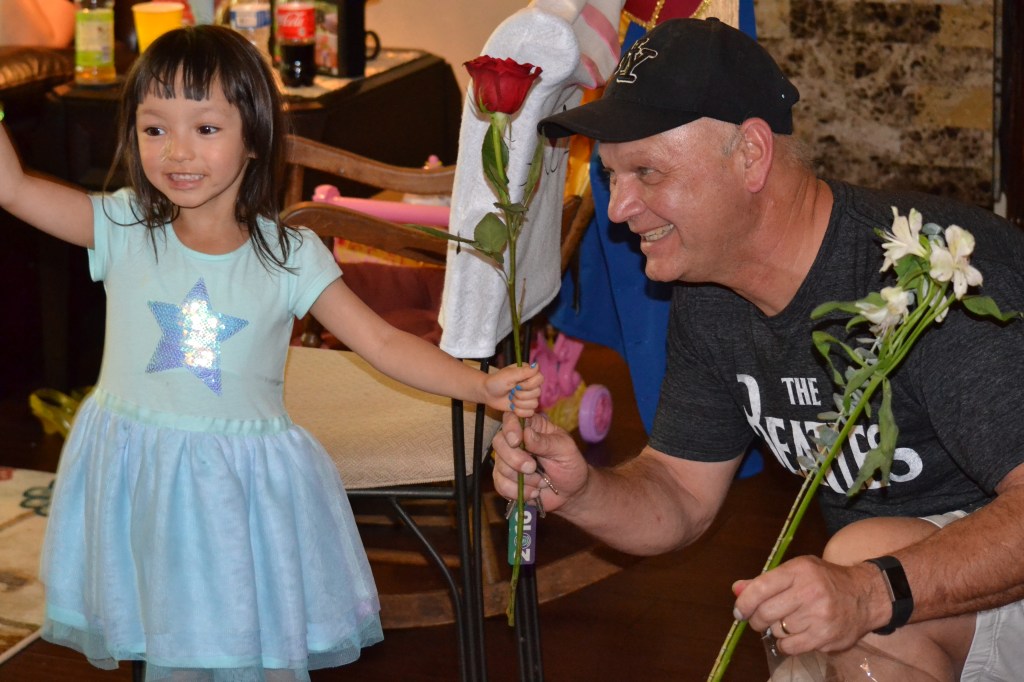
            As a grandparent, Boo is top of the line.  He loves our grandkids unconditionally and proves it by his outrageous and grandiose expressions of affection.  He will build a ninja warrior course in the backyard, plan and execute elaborate fishing trips, play dress-up complete with Beauty and the Beast costumes, and bake their favorite chocolate chip cookies in mass quantity.  If it can be done, he will do it.  His ability to have fun is his super-power as a grandpa.

            Boo doesn’t care about what he wears, whether it matches or even if it has holes or stains.  “That’s why I married you.  No one’s really looking at me.” 

            Was that a compliment?

            One of Boo’s little known twelve-year-old talents is something I was unaware of while we were dating.  Not until we were married did he display this skill.  One weekend we were walking Town Lake.  Mid-point in our trail he stepped over to the bushes, and without using a tissue, blew his nose and kept walking.

            “What are you doing?” I howled, looking around to see who saw this happen.

            While still walking and blowing he answered, “It’s a snot rocket. Don’t knock it till you try it.”

            “I assure you I will never try it,” I said.

            “Well, that’s a shame.  It’s really very satisfying if you’ve been stopped up.”

            Not all of his twelve-year-old antics are as ‘out there’ as a snot rocket, but subtle or not, they are real.

            As character defects go, mine mainly revolve around being too serious, worrying over little things, and trying to control the universe.  While Boo prefers to roll his eyes when I say something he doesn’t like or laugh when someone falls down.

            Of course, Boo is way past puberty, but he still runs the gamut from childish to mature, confident to insecure, rebellious, and impulsive to someone I can always count on. In fact, that is one of Boo’s most wonderful qualities, he is a man of his word.  He always does what he says he will do, and generally with a good attitude.  And while Boo still has his ‘pull my finger’ jokes and toddler table manners, he’s a definite diamond in the rough.  My husband is twelve, but it’s really working out for us.

Posted in Confessions, Contemplations, Relationships

Mind Your Own Beeswax

            Have you ever had the misfortune of finding out something you wish you hadn’t? Sometimes the truth is more than I really want to know.  Being nosy or asking too many questions might seem fun at the beginning, but eventually, ‘oops, there it is!’ and I cannot unhear what I just heard.

            The simple, “How are you feeling?” turns into a graphic description of a lanced boil or a replay of what someone had for lunch that didn’t agree with them.  The innocent, “What did you do this weekend?” parlays into a three-part mini-series complete with Instagram reels and photos.

            When I continue to ask, prod, or coax someone to share information, I would do well to mind my own business 99 % of the time, especially when I am asking my adult children questions about their lives.  Navigating life with grown children is quite different than when they were eleven years old, and I had a right to know all about their comings and goings, friendships, what they ate, and how they were feeling.  Overstepping my boundaries was a given back then, but now it is a definite no-no if we want to stay on good terms.

            I used to think I was rather good at finding out things about our kids, but my husband, Boo, is an expert.  He is the master of ‘21’ questions.  He is the guru of gossip, and like Inspector Clouseau, he is a fact-finder to the nth degree. 

            Boo is generally a man of few words, but seat him next to a stranger on the airplane or give him a beer, and he becomes absolutely chatty and will pry into anyone’s life before they know it.  He is adept at asking questions in rapid fire.  Who, what, when, where, why, and how. He is not afraid to ask any question to anyone at any time.

            He is often frustrated by my lack of snooping into our daughters’ lives.

 “Well, did you ask her how much that was going to cost?” he says.

            “No.  It’s none of our business what they spend their money on,”  I answer.

            “Yes, it is.  I think she should save her money or invest it in some stocks. I have a list here of the best ones.”

            “Boo, mind your own beeswax,” I counter.

The expression, ‘mind your own beeswax,’ comes from the 18th century when the dreaded small pox left scars on people’s skin. To cover the pox marks, women would apply beeswax to their faces.  The story goes that if people got too close to a woman’s face or stared at her covered up spots, she would tell them to “mind your own beeswax.”  Another theory is from the practice of sealing letters with beeswax to prevent others from reading them.  Whichever theory you agree with, the end result is the same, don’t meddle.  Stay in your own lane.  Butt out. 

            Most of the time I try to fly under the radar.  I can sit quietly and entertain myself easily.  I don’t have the need to talk.  I can stay in my own hula hoop, but if there is one lonely elderly person in the grocery store, they will find me.  And, even without asking, I will find out everything they have been thinking and feeling for the last twenty-five years.  I will know their pets’ names; their personal medical diagnosis; vacation plans; their children’s names, where they live, and why they haven’t called in over a month. 

             I rarely initiate these conversations, but I must have that face that says, “Tell me everything.  I really care.”  People tell me why they got divorced; when they found Jesus; their favorite ice cream flavor and how they put on their false eyelashes.

            Once, at Buc-ee’s, I ran in to get a bottle of water while Boo waited at the gas pump.  Twenty-two minutes later I emerged.

            “What happened?” Boo asked.

“ I was paying for the water and noticed the cashier’s false eyelashes were the longest, thickest fake lashes I have ever seen.  I said, “WOW, I love your lashes!,” but I could see the girl thought I was making fun of her, so to make her feel better I said, “No, I really love your lashes.  I wish I could wear those.” 

            I don’t know why I said that.

She proceeded to tell me where she buys them, how much they cost, and step by step instructions on attaching them. Then she explained that her real eyelashes have nearly all been pulled out by the glue, and now she has to wear the false lashes all the time, so her boyfriend won’t know her real eyelashes are gone.

“Don’t get the cheap glue,” she advised. 

 By this time there was a line behind me, and I quickly said, “I’ve learned so much, thank you!  You’ve given me the courage to try it,” and she leaned over the counter and gave me the biggest hug.

 “Go big and dramatic,” she said, “You won’t be sorry.  And have a blessed day,” she added.

“You too,” I called.

            “Wow,” Boo said when I told him the story, “That’s a lot of information.”

            Oh sure, all this could have been avoided had I not said anything about the cashier’s eyelashes.  But don’t you agree that some situations just beg for a question or comment?  In the same way, we want to ask our grown children questions that we probably shouldn’t, even though we think we want to know the answer…we really don’t.  Maybe someday I’ll learn not to ask.  Maybe someday I’ll remember the secret to happiness is minding my own business.

Repeat after me:  The secret to happiness is minding my own business!

Posted in Family, Fathers

Apple…Tree by Ginger Keller Gannaway

When I see Winslow in Casey’s smile, the world becomes a playground of possibilities: a splash pad with a soft foamy surface and gurgles of water that erupt into showers in various heights with tunnels of water where toddlers and some 5 to 8 year-olds race around while adults- parents, grandparents, nannies and friends -stand on the sidelines. The youngest kids squeal, run, and chase the water bursts with total abandon.

Last week Crystal and her grandchild Sunny, took Winslow and me to a totally shady splash pad. My grandson’s first-timer hesitancy lasted less than three minutes. He initially clutched my shirt and watched some thirty kids screaming and running through the water shooting from below and above. When the tall spurts retreated, I set Winslow down next to a gurgling burble, and when the water shot up and soaked his face while the seasoned splash pad kids raced around, he squealed and pumped his outstretched hands up and down. He forgot about me and joined his peers laughing and running through the jets of water.

Like a Cajun embraces bon temps, Winslow embraced the splash pad pandemonium. 

I immediately thought of his dad – Casey McClain- my middle son who was born so fast, I couldn’t get the epidural I so wanted. Casey embodies the “carpe diem” approach to life. He’s full-speed ahead and ready to tackle life’s challenges. He and Winslow have a tight connection. I love watching them together, whether Casey’s reading his son a book or taking him down a slide. He balances rough housing with the soft touch. He loves creating special quesadillas or yummy smoothies for his son, teaching him how to spin a top, helping him walk the dog, or building a Duplo/Leggo city. Plus he seems eager to change a poopy diaper or give Winslow a bath.

Casey is a natural-born father. Last January he beamed like he had discovered the secret to eternal life when we first met Winslow in the hospital. When we babysit Winslow on Wednesdays and Thursdays, Casey pops in for lunches and stroller walks when he can. 

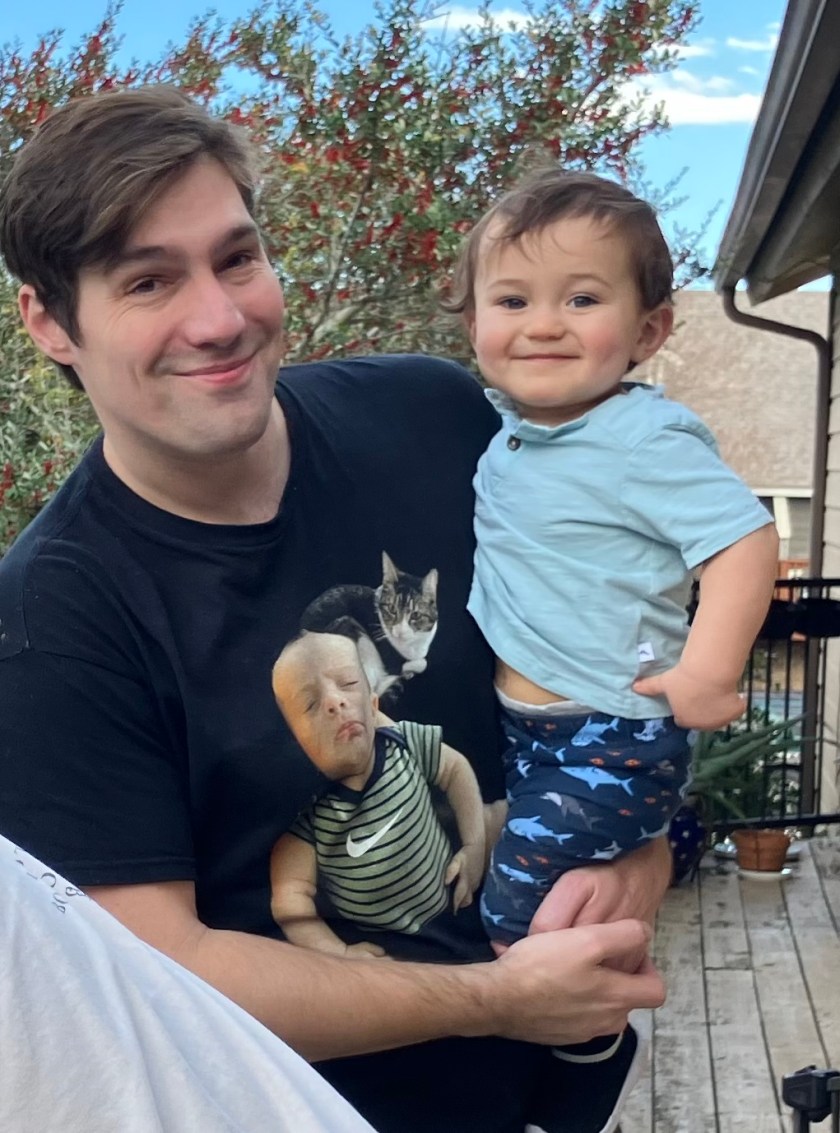
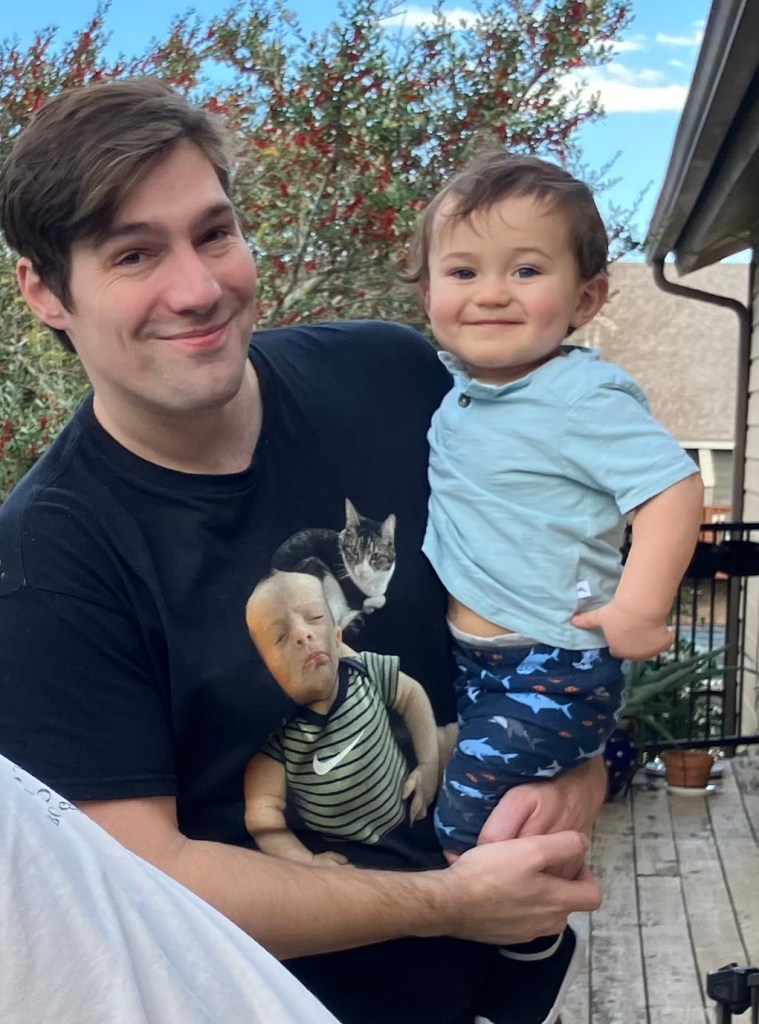
On my grandson’s first Christmas, I gave each immediate family member a t-shirt with a different photo of him on it. Even Winslow got a t-shirt with Winslow on it! Now Casey owns five different t-shirts with various images of his son. He loves it when strangers comment on Winslow’s open-mouthed laugh or furrowed-brow pout.

Winslow does not always look like his dad. He often flashes his momma’s smile and her wistful looks. He also has her cool dance moves.

Winslow has his dad’s non-stop energy, creativity, and independent stubbornness. He insists on feeding himself even though his 4-ounce container of yogurt leaves as much on his face, hair, and shirt as ends up in his tummy. And when Winslow and I make crayon masterpieces together, I may begin a beach scene with waves and fish, but he’ll snatch the color from my hand to add his emphatic touches of “dot! dot! dot!” color.

Like most 17-month-olds, his least favorite word is, “No.” He’ll repeat my “No!” right before he continues the forbidden action.
 
“No, Winslow! Leave the stereo alone.”

He’ll make direct eye contact, say “No,” and then crank the bass up.

However, his tenderness matches his tete dure (hard head) nature. Casey has a heart as big and soft as a John Prine song. And Winslow bestows smooches on his Beanie Babies and his favorite Bluey stuffed animal as well as most family members if he’s not tired or hungry. When Winslow spends time on my tiny patio, he has to kiss my Kiss-Kiss Fish planter at least three times. He’s a hugger and a cuddler. He’ll pat my back as I pat his if we’re dancing to a slow song.

Apple/tree fits the Winslow/Casey connection in the best of ways. I’m understanding the glory of watching my child raise his child. Seeing my son’s full-face smile as he watches his son clop around the living room in size 13 tennis shoes gives me optimism. When clever, caring, creative parents have their kids following in their footsteps we should see the possibility for a better world.  

Posted in Contemplations, Family, Mothers

smaller things by Ginger Keller Gannaway

Momma liked smaller things. A demi-tasse coffee cup, teaspoons, a dessert saucer over a dinner plate, and a purse no bigger than a seven-year-old’s palm. She preferred small, cheap towels like the ones once stuffed into boxes of Breeze detergent over the bath sheets sold in fancy department stores. And she never wanted a whole stick of her favorite Doublemint gum. “Just give me half.”  In our super-sized world, she often ordered an appetizer for her meal, and a small Ruby’s biscuit with a three-inch piece of Johnson’s boudin was all she needed for breakfast. 

One of eleven kids, she likely grew up with smaller portions of everything. Her family nicknamed her “Poulette” (Cajun French for “small chicken”).  I remember all 5’2”, 102 pounds of her pecking around our home with an ever present dish cloth (no bigger than a Kleenex), always cleaning or cooking. 

Geraldine & Reggie
The LaTour Family

However, her preference for smaller things contrasted with the largeness of her heart and her need for beaucoup bon temps. She never turned down a spicy gumbo dinner, a competitive Bouree card game (for money!), or a local festival like the International Crawfish Etouffee Cookoff in Eunice,Louisiana or the Frog Festival in nearby Rayne. 

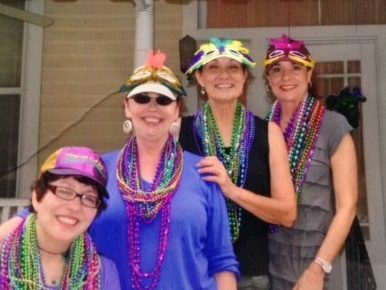
Her “don’t ever leave me out of the fun” attitude continued even after her mind got muddled and she was confined to a wheelchair. In 2014 my Sittin Ugly Sistahs (Nancy, Mary, and Cynthia) joined me in Eunice for Mardi Gras, and we wheeled Momma two blocks to the downtown festivities: a street dance with a zydeco band, a boucherie where cooks used all parts of a butchered pig to make boudin, cracklin, pork chop sandwiches, and Momma’s favorite – backbone stew. After we enjoyed the rocking band, the rich food, and the Second Street parade, a light rain started. Momma half-dozed in her wheelchair while we held an umbrella over her.
“Mom, you ready to go home and take a nap?” I asked.

“Y’all going home, too?” she said.

“We’ll take you home and maybe come back for the next parade.”

“If y’all staying, so am I!”

Momma’s “joie de vivre” was as big and bold as the Eunice Superette’s black bull outside their meat market/ processing plant.

Her love for her kids and grandkids was as strong as the hugs she gave us when she was forced to tell us good-bye after a holiday visit. Wrapping both arms around my waist she’d whine, “ Cha, I don’t want you to go.”

And she’d give me three tight, tight squeezes that always took my breath away even as I braced myself for the intensity. Momma’s smiles set her blue eyes twinkling and proclaimed her marquee-sized, unconditional love that gave me the confidence I needed to have my own children. So I still hold on tight, tight, tight to my memories of Momma’s endless and sometimes jealous love because I truly prefer a salad fork over a long-tined dinner one, and my coffee tastes better in a thin rimmed cup that holds no more than three ounces.

Me, Kelly, Momma, Gayle in Granada, Spain
Posted in #Confessions, Mothers

Not My Usual Mother’s Day Post

            I’ve always had to share my birthday month with some pretty well-known festivities:  the end of school, graduations, and Mother’s Day.  Usually at this time of year I become melancholy  at the thought of Mother’s Day and not having my mother to honor.

            I have spent years dreading Mother’s Day.  I’ve slighted my own celebration of being a mother in lieu of loathing all the reminders of what I don’t have and all I have missed.

            I have spent hours smirking at Hallmark commercials and sneering at florist bouquets that I have never gotten to send.

            I have spent an endless amount of time missing my mother and feeling the huge depth of loneliness from having to grow up without her.

            But, what I meant to say is that I still miss her sixty-six years later.

            I still wish I had known her for myself, and not just through my brother and fathers’ memories.

            I still dread the Hallmark commercials and influx of florist bouquets to buy or nightgowns to gift.

            I still wish my daughters could have had a grandmother.

            I still look at her pictures and marvel at her forever youth and beauty.  She never grew old, and as I age, I wonder…do I look like she would have?

            Lately, I have been thinking of all the ways my daddy tried to be a mother to my brother and me.  I’ve spent lots of time being angry at what he didn’t do or say.  I have written volumes about his temper and harsh ways he disciplined us.  But, lately, ever so softly, I have felt the call to see the good.

            Every Saturday night was bath night when I was a little girl.  My daddy would try to curl my hair on pink spongy rollers so I would look presentable for church the next day.

            He bought me an Easter dress and patent leather shoes every spring, complete with a hat and purse.

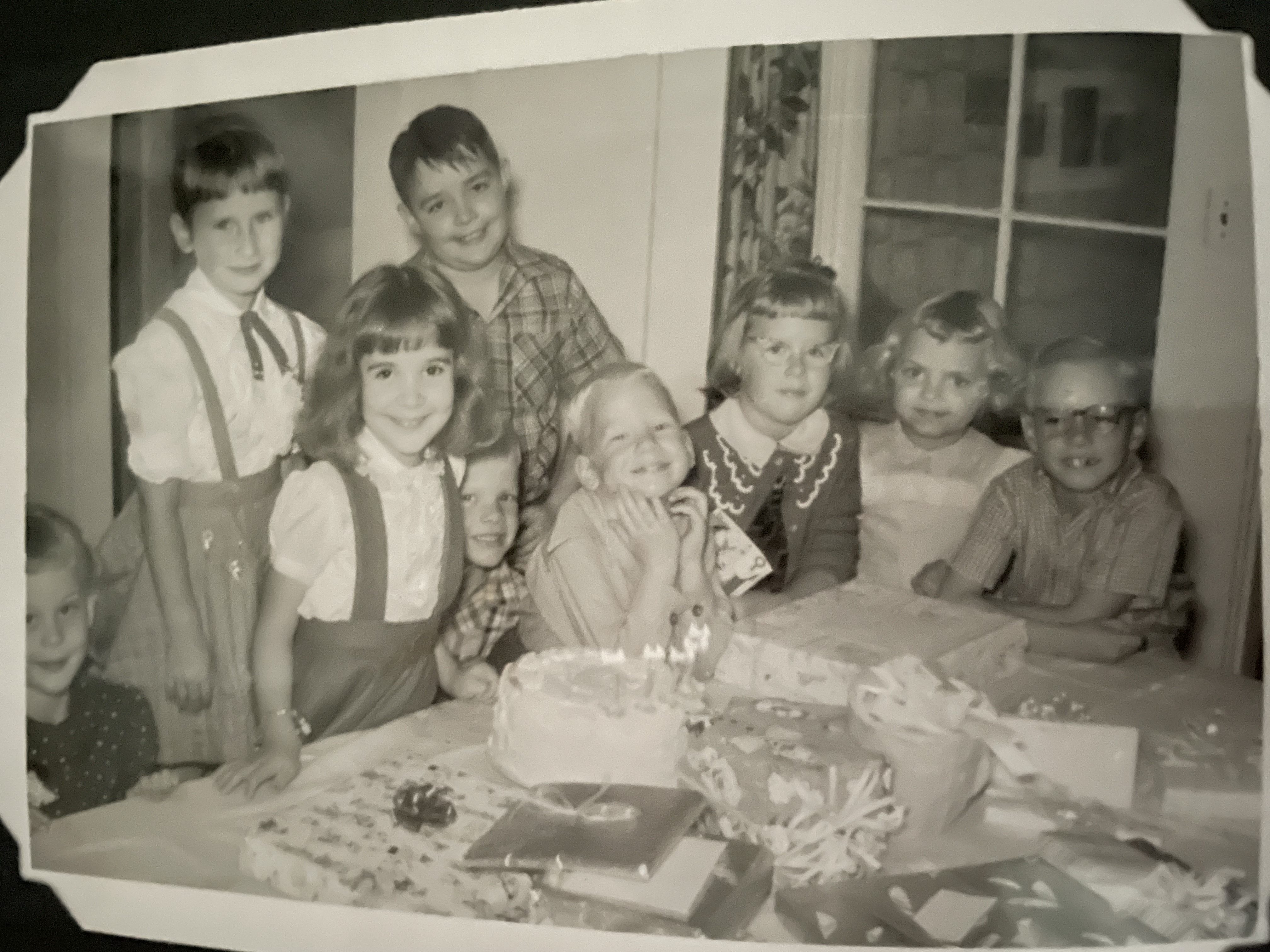
            In elementary school he planned and executed backyard birthday parties for me and my friends.  We played games, had cake and punch, opened gifts and he always took pictures.

            Daddy made sure I joined Girl Scouts and got to go to camp during the summer.  He let me borrow his Brownie Camera and made sure I had a fresh roll of film for my scouting escapades.

            In 8th grade he paid for me to join Cotillion so I could learn manners, how to dance, and the social rules about dating boys.

            He took us to church and made sure we were baptized.  As I got older, he encouraged me to go to MYF (Methodist Youth Fellowship) and took me every Sunday evening. (even though my friends and I sometimes left to smoke cigarettes in the park behind the Church!)

            After I got my driver’s license he let me take the family car, a ’63 Chevy Impala, to high school, complete with bench seating, no power steering, and a secret cigarette burn on the floor board I never confessed to.

            Even though my father was a frugal man and pinched every penny he ever had, I always had a winter coat, a formal dress when I needed it, and new school shoes every year.

            He instilled in my brother and me a strong work ethic and a knowledge and appreciation for saving money.  He worked as an electrical engineer for forty years at the same company.  Being a company man, with a pension, was especially important to him.

            Daddy paid for me to attend four years at Baylor University and my brother to go to The University of Texas.  He used the money my mother inherited from her father and saved it all those years, just for our college education.

            My father did a lot of things for my brother and me in the name of: ‘Your mother would have wanted you to…’

            ‘Your mother would have made sure you…’

            Daddy was strict in a lot of ways and had rules he wanted us to follow come hell or high water.  He was practical and pragmatic, and sometimes critical to a fault, but his love and devotion to our mother guided many things he tried to do for us.  Nurturing didn’t come easy for him, nor did saying ‘I love you,’ or ‘I’m proud of you.’ But sometimes we knew it, just by the way he would look at us with tender eyes.

            I was four and my brother was eight when our mother died.  I don’t know if Daddy made a death bed promise to our mother that he would take care of us the way she would have wanted, but he did take care of us and loved us the best he knew how.  I think she both smiled and cringed as she watched us from above.  As a parent, I can imagine how hard it must have been for him, and how much dedication it took to get up every day with a determination to do his best. I appreciate all he did for us and the many ways he showed up as our only parent.

Recently, my brother and I were talking about Daddy and lamenting about something he did when we were kids.  In a moment of compassion, my brother said, “He really did do the best he knew how.  Remember, he was young.  He was only thirty-three years old and had two small children without a mother.”  I was struck by that loving thought.  What thirty-year-old is prepared to go through a spouse’s long illness and subsequent death, much less be left with two young kids?  It is something no one can be prepared for.

Because of my brother’s words, I have more grace toward Daddy, and a deeper understanding of his situation, not just ours.

And, if I could just say one last thing to my father, one thing that might bring a smile to his face and a warmth to his heart, I think it would be this…

Happy Mother’s Day, Daddy.

Posted in #Confessions, Aging, Gratitude

The Sadness of Getting Older

There’s a sadness to getting older. An underlying cloud of hazy gray covers the days and at night there is worry or maybe remorse at misspent opportunities.  Not every day is seen through this heaviness, of course, but there is a realization that hits, and I begin to know, really know that my days are numbered.

            Time is whizzing by at an alarming rate. I recall the birth of my children as if it were yesterday, yet my baby will be forty-six this year.  It is April and I feel as though I was just putting out my fall decorations and enjoying pumpkin spice coffee creamer.  Fourteen years ago, my first grandchild was born and soon he will be a sophomore in high school.  It all seems to go so fast now, and yet some things never change, like the need to be loved and accepted, the awe of watching a sunset, or the joy of warm chocolate chip cookies fresh from the oven. 

Sometimes I forget that I am older until I pass the mirror and look into the droopy eyes of someone I don’t recognize at first.  “Oh, hi love,” I say to myself. “I see you. It’s ok.  You’re doing ok.”  As reluctant as I am to share my self-talk, I appreciate the encouragement and realize that in most situations my own support and nurturing is much more important than the words of others. (A realization that has taken me years to learn.)

            I’m feeling sad lately at the adversities and misfortunes that are befalling my dearest friends.  All of us, if we live long enough, will pass through the valley of the shadow of death.  All of us will have hard times, and I have had my share of these seasons, but seeing my sweetest friends go through sorrow and suffering puts a heavy pit in my stomach.  I want to help. I want to change the inevitable outcome of diseases and grief.  I want to do anything other than accept the unacceptable.  But, as my Sittin’ Ugly Sistah Ginger says, sometimes all you can do is just show up.

            My dear friend of fifty years has Alzheimer’s.  It has been a slow dissent for her, but things are speeding up. I show up but it rarely seems enough.  I send prayers and good thoughts, but it hasn’t changed the course of this barreling freight train.  My tears have done nothing to soften the harsh reality for her children and yet the tears keep coming and somewhere in there is my own self-pity at being left behind, without my friend.  Aptly named the long goodbye, Alzheimer’s is a cruel and heartless disease that robs the very life from its victims and tortures the family and friends left to watch.

            That is part of the sadness of getting older.  We are either leaving behind or getting left behind.  It’s a constant hello and goodbye.  Things are ever changing and mostly when you least expect it.  Like our bodies, and their predictable, but often unwanted revisions. Our hair, skin, and nails become shapeshifters, morphing into entities that do not resemble their former selves.  Our limbs betray us, and our inner organs are like an old pair of tennis shoes, scuffed, tattered, and worn completely out.

            There is a nursing home with memory care near our neighborhood.  I used to find it humorous that its name was Autumn Leaves.  But it is no coincidence that many homes are named according to this time in life and what that brings.  Serene Meadows, Tranquil Oaks, Sunrise Senior Care all names meant to bring peace to this time in life.  A rose by any other name…

            When my dear friend Randy passed away two years ago, I became mute with sadness.  What I wanted to say to her children and sister, I somehow couldn’t.  I was overcome with this feeling of disbelief and such a deep sense of permanence.  If the unimaginable could happen to her, a vibrant, loving, generous spirit, what could become of us lesser beings? 

There is a sadness to getting older.  The time for do-overs has passed us by.  There will be no more children to try and get it right with.  Our best hope are the grandchildren who we can love with abandon and try not to interfere with their lives.

This year Boo and I bought a new car.  “We need to hurry and buy one before they all become electric.  I’m too old to learn about electric cars,” he said. 

“You know this will probably be your last car, babe,” he added.

“What do you mean?”

“Well, we kept the last one for eight years.  Do the math.  Do you really see yourself car shopping at seventy-eight or seventy-nine?”

“I suppose you may be right, but I’d like to keep my options open, just in case.”

Last new car.  Last colonoscopy.  Last driver’s license. And I probably will not start a rock band or learn to snow ski.  However, even with the sadness of lasts, nevers, and goodbyes, there is an open opportunity for gratitude and appreciation that somehow makes everything more palatable, if I can let it. 

Gratitude for having one day at a time, so the sadness and frailties of life don’t overwhelm me.  Thankfulness for the health and wealth I do have, not what I wish I had.  And compassion for this old body who has served me well all these years.  Aging is not for the faint of heart.  It takes courage to walk through this life with all of its highs and lows, and even though there is sadness around every corner, I will choose to keep walking toward the light.