Posted in #Confessions, #Teaching, Relationships

Tsunami

            My illustrious teaching career began in August of 1975, at Fairway Junior High School in Killeen, Texas.  I was barely twenty-two years old, fresh out of Baylor University with a degree in Home Economics, married, and had a daughter.  I was ‘adulting’ big time.  My then husband was still in law school, so it was imperative that I find a teaching position as soon as possible.  Two weeks before school started, I felt lucky that the junior high school would have an opening for an 8th grade Homemaking teacher.  In all of my false bravado and rose-colored glasses ideals, I never thought my first year of teaching would be anything other than magical.

Fairway had been the only high school in Killeen until a new campus was built and then it became a junior high school.  So, Fairway had seen better days, but it held wonderful memories for the Killeen community and the students it served. Most of the junior high students were from military families whose parents were stationed at Fort Hood Army Base.

The day I was hired, the principal’s secretary handed me a gradebook and a large wooden paddle. “In case you need to give swats,” she said.

I followed her into the storage closet, and she handed me a stapler, a box of staples, and two number two red pencils for grading, a box of chalk and two chalkboard erasers.  I felt so official.  Never did it occur to me to be apprehensive.  At no point did I get a sick feeling in my stomach.  I was the breadwinner of our little family now, and I was in ‘full steam ahead,’ mode. I was going to make this happen. How hard could this teaching thing be?

Truthfully, I do not remember my first day of teaching.  By the time I made breakfast, my lunch, took my daughter to the babysitter, drove to school and met twenty-five new students each period for seven periods in a day, I was somewhere between hyperventilation and zombie land.

By the third day of school, I was beginning to see that because I was teaching Home Economics, and it was considered an elective course, the counselors would sometimes use elective classes as an opportunity to ‘place’ students who might not otherwise fit into the regular stream of academic classes.  Also, in 1975, homemaking classes were only for girls.  Five days a week, seven periods a day, twenty-five girls per period comes out to an amount of estrogen that perhaps is impossible to calculate.  Imagine, if you will, approximately one hundred seventy-five girls in various stages of their menstrual cycles.

My two classrooms consisted of a sewing room with twenty sewing machines in various stages of repair, large tables to lay out fabric and patterns; and a huge room with five separate little kitchens, each with a kitchen table, stove, and cabinets filled with all kitchen utensils and dishware.   So, while some may say homemaking is an easy class to teach, there is a certain level of safety and training that comes with using sewing machines, sharp scissors, hot stoves, butcher knives, open flames, and electrical appliances.

The sewing project for that first semester was a simple, pull over blouse called The Poppet.  This easy Simplicity pattern took nearly all semester for my beginning seamstresses, and still, some did not finish.  As far as safety was concerned, we talked for days about pointing scissors down and away from the body (yours or anyone else’s).  We talked about the sewing machine and its parts, and the importance of keeping your fingers away from the needle while it is engaged.  The iron was another problem as I strived to remind students to turn it off and try not to burn any fingers, fabric, much less burn the building down.

Elective courses were seen as a safe and fun way to expand the day for students with special needs.  The Monday morning of my second week of school, I received a new roster for my second period.  Four new special education students were added to the role and began arriving mid class.  We had introductions and I assigned each of the four girls a buddy. As utterly horrible as having a classroom of pre-teen girls was, I must admit they were kind and helpful to our new classmates.   I did not know then that one of those new students would be a child I would remember for the rest of my life.

Tsunami Martinez had a beautiful light brown complexion with large, dark, slanted eyes.  She wore her hair down, pulled back by a plastic headband or sometimes in a long ponytail that reached halfway down her back.  She had a tentative smile that never showed her teeth and from the first day we met, she and I shared a bond that was hard to describe.  Our smiles and our eyes melted into each other, and I felt I had known her before, maybe in another life.  She wore plain blouses and polyester knit pants, always clean but often too big, and there was one more thing…   

  Tsunami did not speak.  Only her eyes told the story.

Sometimes Tsunami would be absent for two or three days in a row.  I would greet her when she returned and ask, “Were you sick, Tsunami?  We missed you.”

She would smile and her eyes would be searching mine, like they wanted to tell me, but she never uttered a word.  The most I would get would be a slight nod of her head, and even then I wondered if she understood me.

After several more absences, I spoke with the special education teacher about Tsunami’s attendance.  She said, “Tsunami’s mother  keeps her home when she needs help with the younger children.  There are four younger siblings.  Also, just so you know, Tsunami’s mother only speaks Korean, so you won’t be able to call unless her dad is home.” 

I continued to speak to Tsunami and include her in our learning process. As is protocol for any school in a military community, asking for students to have supplies of any kind must be correlated with military payday. Still, Tsunami was two- and one-half weeks later than the other students in bringing in her fabric and patterns.  Her face lit up when she walked in with her bag from the PX Post Exchange, and I knew she felt so proud that she had her own supplies.  I wondered if this extra expense was a hardship for the family or if maybe her mother did not drive, but I never knew the reason.

When it was time for Tsunami to begin using the sewing machine, I sat beside her and demonstrated exactly what she should do.  My fingers would hold the fabric and guide it through the machine.  Then I would put her fingers in the same place and help her guide the fabric through.  It was slow going.  When we would finish a row of stitches, she would smile, and her eyes practically danced as they crinkled upward. Of course, with twenty-four other students, I was not always able to just focus on Tsunami, but it was clear that someone needed to sit beside her in order to move forward.
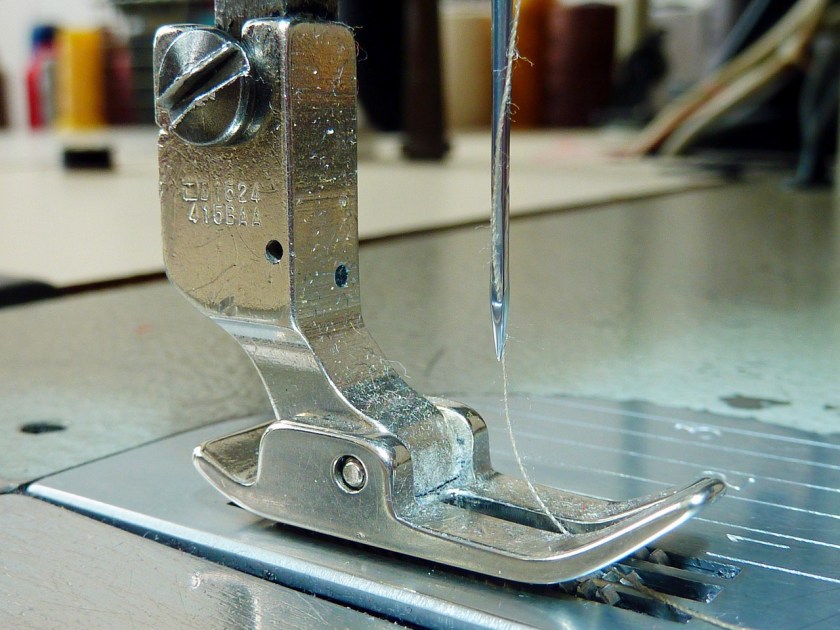
One day, in the middle of class, a student started to yell, “Miss, Miss, come quick!  Tsunami got her finger caught in the sewing machine!”

Practically the whole class gathered around Tsunami’s table, and I pushed my way through the girls to sit down beside her.  She never uttered a word, but her eyes were large and overflowing with tears.  In one motion I turned the wheel to raise the needle up out of her left index finger and instantly blood began to spurt.  She held her finger up and looked at me with such a wide-eyed, almost surprised look.  From the crowd, a student handed us two rough, brown paper towels and I wrapped her finger tightly to stop the bleeding.  “You’re going to be ok, Tsunami.  We’ll go to the nurse’s office.”  And I immediately dispatched another student to escort her to the nurse. 

The next day Tsunami returned to class with a large bandage on her finger, but she did not want to work the sewing machine herself.  The other students took turns helping and encouraging her as they did most of the work on her blouse.  After a few days, things got back to a normal rhythm and Tsunami began to try sewing on her own.

But in two weeks, Tsunami was absent again.  Days later, when she had not returned, I received a note from the office that she had been withdrawn from school. And just like that, Tsunami Martinez, who had won a classroom full of hearts, was gone from our protective love and guidance.

The students and I speculated about the many reasons why she might have gone.

“Maybe she’s sick,” one girl said.

“I bet her dad got orders, and they have to move,” another one said.

“Her parents are probably getting a divorce.  That’s what happened to me,” a student offered.

Finally, I got confirmation that her father had been transferred to Germany.  No one came for her sewing supplies or her blouse which was half way through completion.  She seemed to have disappeared over night, and our class was quiet that next day as we separately thought about our friend.

I carefully took all of Tsunami’s sewing supplies and fabric and put them in a plastic bag labeled, Tsunami Martinez.  I then put it on the top shelf of my supply cabinet, just in case.

Of all the things I learned from my first year of teaching, perhaps the most important thing was that sometimes my heart would break, and there would be nothing I could do about it.  My heart would break because I dared to connect or ventured to care a little more than I should.  But as I look back on my thirty-six years of teaching, I have never regretted the connections or heart break, and I have always remembered a student whose eyes said it all.

Posted in #Teaching, Confessions

Falling into a Box

by Ginger Keller Gannaway

I never dreamed of being a teacher. In 1965, at age nine, reading was my favorite pastime, and I wanted to be a writer. After seeing Funny Girl in 1968, I wanted to be an actress. As I endured my high school years, my cerebral palsied limitations (a mostly useless left hand and a limping leg) I changed my dreams of being on stage with Barbra Streisand to being her best friend. In college I decided writing was my best option, so I majored in journalism. I switched to creative writing when I realized there was a typing requirement for the compulsory news reporting class. After I spent one thrilling semester as a Creative Writing major Dad said, “English major? You need to switch to Education. Get a job as a teacher.” Since he paid for my education, I followed his demand.

So I endured Statistics, Fundamentals of Education, and Testing Measurements. My eyes glazed over as I watched male professors wearing dark suits and frowns explain a female-dominated profession. I struggled to solve basic math problems as I yearned for poetry and short stories. My student teacher semester was my one worthwhile education class because the supervising teacher was a white-haired angel named Dr. Hair whose sage opinions included “Everyone deserves a year living in New York City.”

Dr. Hair made guiding fifteen-year-olds through literary analysis as natural as eating popcorn at the movies. She gave me the perfect balance of praise and pressure. I guided reluctant teens through recognition of the eight parts of speech and  examples of figurative language. I thought I could be a strong teacher who handled any educational challenge that came my way—until my first day of teaching at Anderson Junior High.

The school was in a small south Louisiana town set literally “on the wrong side of the tracks.” On my first day of work, the principal handed me a wooden paddle – “for discipline.” The English Department chair did not tell me how happy she was to have me at Anderson Junior High when she gave me a key to my classroom. Nor did she ever smile.

In theory the schools in Louisiana parishes in 1978 were integrated; in reality Anderson was 90 percent black, and its faculty included only four white teachers. Most other teachers ignored me, maybe because my pale face looked as soft as my disciplinary skills, and they believed I wouldn’t stay there long enough for them to bother learning my name. Their assumptions were as right-on as fried catfish specials on Fridays in our predominantly Catholic state.

My miscalculations began when I missed the obvious warning sign connected to a teaching job starting in January: a teacher had quit in December! My first day of teaching a class without Dr. Hair nearby was as bad as stepping barefoot into a bed of fire ants. The seventh graders had run off their last teacher the week before Christmas break; in January they took one look at the remnants of my bad perm and my plaid wool skirt with its matching vest and recognized new teacher inexperience.

I’d gotten to school early enough to write the day’s agenda on the blackboard below the day’s date and next to my name in white powdery cursive. The front of the room was cluttered with heavy cardboard boxes filled with that semester’s new grammar workbooks. My department chair, who had looked at and spoken to me as little as possible the day before, said, “Distribute these,” after she concluded our thirteen-minute new teacher orientation.

I straightened the rows of battered wooden desks and the stack of my “Welcome to Seventh Grade Language Arts!” packets. I reviewed the names of the 172 students I would meet that day, and I went over the index cards for my first-day-of-school welcome speech. I said a fast Hail Mary and made the sign of the cross when the first bell rang.

In seconds the halls filled with the noise and energy of thirteen-to-sixteen-year-olds. Our school district did not practice “social promotion,” and a few boys with facial hair sat in seats next to boys whose feet did not touch the floor. I mispronounced at least five names that day, but the students did not hold it against me when I changed the roster’s “Edward” to “Eddie” or made pronunciation notations on “Janie” (a short A beginning and a long E at the end). I think they were still uncertain about where I stood on the spectrum of clueless teachers.

The first time I turned my back on the class to list the “Being Verbs” on the board, I heard a four-second belch and watched a wad of paper flying toward the waste basket near the front door. It missed its mark. After I repeated “Be, am, are, is, was, were, being, and been,” I picked up the wadded paper and dropped it in the trash in movements both smooth and confident. I raised my eyebrows when I realized the paper ball was my welcome packet but remembered Dr. Hair’s advice: “Give students your respect and as much eye contact as possible.” Several kids were smirking, and five occupied desks that had nothing on them, so there was no way I knew which student had tossed the welcome packet my way. I suspected a tall black-haired boy with slits for eyes.

I paced in front of the class and moved to my packet’s next bullet point.

“Who knows what an adverb is?” I said and prayed for an answer. The girl in the front row who had answered every other question that period raised her hand. “Let’s give someone else a chance to answer, Trina,” I said as I looked toward the slit-eyed boy. He leaned back in his seat and folded his arms. I decided to call on someone from my seating chart. “Whitney?” I said. “Could you read the definition of an adverb?” I nodded as she complied. Then, walking closer to the middle row of students, I said “Adverbs give verbs and adjectives more flavor.”  I scanned the seating chart: “David, can you use the adverb ‘quickly’ in a sentence?” 

Slit-Eye snorted, and a thin boy looking lost in what was undoubtedly an older sibling’s pale blue sweater said, “Which one?” I then realized there were two Davids in that class. I chose  “David Fontenot.” The slit-eyed David was ready for me, even as Trina raised her hand and wiggled her splayed fingers.

“Stupid bell can’t ring quickly enough to get us out of here,” David F. said.

Most kids laughed, and a girl with bangs that covered the top half of her eyes clapped and smiled at David. I smiled, too, and said, “I totally agree!”

I then ruined my tiny victory by saying, “Good job, David. Our packet also tells us that adverbs can modify adjectives. Can someone give me a sentence using an adverb that describes an adjective?” By this time, eager Trina had given up on me. Looking over my seating chart I saw a name I loved. “Chloe,” I said. “Will you give us a sentence with an adverb describing the adjective ‘happy’?”

From the back of the room the girl with extravagant bangs aimed her chin at me.  “Adjective?” she said in a husky voice loaded with disdain.

“Trina, please define adjective for us.” 

 With a voice like a defeated postal worker, my former ally said, “Adjectives describe nouns and answer the questions what kind, how many, and which one.”

“Chloe, will you give us a sentence with an adverb describing the adjective ‘happy’? Common adverbs are ‘very’ and ‘too’ as in ‘too much.” I gave her the appropriate wait time to answer. Chloe folded her arms and glared at me still grinning.

I took a deep breath. “Anyone have a sentence with an adverb that modifies ‘happy’?” I said as the ticking of the large round school clock seemed to slow down time. I decided to write some examples on the blackboard. I took three steps backwards forgetting about the cardboard boxes of workbooks. My right heel hit the corner of one that was open and half empty, and my left foot turned sideways as I half-fell, half-sat into the box. My only bit of luck was that my plaid skirt was maxi length and I didn’t “bomb” the class with a view of my underwear.

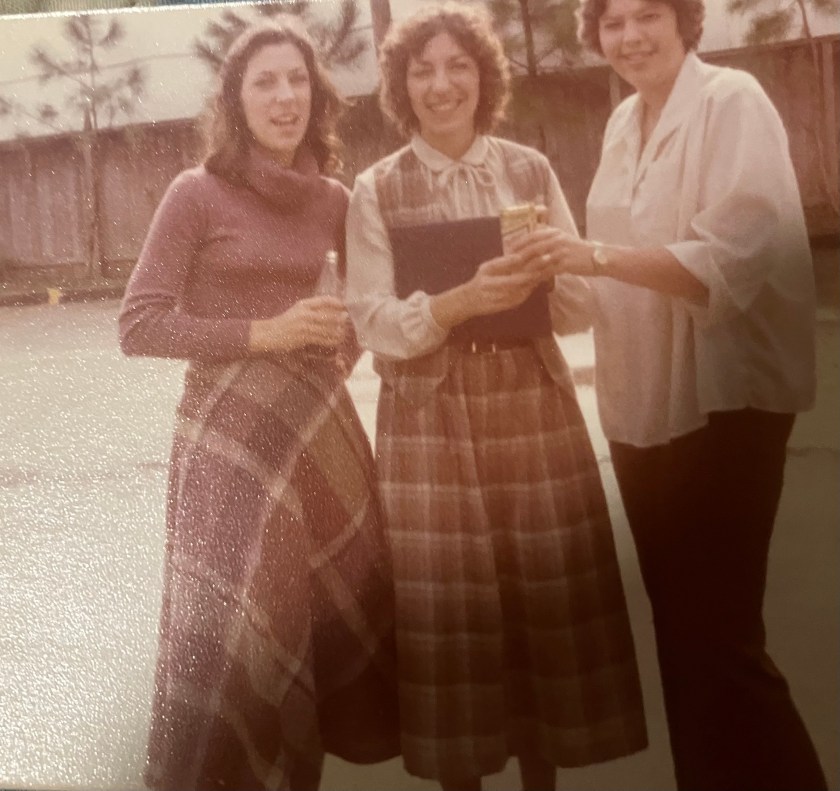
Gayle, me, & Jana
(I’m wearing my first day of teaching outfit).

After two seconds of surprise the class erupted into laughter that unified them against the enemy, the outsider, the one they viewed as a temporary teacher. To get out of the box gracefully, I would have needed a helping hand, but no seventh grader would put a teacher ahead of her reputation—not even Trina. As I spread my feet farther apart, I used my good right hand to grab the metal leg of my desk. My first attempt to pull my butt off of a pile of Houghton Mifflin’s Workbooks for the Fundamentals of Grammar and Writing failed to end my humiliation. I needed to push off with my feet and rock backwards a couple of times to get enough momentum to fall forward onto my knees. The laughter gained strength as if a seasoned comic had followed a dynamite joke with the gag that killed it. Staggering, I ripped out a few inches of my skirt’s hem with my right shoe. I took a long breath as I bent down to retrieve my papers and caught my department chair’s tired eyes looking through my door’s narrow window, probably dreading the search for my replacement so soon.

I mustered a close-lipped smile. “That’s enough,” I said and walked towards a girl laughing and slapping her desk with opened palms and I repeated, “Enough!” The girl stopped the slapping and most kids stopped laughing. I had never before wished I could evaporate into a mist and make everyone in the room forget the last several minutes. The laughter paused, and I felt twenty-seven pairs of eyes focused on me. I cleared my throat and looked at the tops of  their heads. I opened my mouth, but before I could speak, Chloe said, “Bet you ain’t too happy to be here now, Ms. Keller.” 

Despite the fact that she used my name and not the traditional “Hey, miss”; despite her using the adverb “too” correctly with the adjective “happy”; and despite my ability to keep from crying in front of those seventh graders, I could feel nothing but fear in my gut and shame in my soul. How could I ever be a teacher? Why had I not begged my mother to convince my dad to let me major in creative writing? When would be too soon to call in sick to work? What if I quit my job at Anderson and moved back in with my parents? 

I did not hate my students that day. I did not blame the principal, my department chair, or Chloe for my disastrous first day. I accepted that day’s failure and used my 22-year old optimism to get me through that spring semester.

I didn’t realize then that there would be thirty-seven years of teaching ahead of me— instructing junior high students, college freshmen, kindergarteners, and high school seniors. I would become as comfortable in front of a classroom of teens as a crawfish is in a flooded rice field. I would even miss teaching when I became a student teacher field supervisor after I retired from full time teaching. Before this first teaching job, I’d never believed teaching would be my profession. I fell into it like I fell into that box of workbooks.

Books I loved to teach
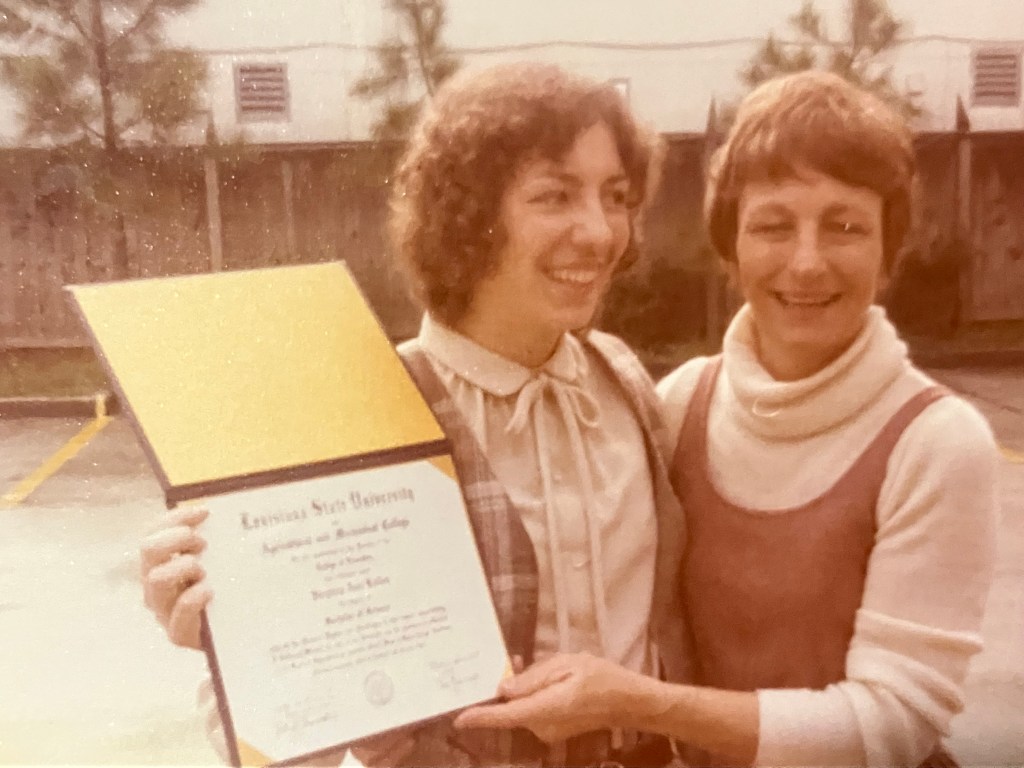
Me and Momma with my LSU diploma

Sometimes, if we’re lucky enough, we improve our talents and learn to like what we do. And maybe we land in a box built just for us. 

Posted in #Confessions, #Teaching

Rock Paper Scissors

          “Repite, por favor.”

            “Senorita?”

            “Senorita?”

            I heard my professor tap into the headset asking me to repeat the phrase that was just spoken on the tape we were listening to.

            “Senorita, verme despues de clase.”

            See me after class.

            For some unknown reason, I advanced placed out of two Spanish classes from high school and landed in a second year Novella class in which I did not belong. Because I had sailed through high school with little studying, I was ill-prepared to keep up with this high-level Spanish class at Baylor University.

            I slithered into the Professor’s office after class, and he wasted no time:

            “Senorita?  I will let you withdraw passing if you will just get out of my class.  You simply cannot continue.”

            His chair-side manner would never win a compassion award.  He offered no remediation or helpful guidance, as I was evidently slowing him down.

            “But my major. What about my major?  I wanted to be a Spanish interpreter and travel the world.”

            “Oh, Dios mio!  No Miss.  You must not continue.”

            “Ok.”  I said, “But, what do I need to do now?”

            “Just go.  I’ll take care of the withdrawal.”

And so, I went back to my dorm room to pour over the curriculum courses trying to find a new major.  Becoming a Spanish interpreter and traveling the world was no longer an option.  How do you say, ‘end of the line,’ in Spanish?

            Because I had learned to sew with my grandma growing up, I thought I could be a fashion designer, which sounded as exotic as a Spanish interpreter.  I did love fashion and as far as I knew I would not have to take any foreign language, so it seemed the perfect fit.  I called my daddy that next weekend to tell him my news and shockingly it did not go the way I predicted.  I explained the Spanish class situation and that I withdrew with a passing and not a failure.  Then I told him my grand plan to become a fashion designer and see the world.

            “No, you will absolutely not become a fashion designer,”  he said.

            “But Daddy…” I interrupted.

            “No buts.  The only acceptable majors are teaching, or nursing.  That way, if your husband dies later in life, you will have a career to fall back on.”

            “But, Daddy, a fashion designer is a career.”

“Nancy Lynn, you need to become a teacher or a nurse, marry a nice, educated man when you graduate, be a stay-at-home mom and live happily ever after.  That’s what you need to do unless you want to start paying your own tuition and then you can waste your own money on fashion designing.  Comprende’?”

            “Yes, Daddy.”

            “O.K. honey, get this taken care of as soon as possible.  Love you.”

            “Love you, too, Daddy.”

            My exciting idea about fashion designing morphed into a Bachelor of Science degree in Home Economics.  My certificate would allow me to teach grades 8-12 Home Economics and Science: and also, Kindergarten.  And although I had never ever, even once thought about being a teacher, it seemed that was my best option. 

            In my junior year at Baylor I met and fell in love with a law school student who was also a widower, ten years my senior and had a six-year-old daughter. We fell for each other in lightning speed and got married six months after our first date. “We got married in a fever, hotter than a pepper sprout!” as Johnny Cash would have said.

            His mother had been a teacher, so he was as happy about my teaching certificate as Daddy was.  We got married before my senior year, and Daddy even agreed to finish paying my tuition as long as I graduated at the end of the year, and that is exactly what I did.

             After my graduation, my ‘then’ husband still had two more semesters of law school, so we decided that our daughter, Lee, and I would move back to his hometown of Killeen, Texas and I would apply for teaching jobs.  My interview with the Killeen Independent School District happened to be the same day we drove from Waco pulling a U-Haul trailer.  Sixty-one miles of pulling a trailer and entertaining a six-year-old left me a little less than fresh as I pulled up to the Human Resources building,(trailer and all) and after a short introduction, I was told to head straight over to the junior high school.

            “Go on over to the junior high and I’ll call the Principal to expect you.  This could be your lucky day,” the Human Resource Director said.

            When we arrived at the junior high, Lee and I went into the front office, and I introduced myself to the secretary.

            “Mr. Lawson is expecting you.  Your daughter can wait out here with me if you like,” she said.

            The school was old and definitely across the railroad tracks.  I just didn’t know if it was on the right or wrong side of those tracks.  And since Killeen, Texas was near Fort Hood army base, I knew there would be a large population of military children attending the school.

            Before I knew it, Mr. Lawson came out and introduced himself to me and Lee. 

            “Be good, sweetie, and I will be back soon,” I said to Lee and sat her in a chair by the counter in the front office.

            Mr. Lawson and I had polite chit chat and he asked questions about my teaching philosophy.  I had no philosophy about teaching or anything else, really.  I was barely twenty-two years old and well, quite frankly, I thought this teaching gig would be a breeze.

Five minutes into our interview we heard ‘click click, likity tickity, click, click.’  We continued talking but when the clicking sound kept on he said, “Maybe we better check on your little one.”  Opening his office door we saw Lee, singing softly to herself and tap dancing on the freshly waxed office floor.  The secretary clapped and cheered, “Bravo!” and Mr. Lawson turned to me saying, “Well, I have to offer you the job now after a performance like that!  School starts in two weeks, what do you say?”

            “Yes,” I said hugging Lee.  And just like that I moved to a new city, with a new family and a new career.

            I became a teacher, something I never aspired to be or dreamed of being.  It was by default from a Spanish Professor who wanted me out of his class as much as I wanted to be out.  It was a life decision I fell into by sheer chance and because my daddy had a vision of what a woman should and should not do. Was it luck?  Would you call it fate?  Both sound too romantic for what it really was, happenstance.

            I became a teacher, averaging way more than the “forty hours a week and summers off,” that a few foolish people believe is true.  My heart was captivated by the sometimes hopeful, sometimes hopeless faces I would meet each year.   Come August, I planned to do better than the year before and create an atmosphere of learning and respect, and each May I looked forward to time away from the constant responsibility and work, which is teaching.  It was a rhythm I would repeat for thirty-six years.

            In 1990-91 I taught Kindergarten at Clear Creek Elementary School on Fort Hood army base in Killeen, Texas.  The Gulf War had just started when we began school that year and what I remember most are the children and mothers crying each morning as they separated for the day.  In my classroom, our main windows faced the highway, and right next to the highway were the railroad tracks.  The trains ran all day and all-night loading and unloading equipment, tanks, and personnel and often my twenty-five little charges would be gathered three deep looking out the window hoping to see their mothers or daddies.

            “Come away from the window now,” I would say.  “Let’s read a book.”

            “But I think I see my daddy,” one child would say, and the rest would press close, hoping for a glimpse.

            Our school was on high alert and the MP’s (Military Police) were positioned by the doors while nearly every day a young mother would come to check out her children in hopes of moving back home where they could be near family.  It was a chaotic year, yet one I felt most honored to be a part of.  I felt my calling to not only teach these children but also to love and nurture them, providing a safe, calm oasis during their otherwise stressful days.

            As time went on, I became the kind of teacher I could be proud of.  I became a teacher with a heart.  A heart for students from all walks of life, backgrounds, and nationalities.  A heart for loving the hard to love and a heart to bring discipline to a troubled spirit.  I enjoyed each grade level, each school, and each role I played from Kindergarten teacher to Assistant Principal of a large high school.  The job requirements might change but the essence of a teacher stays the same.  Connection.

This connection changed my life in a million different ways, all better than I could have ever imagined.  My heart learned when to be tough and when to be tender.  My patience grew by leaps and bounds as eventually, I became exactly what I was always meant to be.

 A teacher.