Posted in #Confessions, #Teaching, Contemplations, Relationships, Teaching

The Long Year

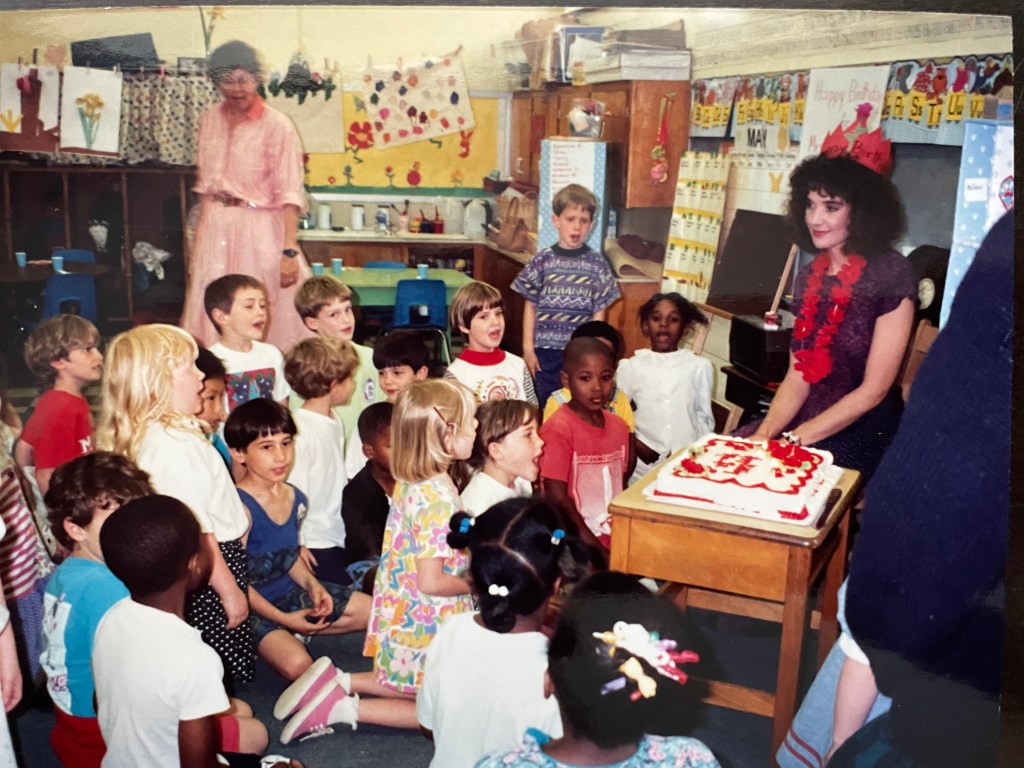
My Honeybee’s singing Happy Birthday

            For one long-fast year of my life, I taught kindergarten in Chapel Hill, North Carolina.

Estes Hills Elementary School was nestled in a mixture of pine and oak trees and was an older school with character, and lots of other characters who worked there.  Each of the classrooms had a back door that opened into a lush courtyard and a front door that lead to a winding sidewalk that circled the school.

The year was 1991 and was one of the most interesting, AKA hard, years of my adult life.  1991 involved a marriage, a move to North Carolina from Texas, a job change and a pending divorce.  1991 was dashed dreams, sour grapes, and a river of tears all rolled into one.  Twelve months of shock and awe.  365 days of “What the hell?”, yet there was a calm, deliberate sweetness that awaited me every morning when I greeted my 25 little charges.  Estes Hills and the 25 Honeybees (our class nickname) gave me purpose and life.

Estes Hils was a neighborhood school that was also near The University of North Carolina.  Many professors’ children attended our school and for that reason, most of the teaching staff was a mature, seasoned group, able to provide the level of learning our clientele demanded.  Each teacher was assigned a teacher assistant to help facilitate classroom learning and discipline.

I was one of several kindergarten teachers that year, and we were each assigned 25 students.  While you may not think 25 students is a lot, 25 five-year-olds is.

My students were eclectic, coming from varied backgrounds and nationalities.  One such student, a handsome little boy named Xolani, came from Africa and had a click language dialect.  While he spoke perfect English, his P sounds had a click, which made his language both fascinating to listen to, and hard to understand.

My teacher assistant, Violet, had her master’s degree in art.  Every day she planned an art project for our students and during that hour, she took over and I assisted.  She was talented, creative, and best of all, patient with a great sense of humor. 

Being new to this school that was so steeped in tradition and culture was like being drop kicked through the goalpost of life into another era.  It didn’t help that I was from Texas.  The North Carolinian women were Berkenstock wearing, clean faced southerners who sounded like they used a question mark at the end of every sentence, with slow paced, elongated v o w e l s.  And even though I had the usual slow, Texas drawl, they proceeded to make fun of my y’all’s and fixin to’s, like I was the one with an accent.

It didn’t help that in 1991 I was still sporting big hair, red lipstick and against the wholesome scrubbed look of the other teachers, I looked, well… a little on the trashy side.  A little too made up for their taste.

            “You Texans,” and they would just shake their heads.

            “You Texans think everything is bigger in Texas.”

            Quite frankly, my self-esteem was already in the toilet because of my horrible, no good, very bad year. But it was hard to make friends, and by the third day of school, I was feeling like the Lone Texas Ranger and would probably be eating lunch by myself for the rest of my life.

            But on the fourth day, my back door swung open and the teacher from two doors down popped his head in.

            “Hey, Miss Texas, want to join us for lunch?” Bryon asked.

            And a friendship was made.

            Bryon and Chris were the two gay teachers from two doors down.  They were charming, hysterically funny and comforted my shaky soul like a bowl of chicken and dumplings.  We ate lunch together, chatted at recess and they even invited me to some of their fabulous weekend parties.  At a time when I felt very little mercy from life, they gifted me friendship and laughter.  And when the end of school came, and the end of my marriage, Bryon and Chris helped me load my U-Haul trailer for the long drive back to Texas. 

My 25 Honeybees were sweet with not a stinger among them. The parents and students even surprised me with a cake and gifts on my thirty-ninth birthday, and as their joyful voices sang happy birthday, I held back tears from the sheer preciousness of that moment.

 One particular day I was leading a lesson about North Carolina as a state, and we were coloring pictures of the flag.

One student raised his hand and asked, “Teacher?”

“Yes, Samuel,” I said.

“Are you a Democrat or a Puerto Rican?”

“You mean Republican?” I asked.

“No,” and he shook his head, “I’m pretty sure its Puerto Rican.”

“Well, which one are you?”  I asked.

“Oh, I’m black,” he said

“Cool.” I answered.  And I gave him a big hug.

The hug seemed to suffice him as an answer, and we finished coloring in silence.

My long-fast year in North Carolina was a blessing in so many ways.  I found out that some people aren’t who they say they are, and that actions really do speak louder than words.  I learned it’s ok to be from Texas and proud of it.  I marveled at the resilience of the human spirit and the inherit kindness that restored my faith in man.  And with great fondness, I remember 25 little Honeybees who needed me as much as I needed them.

Posted in #Confessions, #Teaching, Growing up, Relationships, Teaching, Truth

Understanding  by Ginger Keller Gannaway

After I secured my MA in English at LSU in 1980, I took a teaching position at an un-air-conditioned elementary school north of Baton Rouge. As a Language Development teacher I was part of a state program that helped children who were “culturally deprived.” I gave no grades and used puppets and a small record player to sing songs as we worked on vocabulary building, letter recognition, and basic reading skills. I worked with small groups of kids between 5-7 years old who came to me for 30-minute classes each day.

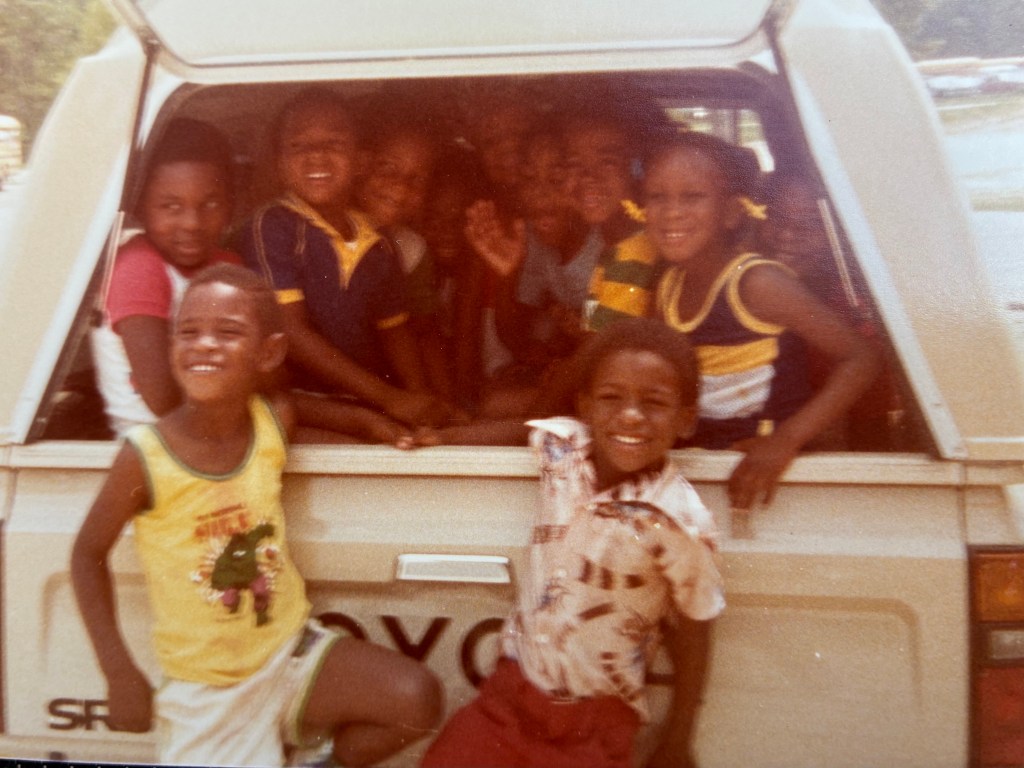
My Elementary School Kids


The school was a long building in the countryside with one classroom for each grade (K thru 8). Recess time for kindergarteners was in a small field next to a fenced area of cows. The mooing of our bovine neighbors mixed with the whirr of electric fans. The population was 98.9% African-American. I remember an extra tall kindergarten boy who was “mixed” and one pale, blonde second grader.

My students spent most of their lives in the rural area they called home. When we took the kindergarteners for a field trip to Baton Rouge, the biggest Wow! was the escalator at the mall where we had lunch. A few five-year-olds needed help getting on and off the moving stairs, but others wanted to ride up and down more times than they could count.

I became friends with Molly, the kindergarten teacher, because I worked with her whole class, and we shared lunch while her kids napped on dark blue mats. I helped her color 3-foot high cardboard cut-outs of the Alphabet Kids. I loved coloring as we chatted. I knew the kindergarten class best since I only worked with a few first and second graders.

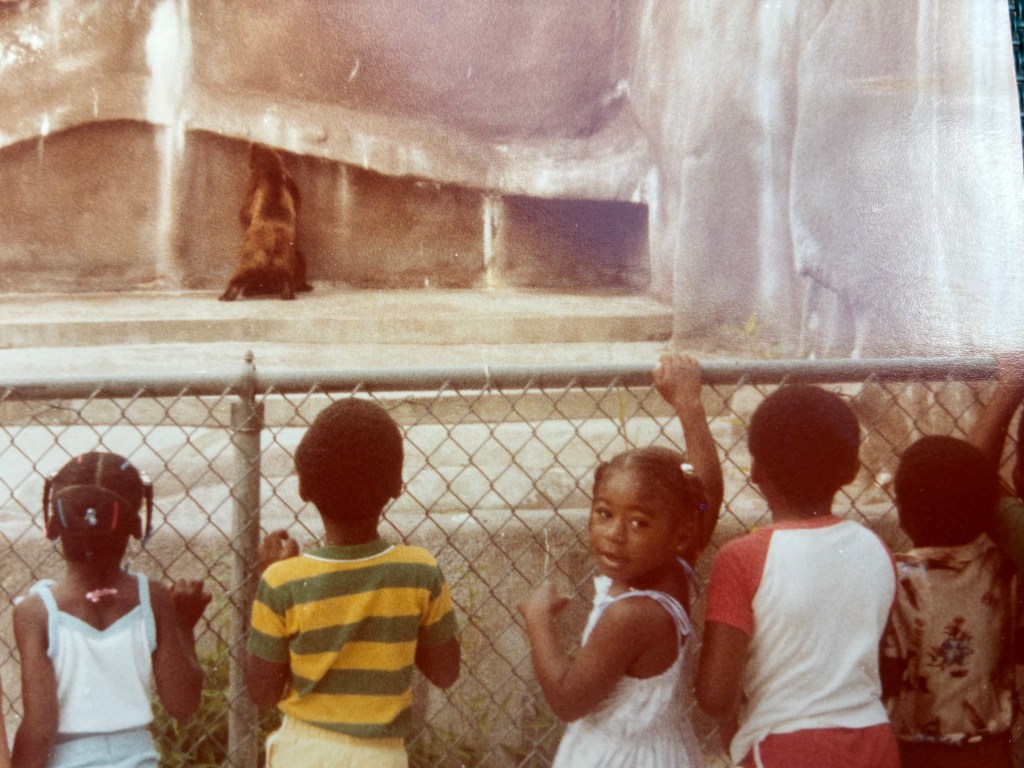
Our zoo field trip

I remember David who rarely slept on his blue mat. He stayed quiet while  squirming and searching the room for another wakeful peer; however, all the other kids had entered the Land of Nod. I smiled often at Sammy, a chubby boy who was first to fall asleep flat on his back with his mouth half- open to make him appear more vulnerable than those who curled into balls or hugged a treasured stuffed animal from home. Sammy was a cute, yet tough bundle of energy when he wasn’t napping. He had a husky laugh and lots of friends. When I had Sammy in my class he sang confidently during the puppet songs and I believed we got along like cheese and crackers.

One humid afternoon I helped Molly with a line of five-year-olds as they waited for the school bus or a parent to take them home. (Kindergarten got out an hour earlier than the rest of the school). Each child had a note pinned to his/her shirt with details about our upcoming field trip. Sammy was kicking up gravel as he waited. I smiled at him and squatted to be eye-level. “Sammy, you excited about going to Baton Rouge next week?”


He continued kicking pebbles and surprised me with, “Momma told me don’t trust a white person farther than I can throw ‘em.”

Maybe he had seen his mother’s car pull up and didn’t want to be caught talking to me. Maybe I had corrected his pronunciation in my class earlier that day. In a moment Sammy went from being a student I felt comfortable with to someone I didn’t know.

For the first time I felt a smidgen of judgement based on the color of my skin. I never had a run-in with any parent that school year. I got only positive feedback from my principal. I thought I was a decent elementary teacher, even if my diploma said “Secondary School English.” But Sammy made me face the separation of races in Louisiana in the 1980s. I did not think I held prejudice in my heart. However, I grew up around racism in my hometown. Sammy’s mother’s beliefs came from her own experiences, and she was teaching her son how to navigate the world she lived in. 

Back then no one used the triggering term “woke,” but Sammy opened me to living Atticus Finch’s advice in To Kill a Mockingbird– “You never really understand another person until you consider things from his point of view…until you climb into his skin and walk around in it.” 

I had a sheltered upbringing when it came to other cultures. My segregated hometown and a Catholic school education kept me ignorant in some ways. I thought I trusted, accepted, and understood people from different races. But teaching in several schools with diverse populations, I got “schooled” by my students and their families. And teaching teens with lives so unlike my own made me a better person.

The quote “Be a person on whom nothing is lost” by Henry James helps me seek new ways to understand other people and to accept our differences.  I will never understand prejudice the way those who lived it have, yet I can be open-minded to their ideas and accept them for who they are…..even if they don’t trust me.

Posted in #Teaching, Teaching

WELCOME TO THE JUNGLE! by Ginger Keller Gannaway


Back in 2004 I was teaching AP English IV at Crockett High School. My seniors took their AP Exam in early May. We had studied Joseph Conrad’s The Heart of Darkness the weeks before the big exam. I had told them, “This book is only 90 pages long; however, it will be the most challenging book you’ve ever read.”

Some sentences meandered for three quarters of a page, and Conrad smashed the dialogue between different characters into a single paragraph. Conrad helped readers feel the confusion and danger of taking an old steamboat down the Congo River in 1834. The paragraphs were as dense as the jungle, and the characters’ secrets were as dark as their greed. Also, the narrator’s story got more menacing as he got closer to Mr. Kurtz, the ivory merchant he was supposed to take out of the jungle.

While my senior classes endured their 3-hour morning AP exam, I realized that my afternoon classes would be in no shape to study literature that day. My video about free verse poetry and the short story with a surprise ending would hold no one’s interest. Their hands would be tired after writing three literary essays, and their brains would be fried after the exam’s grueling multiple choice section. 

My well-used copy of the book

During lunchtime I went to the teacher lounge and noticed two large rolls of colored paper in the supply closet – the kind of paper we used to cover bulletin boards or let students make projects with. One roll was green and the other was brown. An idea emerged. I grabbed a box of scissors and a few rolls of masking tape. With ten minutes left of my lunch, I hurried to the art classes downstairs and borrowed a large roll of blue paper and one of black from my favorite art teacher.

She asked, “What are you making?” 

I looked at her and smiled. “A jungle!”
Being open-minded, supportive, and cool, she asked no questions and had two art students carry the paper rolls upstairs to my classroom.

My seniors came to class both tired and energized. Some wanted to talk about the AP Exam (which violated the form they had signed to not discuss test details with anyone). Others were hoping for a movie to watch, and maybe one or two came in thinking we might analyze a poem.

I surprised all with, “Today we’re turning our classroom into the Heart of Darkness Jungle!”

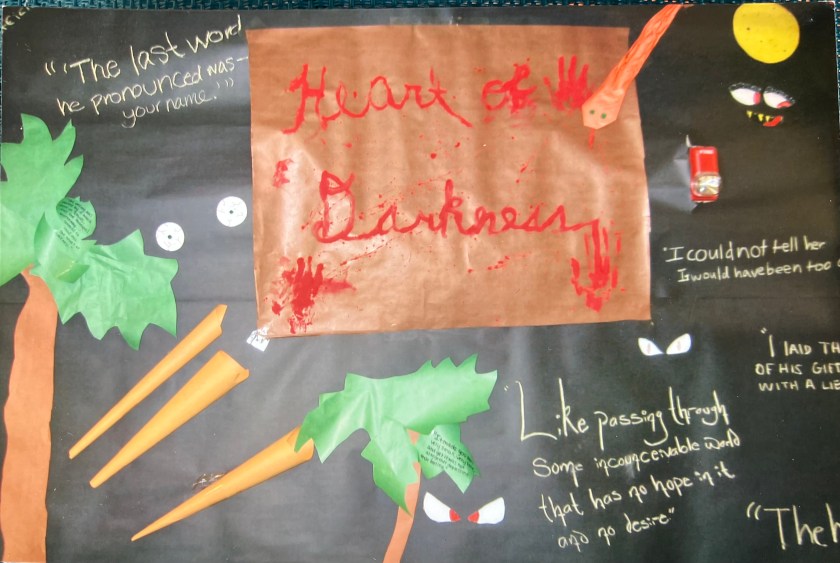
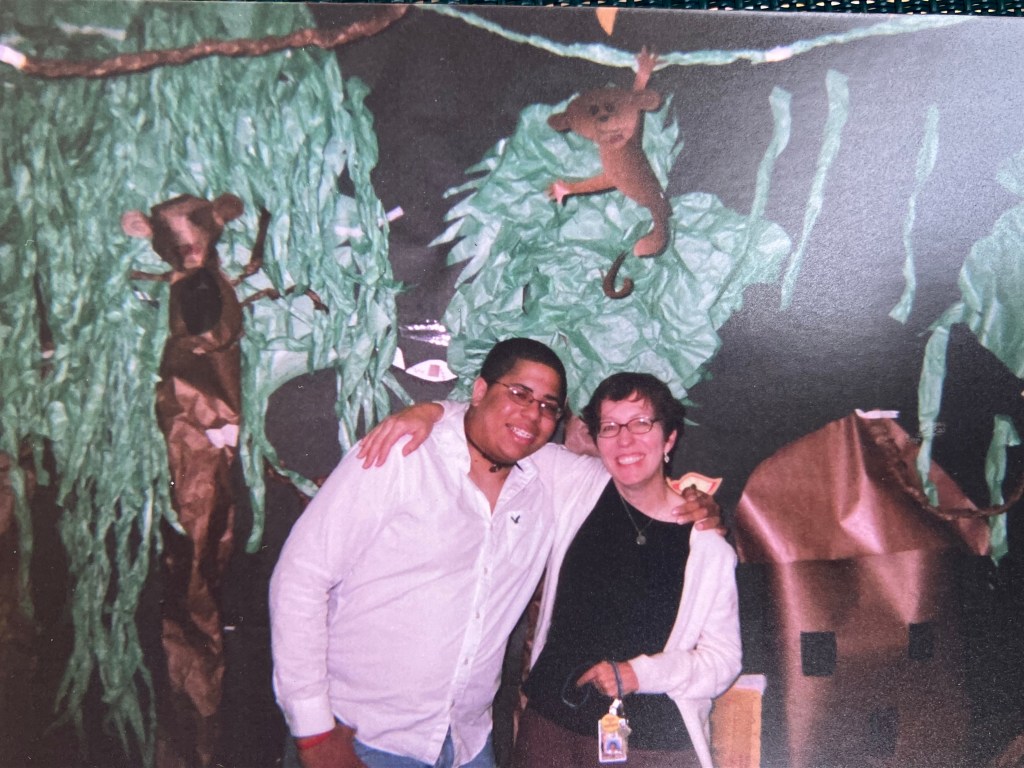
First, we brainstormed setting details from Heart of Darkness. They mentioned the Congo River, the steam boat, Krutz’s cabin in the jungle, and the severed heads on poles used to ward off intruders. We decided to use the green, black, and brown paper to make trees and vines to suggest the jungle, the blue for the river, and white to draw the boat and the main characters. 

All got into the jungle idea. I told them they had to join a group: Vine Makers, River Workers, Steamboat Builders, and Hut Makers. A few asked if they could make the heads on poles. To receive a 100 for the day’s assignment each student had to help build the jungle and to add a quote from Heart of Darkness. My students worked like large elves on Christmas Eve. Someone even used my computer to blast the song, “The Lion Sleeps Tonight” as we worked.

As as an experienced teacher, I’ve had successes some days. Sometimes students really enjoy discussing a thought-provoking story like “The Ones Who Walk Away from Omelas”; or they give star performances of a Hamlet soliloquy; or they cry at the end of Elie Wiesel’s Night. However, so many of my seniors loved building the jungle that the next year I let my sophomores contribute to the jungle by adding details from The Lord of the Flies. One student decided the entrance way needed a waterfall, so people had to push aside the long strips of blue paper as they came to class. Some of my peers told me they’d hate so much chaos and mess in their classroom, but I learned to embrace the wild spirits and high energy of my students.

After a few years of building jungles, I had my coolest teacher buddies (Paul & Janie), who also taught Heart of Darkness, build their own jungles. And the groovy art teacher would visit our classes and give a certificate for “The Best Jungle.” I did not win that certificate, but I did have future students (freshmen, sophomores, juniors, and seniors) come to the very first day of school and say, “Hey, Miss, when are we gonna make a jungle in your class?”