Posted in #Confessions, #Teaching, Contemplations, Relationships, Teaching

The Long Year

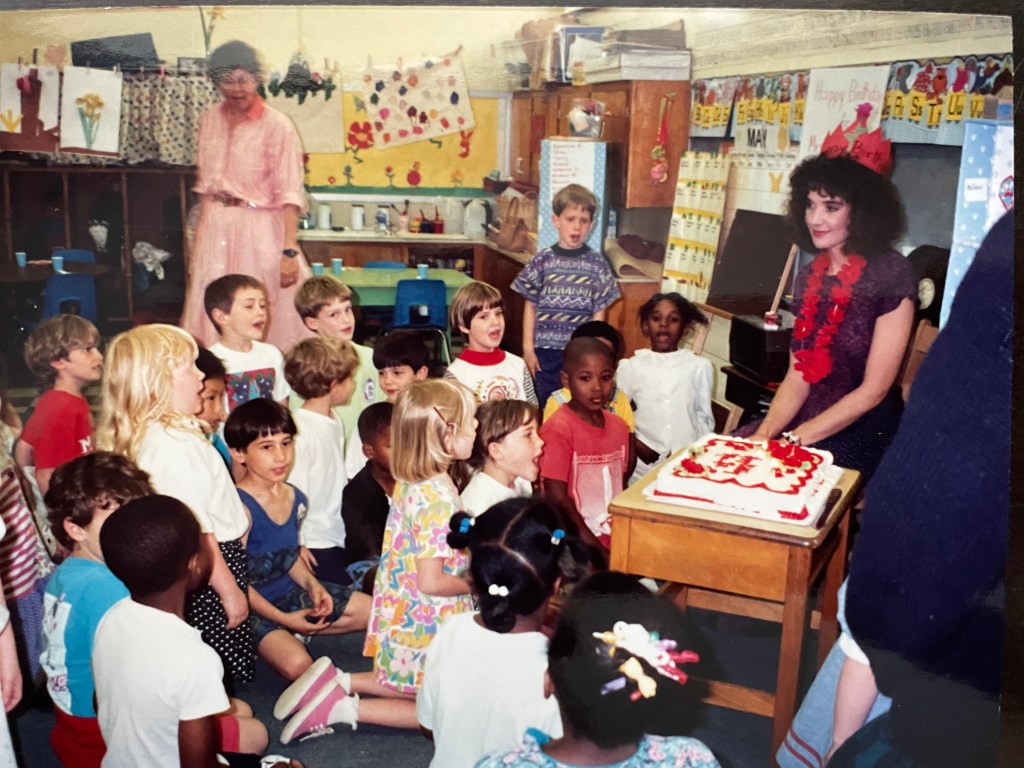
My Honeybee’s singing Happy Birthday

            For one long-fast year of my life, I taught kindergarten in Chapel Hill, North Carolina.

Estes Hills Elementary School was nestled in a mixture of pine and oak trees and was an older school with character, and lots of other characters who worked there.  Each of the classrooms had a back door that opened into a lush courtyard and a front door that lead to a winding sidewalk that circled the school.

The year was 1991 and was one of the most interesting, AKA hard, years of my adult life.  1991 involved a marriage, a move to North Carolina from Texas, a job change and a pending divorce.  1991 was dashed dreams, sour grapes, and a river of tears all rolled into one.  Twelve months of shock and awe.  365 days of “What the hell?”, yet there was a calm, deliberate sweetness that awaited me every morning when I greeted my 25 little charges.  Estes Hills and the 25 Honeybees (our class nickname) gave me purpose and life.

Estes Hils was a neighborhood school that was also near The University of North Carolina.  Many professors’ children attended our school and for that reason, most of the teaching staff was a mature, seasoned group, able to provide the level of learning our clientele demanded.  Each teacher was assigned a teacher assistant to help facilitate classroom learning and discipline.

I was one of several kindergarten teachers that year, and we were each assigned 25 students.  While you may not think 25 students is a lot, 25 five-year-olds is.

My students were eclectic, coming from varied backgrounds and nationalities.  One such student, a handsome little boy named Xolani, came from Africa and had a click language dialect.  While he spoke perfect English, his P sounds had a click, which made his language both fascinating to listen to, and hard to understand.

My teacher assistant, Violet, had her master’s degree in art.  Every day she planned an art project for our students and during that hour, she took over and I assisted.  She was talented, creative, and best of all, patient with a great sense of humor. 

Being new to this school that was so steeped in tradition and culture was like being drop kicked through the goalpost of life into another era.  It didn’t help that I was from Texas.  The North Carolinian women were Berkenstock wearing, clean faced southerners who sounded like they used a question mark at the end of every sentence, with slow paced, elongated v o w e l s.  And even though I had the usual slow, Texas drawl, they proceeded to make fun of my y’all’s and fixin to’s, like I was the one with an accent.

It didn’t help that in 1991 I was still sporting big hair, red lipstick and against the wholesome scrubbed look of the other teachers, I looked, well… a little on the trashy side.  A little too made up for their taste.

            “You Texans,” and they would just shake their heads.

            “You Texans think everything is bigger in Texas.”

            Quite frankly, my self-esteem was already in the toilet because of my horrible, no good, very bad year. But it was hard to make friends, and by the third day of school, I was feeling like the Lone Texas Ranger and would probably be eating lunch by myself for the rest of my life.

            But on the fourth day, my back door swung open and the teacher from two doors down popped his head in.

            “Hey, Miss Texas, want to join us for lunch?” Bryon asked.

            And a friendship was made.

            Bryon and Chris were the two gay teachers from two doors down.  They were charming, hysterically funny and comforted my shaky soul like a bowl of chicken and dumplings.  We ate lunch together, chatted at recess and they even invited me to some of their fabulous weekend parties.  At a time when I felt very little mercy from life, they gifted me friendship and laughter.  And when the end of school came, and the end of my marriage, Bryon and Chris helped me load my U-Haul trailer for the long drive back to Texas. 

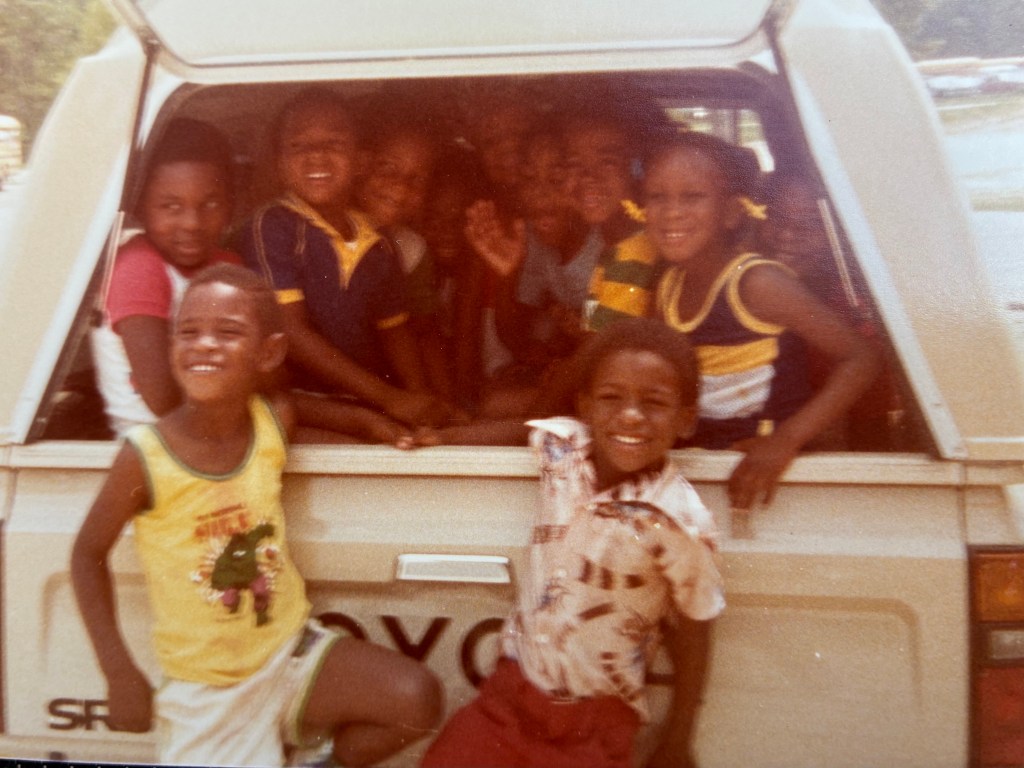
My 25 Honeybees were sweet with not a stinger among them. The parents and students even surprised me with a cake and gifts on my thirty-ninth birthday, and as their joyful voices sang happy birthday, I held back tears from the sheer preciousness of that moment.

 One particular day I was leading a lesson about North Carolina as a state, and we were coloring pictures of the flag.

One student raised his hand and asked, “Teacher?”

“Yes, Samuel,” I said.

“Are you a Democrat or a Puerto Rican?”

“You mean Republican?” I asked.

“No,” and he shook his head, “I’m pretty sure its Puerto Rican.”

“Well, which one are you?”  I asked.

“Oh, I’m black,” he said

“Cool.” I answered.  And I gave him a big hug.

The hug seemed to suffice him as an answer, and we finished coloring in silence.

My long-fast year in North Carolina was a blessing in so many ways.  I found out that some people aren’t who they say they are, and that actions really do speak louder than words.  I learned it’s ok to be from Texas and proud of it.  I marveled at the resilience of the human spirit and the inherit kindness that restored my faith in man.  And with great fondness, I remember 25 little Honeybees who needed me as much as I needed them.

Posted in #Confessions, #Teaching, Growing up, Relationships, Teaching, Truth

Understanding  by Ginger Keller Gannaway

After I secured my MA in English at LSU in 1980, I took a teaching position at an un-air-conditioned elementary school north of Baton Rouge. As a Language Development teacher I was part of a state program that helped children who were “culturally deprived.” I gave no grades and used puppets and a small record player to sing songs as we worked on vocabulary building, letter recognition, and basic reading skills. I worked with small groups of kids between 5-7 years old who came to me for 30-minute classes each day.

My Elementary School Kids


The school was a long building in the countryside with one classroom for each grade (K thru 8). Recess time for kindergarteners was in a small field next to a fenced area of cows. The mooing of our bovine neighbors mixed with the whirr of electric fans. The population was 98.9% African-American. I remember an extra tall kindergarten boy who was “mixed” and one pale, blonde second grader.

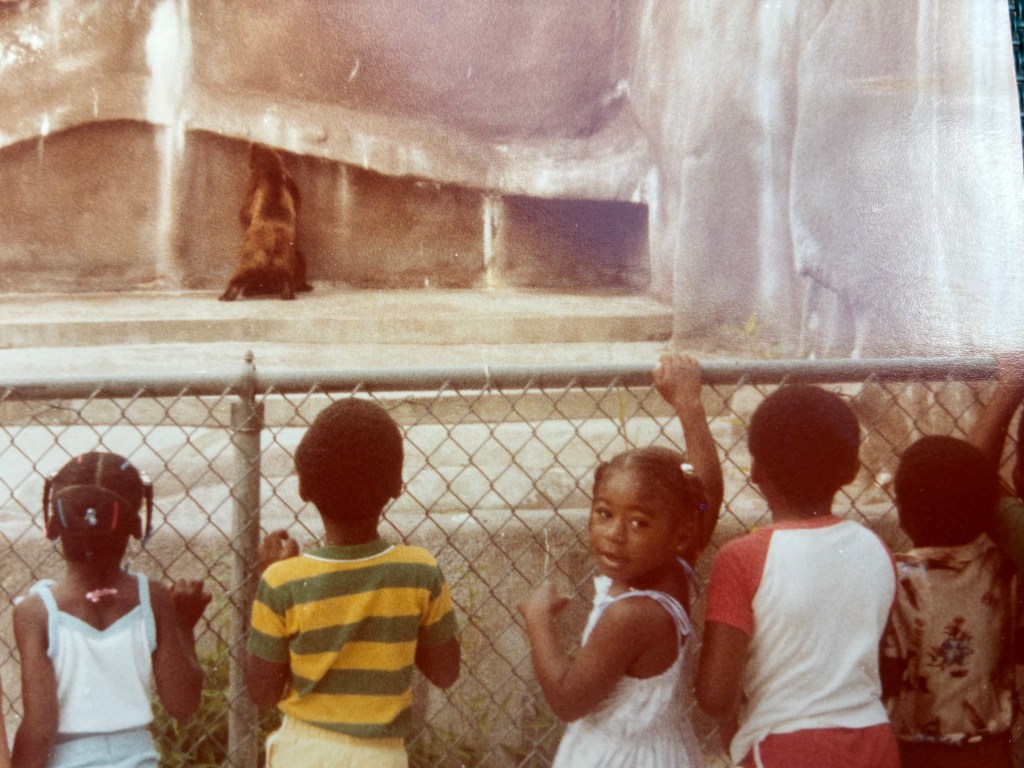
My students spent most of their lives in the rural area they called home. When we took the kindergarteners for a field trip to Baton Rouge, the biggest Wow! was the escalator at the mall where we had lunch. A few five-year-olds needed help getting on and off the moving stairs, but others wanted to ride up and down more times than they could count.

I became friends with Molly, the kindergarten teacher, because I worked with her whole class, and we shared lunch while her kids napped on dark blue mats. I helped her color 3-foot high cardboard cut-outs of the Alphabet Kids. I loved coloring as we chatted. I knew the kindergarten class best since I only worked with a few first and second graders.

Our zoo field trip

I remember David who rarely slept on his blue mat. He stayed quiet while  squirming and searching the room for another wakeful peer; however, all the other kids had entered the Land of Nod. I smiled often at Sammy, a chubby boy who was first to fall asleep flat on his back with his mouth half- open to make him appear more vulnerable than those who curled into balls or hugged a treasured stuffed animal from home. Sammy was a cute, yet tough bundle of energy when he wasn’t napping. He had a husky laugh and lots of friends. When I had Sammy in my class he sang confidently during the puppet songs and I believed we got along like cheese and crackers.

One humid afternoon I helped Molly with a line of five-year-olds as they waited for the school bus or a parent to take them home. (Kindergarten got out an hour earlier than the rest of the school). Each child had a note pinned to his/her shirt with details about our upcoming field trip. Sammy was kicking up gravel as he waited. I smiled at him and squatted to be eye-level. “Sammy, you excited about going to Baton Rouge next week?”


He continued kicking pebbles and surprised me with, “Momma told me don’t trust a white person farther than I can throw ‘em.”

Maybe he had seen his mother’s car pull up and didn’t want to be caught talking to me. Maybe I had corrected his pronunciation in my class earlier that day. In a moment Sammy went from being a student I felt comfortable with to someone I didn’t know.

For the first time I felt a smidgen of judgement based on the color of my skin. I never had a run-in with any parent that school year. I got only positive feedback from my principal. I thought I was a decent elementary teacher, even if my diploma said “Secondary School English.” But Sammy made me face the separation of races in Louisiana in the 1980s. I did not think I held prejudice in my heart. However, I grew up around racism in my hometown. Sammy’s mother’s beliefs came from her own experiences, and she was teaching her son how to navigate the world she lived in. 

Back then no one used the triggering term “woke,” but Sammy opened me to living Atticus Finch’s advice in To Kill a Mockingbird– “You never really understand another person until you consider things from his point of view…until you climb into his skin and walk around in it.” 

I had a sheltered upbringing when it came to other cultures. My segregated hometown and a Catholic school education kept me ignorant in some ways. I thought I trusted, accepted, and understood people from different races. But teaching in several schools with diverse populations, I got “schooled” by my students and their families. And teaching teens with lives so unlike my own made me a better person.

The quote “Be a person on whom nothing is lost” by Henry James helps me seek new ways to understand other people and to accept our differences.  I will never understand prejudice the way those who lived it have, yet I can be open-minded to their ideas and accept them for who they are…..even if they don’t trust me.

Posted in #Confessions, #Teaching, Relationships

Tsunami

            My illustrious teaching career began in August of 1975, at Fairway Junior High School in Killeen, Texas.  I was barely twenty-two years old, fresh out of Baylor University with a degree in Home Economics, married, and had a daughter.  I was ‘adulting’ big time.  My then husband was still in law school, so it was imperative that I find a teaching position as soon as possible.  Two weeks before school started, I felt lucky that the junior high school would have an opening for an 8th grade Homemaking teacher.  In all of my false bravado and rose-colored glasses ideals, I never thought my first year of teaching would be anything other than magical.

Fairway had been the only high school in Killeen until a new campus was built and then it became a junior high school.  So, Fairway had seen better days, but it held wonderful memories for the Killeen community and the students it served. Most of the junior high students were from military families whose parents were stationed at Fort Hood Army Base.

The day I was hired, the principal’s secretary handed me a gradebook and a large wooden paddle. “In case you need to give swats,” she said.

I followed her into the storage closet, and she handed me a stapler, a box of staples, and two number two red pencils for grading, a box of chalk and two chalkboard erasers.  I felt so official.  Never did it occur to me to be apprehensive.  At no point did I get a sick feeling in my stomach.  I was the breadwinner of our little family now, and I was in ‘full steam ahead,’ mode. I was going to make this happen. How hard could this teaching thing be?

Truthfully, I do not remember my first day of teaching.  By the time I made breakfast, my lunch, took my daughter to the babysitter, drove to school and met twenty-five new students each period for seven periods in a day, I was somewhere between hyperventilation and zombie land.

By the third day of school, I was beginning to see that because I was teaching Home Economics, and it was considered an elective course, the counselors would sometimes use elective classes as an opportunity to ‘place’ students who might not otherwise fit into the regular stream of academic classes.  Also, in 1975, homemaking classes were only for girls.  Five days a week, seven periods a day, twenty-five girls per period comes out to an amount of estrogen that perhaps is impossible to calculate.  Imagine, if you will, approximately one hundred seventy-five girls in various stages of their menstrual cycles.

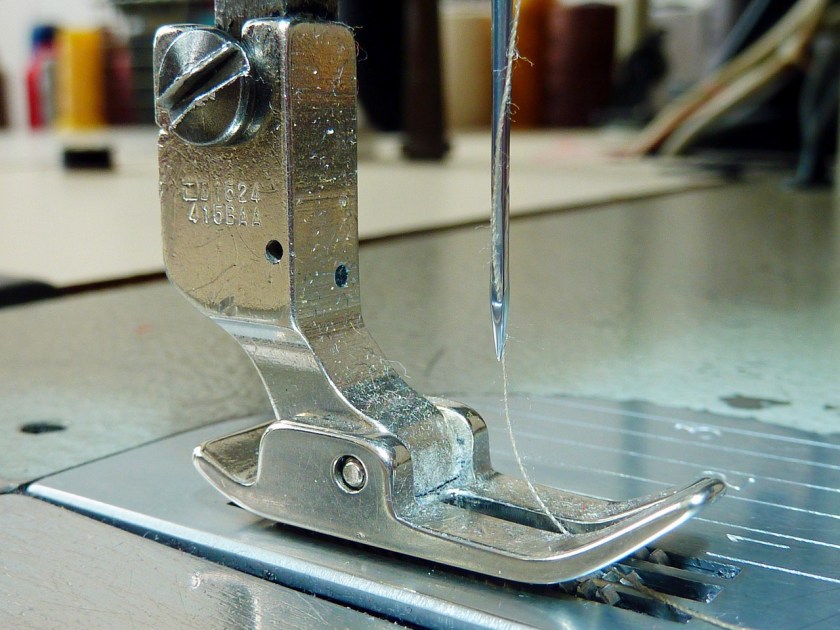
My two classrooms consisted of a sewing room with twenty sewing machines in various stages of repair, large tables to lay out fabric and patterns; and a huge room with five separate little kitchens, each with a kitchen table, stove, and cabinets filled with all kitchen utensils and dishware.   So, while some may say homemaking is an easy class to teach, there is a certain level of safety and training that comes with using sewing machines, sharp scissors, hot stoves, butcher knives, open flames, and electrical appliances.

The sewing project for that first semester was a simple, pull over blouse called The Poppet.  This easy Simplicity pattern took nearly all semester for my beginning seamstresses, and still, some did not finish.  As far as safety was concerned, we talked for days about pointing scissors down and away from the body (yours or anyone else’s).  We talked about the sewing machine and its parts, and the importance of keeping your fingers away from the needle while it is engaged.  The iron was another problem as I strived to remind students to turn it off and try not to burn any fingers, fabric, much less burn the building down.

Elective courses were seen as a safe and fun way to expand the day for students with special needs.  The Monday morning of my second week of school, I received a new roster for my second period.  Four new special education students were added to the role and began arriving mid class.  We had introductions and I assigned each of the four girls a buddy. As utterly horrible as having a classroom of pre-teen girls was, I must admit they were kind and helpful to our new classmates.   I did not know then that one of those new students would be a child I would remember for the rest of my life.

Tsunami Martinez had a beautiful light brown complexion with large, dark, slanted eyes.  She wore her hair down, pulled back by a plastic headband or sometimes in a long ponytail that reached halfway down her back.  She had a tentative smile that never showed her teeth and from the first day we met, she and I shared a bond that was hard to describe.  Our smiles and our eyes melted into each other, and I felt I had known her before, maybe in another life.  She wore plain blouses and polyester knit pants, always clean but often too big, and there was one more thing…   

  Tsunami did not speak.  Only her eyes told the story.

Sometimes Tsunami would be absent for two or three days in a row.  I would greet her when she returned and ask, “Were you sick, Tsunami?  We missed you.”

She would smile and her eyes would be searching mine, like they wanted to tell me, but she never uttered a word.  The most I would get would be a slight nod of her head, and even then I wondered if she understood me.

After several more absences, I spoke with the special education teacher about Tsunami’s attendance.  She said, “Tsunami’s mother  keeps her home when she needs help with the younger children.  There are four younger siblings.  Also, just so you know, Tsunami’s mother only speaks Korean, so you won’t be able to call unless her dad is home.” 

I continued to speak to Tsunami and include her in our learning process. As is protocol for any school in a military community, asking for students to have supplies of any kind must be correlated with military payday. Still, Tsunami was two- and one-half weeks later than the other students in bringing in her fabric and patterns.  Her face lit up when she walked in with her bag from the PX Post Exchange, and I knew she felt so proud that she had her own supplies.  I wondered if this extra expense was a hardship for the family or if maybe her mother did not drive, but I never knew the reason.

When it was time for Tsunami to begin using the sewing machine, I sat beside her and demonstrated exactly what she should do.  My fingers would hold the fabric and guide it through the machine.  Then I would put her fingers in the same place and help her guide the fabric through.  It was slow going.  When we would finish a row of stitches, she would smile, and her eyes practically danced as they crinkled upward. Of course, with twenty-four other students, I was not always able to just focus on Tsunami, but it was clear that someone needed to sit beside her in order to move forward.

One day, in the middle of class, a student started to yell, “Miss, Miss, come quick!  Tsunami got her finger caught in the sewing machine!”

Practically the whole class gathered around Tsunami’s table, and I pushed my way through the girls to sit down beside her.  She never uttered a word, but her eyes were large and overflowing with tears.  In one motion I turned the wheel to raise the needle up out of her left index finger and instantly blood began to spurt.  She held her finger up and looked at me with such a wide-eyed, almost surprised look.  From the crowd, a student handed us two rough, brown paper towels and I wrapped her finger tightly to stop the bleeding.  “You’re going to be ok, Tsunami.  We’ll go to the nurse’s office.”  And I immediately dispatched another student to escort her to the nurse. 

The next day Tsunami returned to class with a large bandage on her finger, but she did not want to work the sewing machine herself.  The other students took turns helping and encouraging her as they did most of the work on her blouse.  After a few days, things got back to a normal rhythm and Tsunami began to try sewing on her own.

But in two weeks, Tsunami was absent again.  Days later, when she had not returned, I received a note from the office that she had been withdrawn from school. And just like that, Tsunami Martinez, who had won a classroom full of hearts, was gone from our protective love and guidance.

The students and I speculated about the many reasons why she might have gone.

“Maybe she’s sick,” one girl said.

“I bet her dad got orders, and they have to move,” another one said.

“Her parents are probably getting a divorce.  That’s what happened to me,” a student offered.

Finally, I got confirmation that her father had been transferred to Germany.  No one came for her sewing supplies or her blouse which was half way through completion.  She seemed to have disappeared over night, and our class was quiet that next day as we separately thought about our friend.

I carefully took all of Tsunami’s sewing supplies and fabric and put them in a plastic bag labeled, Tsunami Martinez.  I then put it on the top shelf of my supply cabinet, just in case.

Of all the things I learned from my first year of teaching, perhaps the most important thing was that sometimes my heart would break, and there would be nothing I could do about it.  My heart would break because I dared to connect or ventured to care a little more than I should.  But as I look back on my thirty-six years of teaching, I have never regretted the connections or heart break, and I have always remembered a student whose eyes said it all.

Posted in Relationships, Sittin Ugly

Sittin’ Ugly by Nancy Malcolm

coffee-mug-everyday-enviro-spl

Here’s To Auntie Sue!!!!!!!!!!!!!!!!!!!!!!!!!!!!!!!!!!!!!!!!!!!!!!

In the early morning hours, before anyone else is up, while the cat is still stretching languidly in her chair, I begin my day. In this quiet early hour I can hear the thud of the newspaper being thrown on the sidewalks, the coffeemaker finishing the last few drops and I hear the tick of our clock on the mantle. This is my selfish hour. This is my cherished solitude. I must have it!! This is my time to drink my coffee and absolutely, unequivocally “sit ugly”.

Sittin’ Ugly is a family tradition passed on by my 88 year old Auntie Sue. Her mother did it, she does it and now I do it. I’m sure lots of other people on earth are doing it, but to do it correctly is an art. The art of sittin’ ugly is learned and perfected through years of practice. There are rules of course, and above all, one must respect another’s’ right to sit ugly. There should be no judgment about sittin’ ugly. The fact is, one just simply does…..sit ugly. No judgment, no shame.

Everyone has their own way to sit ugly. But there are guidelines that I find very comforting and helpful to follow. Anyone that is new to the art will surely want to comply. The rules are as follows:

1. There must be coffee. Preferably freshly brewed with everything extra that you need, (cream, sugar etc.) and of course the favorite mug. I’ve never known a tea drinker to sit ugly, but I suppose it could be done.

2. No talking!! No one speaks to you-you speak to no one. Sometimes it may be necessary to point or grunt especially if you have small children and they absolutely must encroach on your time. But, the only talking truly allowed is to yourself.

3. You must sit. My favorite spot is an oversized chair by the window. Above all else, you must pick a comfortable, familiar place to sit. It is always good to be able to put up your feet and have a little table nearby. Your sittin’ area should be away from anyone else who might be awake.

4. You may be asking yourself, now what? I have the coffee. I’m sitting quietly. Now what? The “what” to do part is really up to you. Sometimes I just sit and stare while sipping my coffee. Staring is perfectly allowable and even encouraged. I also read my daily devotionals and have long conversations with God. I contemplate my day and my life. I think. I don’t think and then I may stare some more, all the while continuing to drink my coffee. This part may go on for a long as necessary. One hour is perfect for me.

5. Lastly, about this “ugly” part. Sittin ugly simply means that you come as you are, straight from bed. No primping allowed! One must be ones’ self. Tattered nighty? That’s ok! Acne medicine dotted on your face? Beautiful! Scruffy old favorite robe and slippers? The older the better! Sittin’ ugly is actually a super-natural phenomenon that makes you more good looking. The longer time you have to sit, the better you will look and feel. Try it and see!

Sittin’ ugly is my personal time. It is my favorite time of the day. Sometimes I can hardly wait to get up in the morning just to sit ugly. I am always at my best while sittin’ ugly, mainly because no one is speaking to me or me to them. What a joyous, peaceful time! What a perfect way to start your day, infact for me, it is a necessity.

Some mornings my little Auntie will call me and ask, “Honey, are you sittin’ ugly or can you talk?” It is always good manners to ask first encase one is not fit for conversation.

So here’s to “Sittin’ Ugly”, to having this special time each and every day and to the millions of us who find it necessary for the sustainment of sanity. Here’s to my precious Auntie Sue and all the beautiful ones who “sit ugly”.

Posted in Confessions, Contemplations, Relationships

Mind Your Own Beeswax

            Have you ever had the misfortune of finding out something you wish you hadn’t? Sometimes the truth is more than I really want to know.  Being nosy or asking too many questions might seem fun at the beginning, but eventually, ‘oops, there it is!’ and I cannot unhear what I just heard.

            The simple, “How are you feeling?” turns into a graphic description of a lanced boil or a replay of what someone had for lunch that didn’t agree with them.  The innocent, “What did you do this weekend?” parlays into a three-part mini-series complete with Instagram reels and photos.

            When I continue to ask, prod, or coax someone to share information, I would do well to mind my own business 99 % of the time, especially when I am asking my adult children questions about their lives.  Navigating life with grown children is quite different than when they were eleven years old, and I had a right to know all about their comings and goings, friendships, what they ate, and how they were feeling.  Overstepping my boundaries was a given back then, but now it is a definite no-no if we want to stay on good terms.

            I used to think I was rather good at finding out things about our kids, but my husband, Boo, is an expert.  He is the master of ‘21’ questions.  He is the guru of gossip, and like Inspector Clouseau, he is a fact-finder to the nth degree. 

            Boo is generally a man of few words, but seat him next to a stranger on the airplane or give him a beer, and he becomes absolutely chatty and will pry into anyone’s life before they know it.  He is adept at asking questions in rapid fire.  Who, what, when, where, why, and how. He is not afraid to ask any question to anyone at any time.

            He is often frustrated by my lack of snooping into our daughters’ lives.

 “Well, did you ask her how much that was going to cost?” he says.

            “No.  It’s none of our business what they spend their money on,”  I answer.

            “Yes, it is.  I think she should save her money or invest it in some stocks. I have a list here of the best ones.”

            “Boo, mind your own beeswax,” I counter.

The expression, ‘mind your own beeswax,’ comes from the 18th century when the dreaded small pox left scars on people’s skin. To cover the pox marks, women would apply beeswax to their faces.  The story goes that if people got too close to a woman’s face or stared at her covered up spots, she would tell them to “mind your own beeswax.”  Another theory is from the practice of sealing letters with beeswax to prevent others from reading them.  Whichever theory you agree with, the end result is the same, don’t meddle.  Stay in your own lane.  Butt out. 

            Most of the time I try to fly under the radar.  I can sit quietly and entertain myself easily.  I don’t have the need to talk.  I can stay in my own hula hoop, but if there is one lonely elderly person in the grocery store, they will find me.  And, even without asking, I will find out everything they have been thinking and feeling for the last twenty-five years.  I will know their pets’ names; their personal medical diagnosis; vacation plans; their children’s names, where they live, and why they haven’t called in over a month. 

             I rarely initiate these conversations, but I must have that face that says, “Tell me everything.  I really care.”  People tell me why they got divorced; when they found Jesus; their favorite ice cream flavor and how they put on their false eyelashes.

            Once, at Buc-ee’s, I ran in to get a bottle of water while Boo waited at the gas pump.  Twenty-two minutes later I emerged.

            “What happened?” Boo asked.

“ I was paying for the water and noticed the cashier’s false eyelashes were the longest, thickest fake lashes I have ever seen.  I said, “WOW, I love your lashes!,” but I could see the girl thought I was making fun of her, so to make her feel better I said, “No, I really love your lashes.  I wish I could wear those.” 

            I don’t know why I said that.

She proceeded to tell me where she buys them, how much they cost, and step by step instructions on attaching them. Then she explained that her real eyelashes have nearly all been pulled out by the glue, and now she has to wear the false lashes all the time, so her boyfriend won’t know her real eyelashes are gone.

“Don’t get the cheap glue,” she advised. 

 By this time there was a line behind me, and I quickly said, “I’ve learned so much, thank you!  You’ve given me the courage to try it,” and she leaned over the counter and gave me the biggest hug.

 “Go big and dramatic,” she said, “You won’t be sorry.  And have a blessed day,” she added.

“You too,” I called.

            “Wow,” Boo said when I told him the story, “That’s a lot of information.”

            Oh sure, all this could have been avoided had I not said anything about the cashier’s eyelashes.  But don’t you agree that some situations just beg for a question or comment?  In the same way, we want to ask our grown children questions that we probably shouldn’t, even though we think we want to know the answer…we really don’t.  Maybe someday I’ll learn not to ask.  Maybe someday I’ll remember the secret to happiness is minding my own business.

Repeat after me:  The secret to happiness is minding my own business!

Posted in Relationships, Truth

I Walk Tall; I Got a Tall Attitude

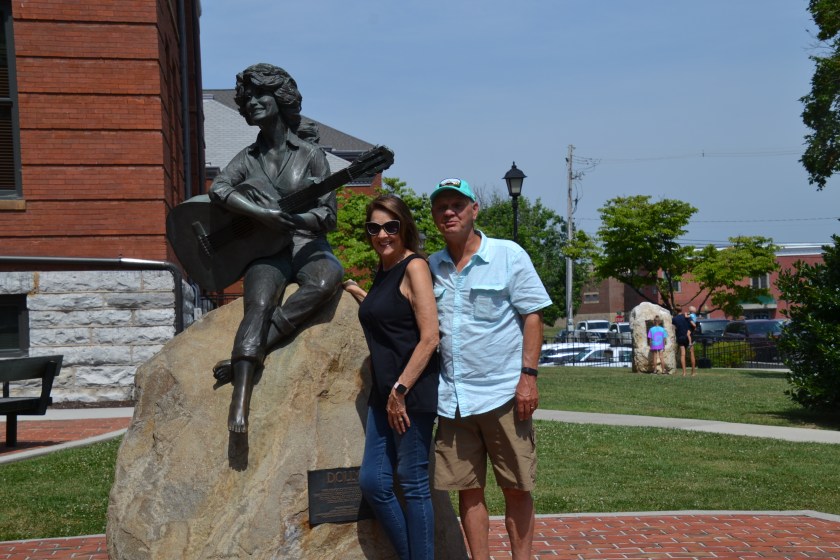
   Four years ago, we took a summer vacation to The Great Smoky Mountains.  To date, it still remains one of my favorite destinations, topping the charts in scenic views, lush mountainsides, and rivers.  We saw so many black bears that it seemed they were making an appearance just for us.  And then there was Dolly.  Dolly’s childhood home, Dolly’s theme park, Dolly’s statues, and Dolly’s Stampede.  As much as we intended to stay strictly in the wilds of nature, we were drawn to Dolly Parton like a pat of butter to a piping hot square of cornbread.

            Gatlinburg, Tennessee is one of the entrances to The Smoky Mountains, and you can’t drive through Gatlinburg without seeing, hearing, and feeling Dolly Parton.  Dollywood, Dolly Parton’s Appalachian-themed park is located in Pigeon Forge which is a hop, skip and a jump from Gatlinburg.  Dolly and Dolly-type things to do are everywhere, and well…when in Rome.

Boo

            I could go on and on about Dolly’s Stampede, where we ate a four-course feast followed by a show featuring music, comedy, animals, and pyrotechnics.  I could tell you about the horseback riders who did tricks, and how patriotic the show was, but what we mostly came away with is the absolute magnetism of Dolly as a country singer, songwriter, actress, and philanthropist.  She gives money for scholarships and donates books to inner-city schools so that all children can have a book of their own to read.  Her talent, charm, and grace are undeniable.  And by the way, she is a Capricorn.  Her birthday was January 19th, the last day to be a Capricorn.

            Capricorns are known to be hard workers.  They are often overachievers, persistent, practical, and sensitive.  They make success look effortless even though they do put a lot of energy and time into their careers and relationships.  And while Dolly Parton is an extravagant example of zodiac energy and creative entrepreneurship, she has a soul twin who shares so many common denominators and the same birthday,  my little Auntie Sue.

            Dolly and Sue, both short in stature and big on attitude, have an unstoppable will to survive and thrive.  Both are givers and have never known a stranger.  Both can kick ass and take names later and both love to love others.   Although Dolly is obviously living life to the fullest, Auntie Sue has gone on to Glory, both are excelling and exhilarating in their respective spaces.

            Dolly and Sue were faithful to their belief in God.  In fact, there is a Bible verse that reminds me of them both.  Proverbs 27:17,  “As iron sharpens iron, so one person sharpens another.”  Anyone who ever spent time with Auntie Sue knew she was special.  Her confidence, endearing humor, magnetism, and compassion for mankind was a force that attracted others, drew them in, and encouraged them to be better people.  What a legacy, what a quality to have.  Both of these tiny dynamos obviously lived by Dolly’s quote:  I walk tall: I got a tall attitude.

            I was always one of the tallest girls in my class all through elementary school, perpetually on the back row, center on picture day.  I was taller than every boy in my class until seventh grade.  I was always scouring the pant rack for tall, not regulars, and tried endlessly to find stylish flat shoes with not too much heel. 

            I never wanted to be tall.

            You should be glad you’re tall.

            The growth of my arms and legs was the source of many tears and angst.

            I wish I was tall like you.

It didn’t matter what anyone said, my inner self could not manage a tall attitude.

            Growing up, I would occasionally forget that I was a full head taller than everyone else until I saw myself in photographs or looked down to see my pants fit as though they were ready for a flood.  I was tall, but I never walked tall.  As I gradually grew into my own in high school, I was glad the boys were taller but painfully aware that when standing with a group of girls, I could see the top of everyone’s head.

            In college sorority pictures, I tried to casually slump, scrunching my shoulders to be more ‘right-sized.’  Unsure of myself, holding back and trying to fit my tall peg into a short hole left me never feeling good enough.  It’s the kind of thing self-help books are made of.  Shrinking back, making myself small, so others could be tall.

            Enter Auntie Sue.  Tiny like Dolly.  Big hair, like Dolly, and outspoken, like Dolly,  Auntie Sue believed in me with a force as strong as the Oklahoma wind.  Growing up without my mother, I never had that approval and acceptance that many might take for granted.  I simply bluffed my way to adulthood where Auntie Sue finally reentered my life with a new perspective;  Walk tall and have a tall attitude.

            I have written volumes about Auntie Sue.  Stories about her humor, her sacred sittin’ ugly time, her glory hole, and her fierce loyalty to those she loved.  I will never tire of singing her praises.  I’ll never forget her hysterical Sue-isms, and I’ll forever be grateful for her love.  Her walk-tall attitude encompassed me and lifted my slouchy frame from a wanna-be 5’6” to a real 5’8 ½”.  Unconditional love has the power to make even the shakiest walk tall.

            Maybe some might think it a  s t r e t c h  to compare Auntie Sue with the big as life, Dolly Parton, but I think it’s just right.  As iron sharpens iron, a tall attitude encourages the same.

    Dolly’s living the dream and embracing her tall attitude.  She’s singing her songs, selling her cornbread, and bringing the world together with her podcast, Dolly Parton’s America.  And Auntie Sue?  My little Auntie Sue is still sending her love and guidance to me, and she’s still walking tall….walking tall on the streets of gold.

Posted in Family, Fathers, Grandmother, Mothers, Relationships

Stained by Ginger Keller Gannaway   

I met my new favorite person in this world two weeks ago – Winslow McClain Gannaway! He weighed eight pounds, ten ounces and made funny faces while he slept. His mother Catherine said he looked just like his dad, Casey, my middle son. I saw Catherine in his chubby cheeks and soulful eyes as well as Casey in his long limbs and perfect nose.

We begin life with people wanting us to resemble our parents. “He has his dad’s big feet” or “his mom’s smile.” And as kids, we imitate our parents – combing our hair like Momma’s, pretending to shave like Dad. We often adopt their interests. Chefs have children who love to cook. The lawyer hopes his/her offspring will one day take over the family practice. A tennis player starts lessons for the kids as soon as they can hold a racket. For eleven years or so many children follow their parents’ lead. 

As a kid I went to church every Sunday and learned to love our family’s traditions – from Good Friday crawfish boils to getting up before dawn for long vacations. Then my teenage brain veered into other directions, and I pushed back. 

I went from loving to dance with my kid feet atop my dad’s size fourteen shoes to hating my size eight feet when I entered eighth grade. Would I, like him, need to drive to Lafayette to find oversized shoes? Would I even find women size twelves for when I became a senior? 

I rebelled, rejected, and criticized my parents. I resented their help and worked hard not to become them. I felt proud of our differences and later believed my own kids would be closer to me than I was to my parents. I gave my kids more choices as I also hovered over their lives.

However, after all my pushing back on my parents’ influences, I realize I am stained with personality traits and habits that are just like theirs. My dad ate breakfast in white v-neck t-shirts and slacks. His undershirts had stains from previous meals, rushed shaving jobs, or paint from work. I remember Momma exclaiming,“Reginald!” at the table when Dad’s sloppy manners created round grease stains that Momma’s aggressive cleaning could not erase. So I judged Dad for his messy eating.

Just yesterday I noticed a circular stain on the right thigh of my favorite jeans. I can’t remember if I spilled the contents of a pork taco or the filling from a blackberry cobbler on that leg. When did I become stained with the flaws of my parent? Like Dad, I’m a messy eater. I also have big feet and hate asking others for directions. I love every kind of fruit and I salt my watermelon. I enjoy gatherings with relatives and friends where good food, strong drinks, and well-told jokes connect us. My siblings and I got his short-fused temper as well as his love of movies. He taught us and his grandkids how to pull our rackets back and to get our first serves in when playing tennis. I embrace Dad’s love of travel and adventure, especially the times that are unplanned and serendipitous.

When I was young relatives said I looked like my dad (which did not make me happy); I’d rather look like my momma with her petite stature and tiny waist. I still do have plenty of Mom connections.  She loved her breakfast food well done. My husband often warns me: “You’re burning your toast!” and I say the obvious, “That’s the way I like it.” Over the years with practice I have learned to make good gumbo and crawfish etouffee, but I still dream of her pork roast with rice and gravy that I cannot copy. I also failed at mastering her portion-control ways; she never weighed over 110 pounds. She stayed a poulette (a small chicken) – dusting, picking-up, putting-away, ironing, cooking, and wiping clean every counter she passed. I did not inherit her need for a spotless kitchen and an organized living room.

I don’t think Momma nor Dad understood my love of reading and writing or my desire to live in a large city. They were small town born and bred, never leaving the south central Louisiana parish they raised their family in. Religion remained a major part of their lives, and they did their best to look the other way when their three grown daughters moved away from the Catholic Church.

I don’t attend weekly mass and I’ve not been in a confessional in more years than I want to confess to, but I often pray to the Virgin Mary and have rosaries in my desk, my car’s glovebox, and by my bedside. 

The saying “the apple doesn’t fall far from the tree” fits my food tastes, entertainment tendencies, love of New Orleans and New York City, and interest in major tennis tournaments. I’ve learned to value my parents’ respect for close family ties and shared vacations. However, I have lived longer in Austin, Texas than I lived in Cajun Country. I believe in recycling, breakfast tacos, greenbelt hikes, tattoos, and lots of live music.

I have the Kellers’ obsession with movies and card playing and the LaTours’ love of music and laughter. The stains of my parents’ parents were pressed into their hearts and minds from those before them, so I claim the traits I’ve inherited, and now that Momma and Daddy have died, I do not want those stains to disappear. Like the thrift store robe that once belonged to my sister Kelly, I treasure old things, especially when they have imprints from my past.

I will hopefully leave my marks on my own three sons and their offspring. And one chilly day Winslow McClain Gannaway may ask me to make him some gumbo, and we will watch Cat Ballou together before I tuck him in at night and read him “Clovis Crawfish and His Friends.” 

Posted in Pets, Relationships

Pee-Mail by Ginger Keller Gannaway

Years ago I met the kindest octogenarian in a park near my home. While I was walking my dog Jambo, this man stopped to say howdy and give Jambo plentiful ear rubs and head pats. His voice was soft and his smiles quick. He shared wisdom without judgement. (I later found out he was a retired judge). He and I met often and enjoyed quick chats about the weather and local news, but he seemed to most enjoy time with Jambo. He’d take a knee to get nose to nose with my dog and rub his ears and tell him what a good boy he was.

Jambo – our first Gannaway family dog

One morning I complained about Jambo getting out of the back yard AGAIN. Our mixed breed was an escape artist – squeezing between the fence and its gate, digging beneath the gate after a rain, and even twisting the gate’s chain link with his mouth to make a hole and head for open spaces. We were lucky that we always got Jambo home – even once going to the animal shelter to pick him up after the 4th of July fireworks.

Judge told me, “Oh Jambo must have needed a walkabout, that’s all.” And then my dog got a second helping of ear rubs.

Another time I said, “Jambo would be perfect if he didn’t need to sniff every tree, bush, and fallen branch we pass.”

“Oh, he just has a lot of pee-mail some days,” said Judge.

I laughed and said, “I hadn’t thought of that.”

Now that I’ve downsized to a smaller home and a larger dog, I believe the judge’s explanation was right-on! Our dog Millie smells tree trunks and fallen leaves with serious concentration before squatting to leave her own pee-mail. And she sniffs all angles of a fire hydrant, utility pole, or on-street mailbox. These manmade objects hold as much information as as a clump of dead grass does. Pee-mail comes in various lengths.

Millie – big dog in small place

After I read Sigrid Nunez’s  wonderful novel The Friend, which featured a remarkable Great Dane as a main character, I saw how dogs’ noses are their favorite way to interact with the world. Millie not only recognizes my scent from many yards away, but up close she smells what I had for breakfast AND what I had for supper three days before. A dog’s nose is at least 10,000 times more sensitive than a human’s, and it has about 225 million scent receptors compared to a human’s mere five million.

So Millie’s walks must include frequent stops so she can read all of her pee-mail. While she will stick her nose deep into a pile of leaves or sometimes a drain ditch, she does not always answer every pee-mail. After several seconds of aggressive sniffing, Millie may just walk on. Every third or forth “no response” is followed by a squat and release of her own pee-mail. I wonder if she smells something interesting (or perhaps confrontational) that requires leaving a reply. Is she “marking her territory” or telling a canine friend, “What’s up, dawg?! Long time no smell.” I’ve gotten used to the stop-and-sniff rhythm of dog-walking. I give Millie time to read all her pee-mail and to reply when necessary. I get concerned only when her sniffs become frantic as if  she’s searching for a small bit of very old cheese or a broken piece of a chicken bone. Then I must pull her nose up and hurry away from something she considers delectable but I know is dangerous.

Millie and I on a walk

I could take lessons from Millie. She reads all her pee-mail but only answers the important correspondences. And none of her responses are too long. She says just enough before she’s on to the next piece of pee-mail. Also, if we approach a dog walking towards us, she ignores the smells on the ground and greets her potential friend with good eye contact and a quick bark. Then the two dogs can give each other the ultimate compliment – some serious butt sniffing.

As interesting as an electronic piece of mail may be, it’s no comparison to face-to-face conversation. I strengthen my human bonds when I share ideas, stories, and even worries with others in person. We may offer one another advice or laugh about life’s crazy twists and silly slip-ups that remind us that comedy connects us, especially when we share our embarrassing moments or weird observations. We don’t need to smell each other’s britches to understand the crazy all around us. I suppose we humans rely on our ears and eyes more than our noses. E-mail is ok, phone calls are better, and face-to-face/in-person is the best kind of connection. 

Posted in Contemplations, Relationships

OWT’s (One Way Talkers) by Ginger Keller Gannaway

The Princess of our family

“Did I tell you about Lucky getting to ride the ferry with us?”

I nod and smile before I let my dog Millie pull me toward our apartment. I did not need a second telling of my neighbor’s trip to Galveston with her dog. When I move beyond the “Looks like another scorcher” level of talk with acquaintances, I learn about their pets, their family, and their personal tastes. While casual conversations may connect me with good neighbors, they are not all equal. Some people lead interesting lives and know the importance of clever wording and good timing. They also realize that a chat is better when both parties contribute to the conversation.

Then there are those who share endless ho-hum info. about their pets, family, friends, and hobbies. They have not an iota of curiosity about my pets, family, friends, or interests. They are One-Way Talkers and they’d be at home in a Seinfeld episode. They are clueless to the apathy of their audiences. I do not need to know a short cut to the cheapest La Quinta in El Paso or a pet’s favorite place to take a poo, and I don’t have time for someone’s else’s grandparent’s weekly activity schedule at the nursing home.

OWT’s follow their own rules of engagement:

  1. Give listeners a slew of details like what you had for lunch, what your cousin had, and what your great-uncle took home in a “doggy bag.” 
  2. Do not respond to fellow talkers’ own experiences about a similar experience. (If you explain your partner’s unfortunate bowel mishaps, ignore what the listener says about their cousin’s bad colonoscopy).
  3. Never give listeners an opening for conversational feedback. Listeners need only nod their heads or throw out “Huh-uh.” They should keep ears open and mouths shut.
  4. If a listener attempts a suggestion on how to deal with a dog’s allergy to polyester for example, interrupt him with a list of experts you have already consulted and describe your pet’s projectile vomiting tendencies.

My apartment complex has at least three OWTs and only one is worth listening to. Let’s call him Scheherazade. He’s in his 80’s and has been in the military, worked at our state’s biggest university, traveled all over our nation, and not always followed the rules. He went to New Orleans once to deliver a race horse and got involved in some Mardi Gras madness. His younger days involved bootlegging and sharecropping. He may repeat his tales, but he’ll add a twist or insert a new detail. And his stories include valuable life lessons. If one goes to New Orleans to carry out an illegal transaction, one should avoid going during Mardi Gras or Jazz Fest. This type of OWT is as unique as a laid-back two-year-old who missed her nap.

So don’t think I’m cruel when I look out my window before I go to our mailboxes, and I don’t venture out if a certain OWT is nearby. And if I do get caught with this OWT, it’s ok to fib about having to hurry home because I have a Zoom meeting in two minutes. An OWT has followed me out to the parking lot when I said I had no time to talk and can continue telling me about Lucky’s upcoming grooming appointment even after I’ve gotten a half-block down the sidewalk. I may be mostly retired, but these days I don’t have the patience for OWTs  ever since Scheherazade moved away to live nearer his grandkids.

Posted in Contemplations, Friendship, Relationships

Talking to Strangers  by Ginger Keller Gannaway    

The day after Christmas, Gary and Evan drove from Austin, Texas to Mariposa, California to visit Evan’s fiancee Tashea and to spend time in Gary’s mecca – Yosemite Valley – where he had rented heated tent cabins in Curry Village. Ever since he spent time there when he was eighteen, the park has beckoned Gary back, and he dreams of buying property near the park. To quote  John Muir: “Its natural beauty cleans and warms like a fire, and you will be willing to stay forever in one place like a tree.”

Yosemite, 2022

Three days later, a woman from Yosemite National Park called me.

“Gary?” she said.

“No, I’m his wife. Is everything ok?”

“I’ve been trying with no luck to reach Gary.  A big snow storm is hitting the park tonight, so we have to cancel his tent cabin rentals.”

“Oh no! For all three nights? Gary will be devastated.”

“We’re canceling on a day-by-day basis. Might just be one night.”

I sighed. “I so hope so. Are y’all ok now?”

And this compassionate stranger and I chatted about how wonderful Yosemite is and I shared my husband’s love affair with the park. “Gary’s 76 years old,” I said. “Yosemite is his favorite place on earth. He worked there when he was eighteen, and we’ve visited several times, taking our three sons when they were little and just this June with their significant others. Last night he got to the Yosemite Bug with our youngest son and his fiancee.”

“He should stay at the Bug,” she said.  And she gave me the number for Gary to call when I reached him.

I used Messenger to give Evan the number, but because of spotty cell phone reception, he didn’t receive the news until they were on a bus with their luggage headed to the park. Two hours later Gary called.

“They cancelled our tents?! Where are they gonna put us up?”

“It’s not like that,” I said. “The woman said you should stay at the Bug.”

I heard him huffing and puffing.  “I’m walking to the office now. Gotta go.”

 That evening Evan called. “What did you tell the lady in Yosemite? All the workers acted like they knew Dad when we walked in. They’re letting us stay at a cottage in Curry Village tonight and giving us an employee’s discount!” Talking with a stranger about my family had brought us unforeseen kindness. We had connected over our love of Yosemite and she showed empathy for an old guy and his son.

Cottage in Curry Village

I enjoy talking with strangers because I’m curious about their lives. Like the cashier who works weekends at the 7-Day Food Store down my street who stays upbeat even after an attempted holdup. Or the young teacher who first exchanged waves with me and now gives me vegetables from her garden.

We rightly tell young children, “Don’t talk to strangers,” to protect them from sickos. But as adults, shouldn’t we feel free to talk with strangers? To make a connection, to commiserate, to say, “I see you. You’re not invisible or insignificant.”

Stranger talk starts with weather comments. I don’t try dangerous topics like politics, religion, or pandemic advice. But I smiled behind my mask when a very short woman who walks her very fat dachshund wanted to show me pictures of her grandkids on her phone. We always wave now, and I feel less alone on chilly morning walks because most strangers and I have more similarities than differences. Our encounters feed the fresh-faced optimist inside me and send my pimply pessimist with chronic indigestion and facial tics to her room for an indefinite time-out until she’s rediscovered her sense of humor.

The pandemic has separated us in a list of necessary ways, but aren’t we all still struggling to get on with life the best we can? If I ask a stranger, “What’s your dog’s name?” or tell a waiter, “Cool tattoo,” am I not making a connection? Not in the generic, robotic, “Have a nice day,” way. Specificity counts. This past fall, a school crossing guard and I bonded over both being from Louisiana, so right before Christmas, I gave her some boudin from Lafayette. We exchanged holiday greetings and our names that day.

Some friends give me a hard time about talking to strangers. They roll their eyes and take a few steps back as they maybe mutter, “There she goes again.” But I want to be like the protagonist on my favorite TV series Better Things. Writer, actor, and director Pamela Adlon ’s protagonist Sam Fox shares time with a quiet man on a film set or she gets to know the mother of her daughter’s Mormon friend. Her honesty creates powerful moments in her show. I’d say that a key rule when talking with strangers is “understanding, not judging.”
 

Talking with strangers has given me memories I treasure:

*taking a selfie with a scruffy guy at 7 a.m. outside Cafe Du Monde in New Orleans.

The Professor, Maryanne, and me in Montreal

*getting a list of good places to eat in Montreal from a couple, nicknamed the Professor and Maryanne, who owned a tiny coffee shop and who got jazzed when I told them,”I’m Ginger!” So the three of us posed for a Gilligan’s Island tribute pic.

*meeting a groovy neighbor six years ago as we both walked our large dogs. She has become a close friend and the mother of my three amazing “practice grandchildren”!

Strangers have enriched my life, and even though every encounter is not hitting the jackpot, connecting with someone else may add serendipity to my life. I never know when a casual chat can lead to knowing three of the most wonderful children in the world!