Posted in #Teaching, Confessions, poetry

Who Are You? by Ginger Keller Gannaway

When I consider my 34 years of teaching, I think one of my most important challenges was understanding and supporting each of my teen-aged readers and writers. As an English teacher, I see the task of “getting to know your students” as a Herculean job since we also have to grade and give useful feedback on their essays and research reports.

My students often shared things in their personal narratives that shocked, saddened, or confused me. (And I’m NOT talking about the handwritten scribbles without punctuation or capitalization or the cursive that is so tiny I needed either direct sunlight or a magnifying glass to figure it out). I’m referring to the loneliness, the trauma, the heartaches, and the stress they routinely shared in their essays. I’m remembering the stories that made me cringe, laugh aloud, and cry. I’m remembering the ones that called for an after-class conference or a visit to the school counselor.

 I felt both honored and burdened by their honesty. Since high school teachers often have rosters with 180-plus students, how do we learn their names before back-to-school night?  How do we handle so much angst, joy, depression, immaturity, intelligence, and cynicism without giving up every second of our home lives? And how do I separate each school day’s drama from my family responsibilities? How do I focus on my own children’s needs and forget my students’ issues?

Like the tv series Severance where Lumon employees sever the connection between their work lives and their private lives. A worker’s “innie” doesn’t remember anything about his/her “outie” home life (and vice/versa). Maybe a teacher could cope better if her “outie” forgot all the details of her “innie” life.


I’ve taught over 6,000 students, and I confess I don’t remember every single kid. But so, so many smiles, smirks, glares, and empathetic nods remain. The ones who shared their wisdom and laughter stay with me as much as the ones who made me cry and rush to another teacher or an assistant principal for help. The faces, of course, linger longer than the names.

Here is a short account of one of my students. Using a different name, this is a brief remembrance of an unforgettable freshman at Crockett High School.

Thomas                 

Three weeks into the school year I noticed a freshman’s black and white marbled composition book on my desk atop fat folders of ungraded quizzes – a writing journal without a name and not returned to second period’s designated shelf where even stacks of non-spiral notebooks gave the illusion of order.
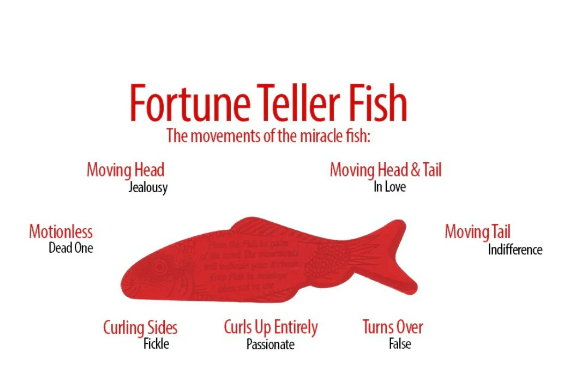
I finished writing next period’s agenda on the streaked white board before I flipped through pages of black ink scrawls that made the lined paper curl like those paper-thin red plastic fish that move in your palm and predict the future. The last few pages had more cursive than print and less punctuation. “i sit on the roof & wonder why im even here” made me sit down. I scanned previous lines about “a heart of hurt,” a girl’s “soulful eyes,” a “silence that slices” and a “cold colorless world.”

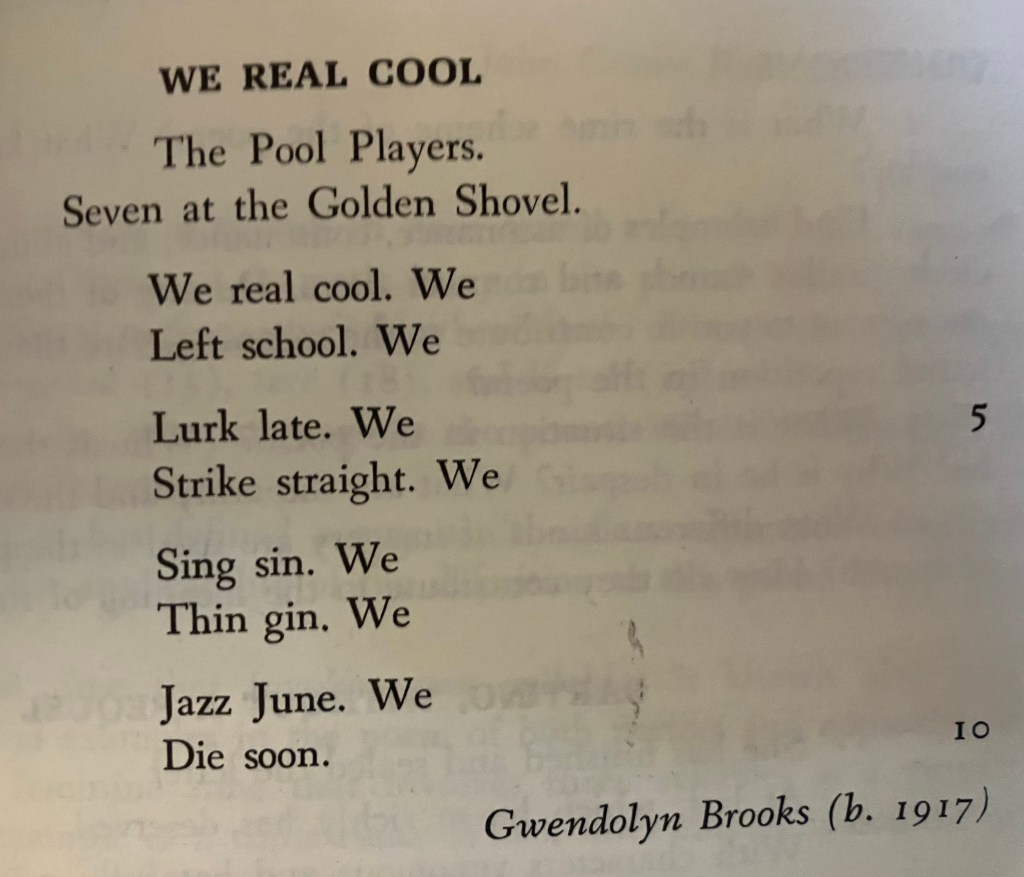
I reread the notebook searching for a specific name. Nothing. I flipped through second period’s quizzes searching for that same hard-pressed ink, minimal punctuation, print/cursive mix, and the lowercase i’s until I held Thomas’s quiz about Gwendolyn Brook’s poem “We Real Cool.” He’d circled the poet’s use of alliteration and underlined “We die soon” six times.

I referred back to Thomas’s journal and touched the words “on the roof” before having the sense to seek help. I rushed downstairs to my favorite counselor’s office. The woman who focused on class schedules and state mandated testing switched to doing what she was trained to do. We compared the journal with the quiz paper and agreed Thomas was the author. A slim boy with wild blond curls and a skateboard stuck out of his backpack. He wore over-sized, faded 80’s rock concert t-shirts and loose black jeans. A mix of grunge and emo. Withdrawn yet observant. Someone who sat in the back row, stared out the window, and usually avoided his 31 classmates. Someone a teacher with 184 students could fail to notice.

My vague answers to the counselor’s specific questions made me squirm. We labeled Thomas a smart student with a “B” average, neither a joiner nor a trouble maker. He melded into crowds of teens struggling to be seen and ignored at the same time.
I thought about next week’s Back-to-School Night when tired parents would come to Crockett High School to trudge up and down stairs and visit eight teachers who might remember half of their students’ names, so the question “How’s my son doing?” was as pointless as “What’s my kid’s blood type?”

By now I had missed my lunch duty and had eight minutes before third period began. The counselor kept the journal and nodded to me while reading details about Thomas’s classes and his family on her computer.

I left her office, walked through the school’s open-air courtyard, and looked up past the massive oaks and concrete steps that led to my second floor classroom. Could Thomas be on the school roof? Or across the street atop the flat tops of the strip mall businesses? Had he gone to the neighboring city park’s rec. center next to an empty swimming pool with a peeling, cracked blue bottom?

At my desk I ate broken Pringles from a plastic baggy. I thought of the one time Thomas had spoken up in class telling a peer to “quit stereotyping the story’s protagonist.” My teacher heart had danced a jig then, but I couldn’t remember the rest of the literary discussion. I thought of Thomas’s extra dark eyes beneath long bleached curls and how he responded to my morning greetings with eye contact and head nods.

The assault of third period’s buzzer-bell sent me to my door to greet 33 teens. My after-lunch sophomores came in loud and messy. Conspiratorial laughs from two girls preceded a running Sam who tossed a bag of Flamin’ Hot Cheetos to Carlos who tugged on a cheerleader’s backpack which made her yell, “Loser!” before swatting at the runner who headed toward a window past short, short Cici who wore headphones and slipped into her desk before putting her head down while a new girl taller than me stopped at my door. New girl’s thin hand with chipped black nail polish held a printout from the attendance office. I gave her a smile and a “Hey there,” took the paper, and pointed to my last empty desk. When Gabriella began passing out the black and white journals, I forgot which chapter of Animal Farm we were on because all my head could do was scan rooftops for a fourteen-year-old boy I hardly knew.  

Note to readers:  The school counselor did locate Thomas off-campus that day. He was hanging out in Garrison Park and despite his broken heart he was fine. She talked with him, but I never confronted him about the “sitting on the roof” drama. He passed freshman English and graduated a few years later. I have no further info. but I hope he remembers some of the literature we talked about like I’ll always remember the panic I felt about the journal he had left on my desk and my flawed attempt at “getting to know my students.”

Posted in #Teaching, Confessions

Falling into a Box

by Ginger Keller Gannaway

I never dreamed of being a teacher. In 1965, at age nine, reading was my favorite pastime, and I wanted to be a writer. After seeing Funny Girl in 1968, I wanted to be an actress. As I endured my high school years, my cerebral palsied limitations (a mostly useless left hand and a limping leg) I changed my dreams of being on stage with Barbra Streisand to being her best friend. In college I decided writing was my best option, so I majored in journalism. I switched to creative writing when I realized there was a typing requirement for the compulsory news reporting class. After I spent one thrilling semester as a Creative Writing major Dad said, “English major? You need to switch to Education. Get a job as a teacher.” Since he paid for my education, I followed his demand.

So I endured Statistics, Fundamentals of Education, and Testing Measurements. My eyes glazed over as I watched male professors wearing dark suits and frowns explain a female-dominated profession. I struggled to solve basic math problems as I yearned for poetry and short stories. My student teacher semester was my one worthwhile education class because the supervising teacher was a white-haired angel named Dr. Hair whose sage opinions included “Everyone deserves a year living in New York City.”

Dr. Hair made guiding fifteen-year-olds through literary analysis as natural as eating popcorn at the movies. She gave me the perfect balance of praise and pressure. I guided reluctant teens through recognition of the eight parts of speech and  examples of figurative language. I thought I could be a strong teacher who handled any educational challenge that came my way—until my first day of teaching at Anderson Junior High.

The school was in a small south Louisiana town set literally “on the wrong side of the tracks.” On my first day of work, the principal handed me a wooden paddle – “for discipline.” The English Department chair did not tell me how happy she was to have me at Anderson Junior High when she gave me a key to my classroom. Nor did she ever smile.

In theory the schools in Louisiana parishes in 1978 were integrated; in reality Anderson was 90 percent black, and its faculty included only four white teachers. Most other teachers ignored me, maybe because my pale face looked as soft as my disciplinary skills, and they believed I wouldn’t stay there long enough for them to bother learning my name. Their assumptions were as right-on as fried catfish specials on Fridays in our predominantly Catholic state.

My miscalculations began when I missed the obvious warning sign connected to a teaching job starting in January: a teacher had quit in December! My first day of teaching a class without Dr. Hair nearby was as bad as stepping barefoot into a bed of fire ants. The seventh graders had run off their last teacher the week before Christmas break; in January they took one look at the remnants of my bad perm and my plaid wool skirt with its matching vest and recognized new teacher inexperience.

I’d gotten to school early enough to write the day’s agenda on the blackboard below the day’s date and next to my name in white powdery cursive. The front of the room was cluttered with heavy cardboard boxes filled with that semester’s new grammar workbooks. My department chair, who had looked at and spoken to me as little as possible the day before, said, “Distribute these,” after she concluded our thirteen-minute new teacher orientation.

I straightened the rows of battered wooden desks and the stack of my “Welcome to Seventh Grade Language Arts!” packets. I reviewed the names of the 172 students I would meet that day, and I went over the index cards for my first-day-of-school welcome speech. I said a fast Hail Mary and made the sign of the cross when the first bell rang.

In seconds the halls filled with the noise and energy of thirteen-to-sixteen-year-olds. Our school district did not practice “social promotion,” and a few boys with facial hair sat in seats next to boys whose feet did not touch the floor. I mispronounced at least five names that day, but the students did not hold it against me when I changed the roster’s “Edward” to “Eddie” or made pronunciation notations on “Janie” (a short A beginning and a long E at the end). I think they were still uncertain about where I stood on the spectrum of clueless teachers.

The first time I turned my back on the class to list the “Being Verbs” on the board, I heard a four-second belch and watched a wad of paper flying toward the waste basket near the front door. It missed its mark. After I repeated “Be, am, are, is, was, were, being, and been,” I picked up the wadded paper and dropped it in the trash in movements both smooth and confident. I raised my eyebrows when I realized the paper ball was my welcome packet but remembered Dr. Hair’s advice: “Give students your respect and as much eye contact as possible.” Several kids were smirking, and five occupied desks that had nothing on them, so there was no way I knew which student had tossed the welcome packet my way. I suspected a tall black-haired boy with slits for eyes.

I paced in front of the class and moved to my packet’s next bullet point.

“Who knows what an adverb is?” I said and prayed for an answer. The girl in the front row who had answered every other question that period raised her hand. “Let’s give someone else a chance to answer, Trina,” I said as I looked toward the slit-eyed boy. He leaned back in his seat and folded his arms. I decided to call on someone from my seating chart. “Whitney?” I said. “Could you read the definition of an adverb?” I nodded as she complied. Then, walking closer to the middle row of students, I said “Adverbs give verbs and adjectives more flavor.”  I scanned the seating chart: “David, can you use the adverb ‘quickly’ in a sentence?” 

Slit-Eye snorted, and a thin boy looking lost in what was undoubtedly an older sibling’s pale blue sweater said, “Which one?” I then realized there were two Davids in that class. I chose  “David Fontenot.” The slit-eyed David was ready for me, even as Trina raised her hand and wiggled her splayed fingers.

“Stupid bell can’t ring quickly enough to get us out of here,” David F. said.

Most kids laughed, and a girl with bangs that covered the top half of her eyes clapped and smiled at David. I smiled, too, and said, “I totally agree!”

I then ruined my tiny victory by saying, “Good job, David. Our packet also tells us that adverbs can modify adjectives. Can someone give me a sentence using an adverb that describes an adjective?” By this time, eager Trina had given up on me. Looking over my seating chart I saw a name I loved. “Chloe,” I said. “Will you give us a sentence with an adverb describing the adjective ‘happy’?”

From the back of the room the girl with extravagant bangs aimed her chin at me.  “Adjective?” she said in a husky voice loaded with disdain.

“Trina, please define adjective for us.” 

 With a voice like a defeated postal worker, my former ally said, “Adjectives describe nouns and answer the questions what kind, how many, and which one.”

“Chloe, will you give us a sentence with an adverb describing the adjective ‘happy’? Common adverbs are ‘very’ and ‘too’ as in ‘too much.” I gave her the appropriate wait time to answer. Chloe folded her arms and glared at me still grinning.

I took a deep breath. “Anyone have a sentence with an adverb that modifies ‘happy’?” I said as the ticking of the large round school clock seemed to slow down time. I decided to write some examples on the blackboard. I took three steps backwards forgetting about the cardboard boxes of workbooks. My right heel hit the corner of one that was open and half empty, and my left foot turned sideways as I half-fell, half-sat into the box. My only bit of luck was that my plaid skirt was maxi length and I didn’t “bomb” the class with a view of my underwear.

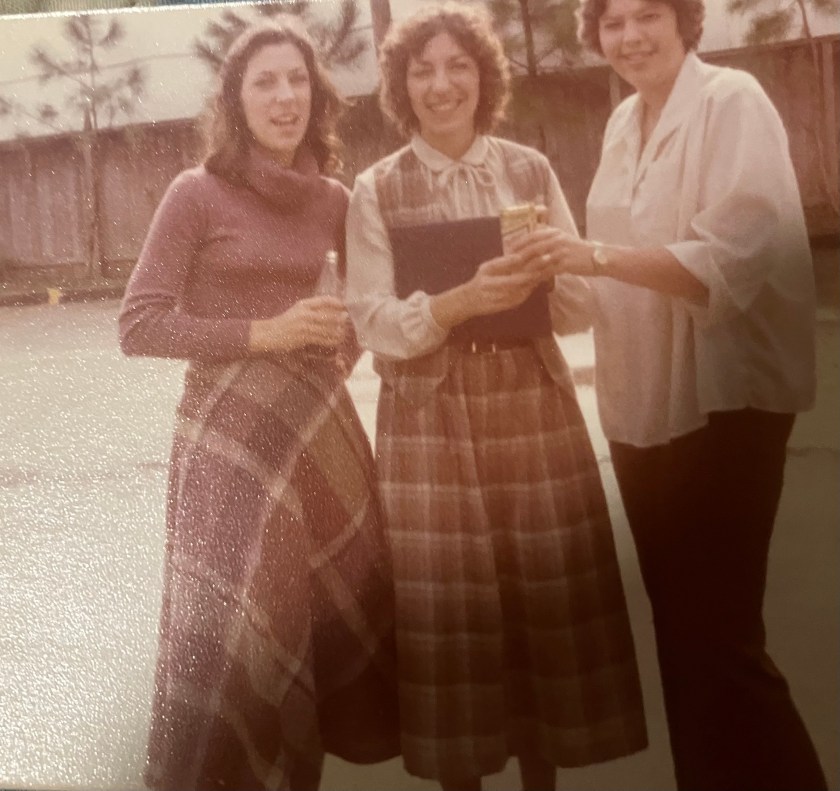
Gayle, me, & Jana
(I’m wearing my first day of teaching outfit).

After two seconds of surprise the class erupted into laughter that unified them against the enemy, the outsider, the one they viewed as a temporary teacher. To get out of the box gracefully, I would have needed a helping hand, but no seventh grader would put a teacher ahead of her reputation—not even Trina. As I spread my feet farther apart, I used my good right hand to grab the metal leg of my desk. My first attempt to pull my butt off of a pile of Houghton Mifflin’s Workbooks for the Fundamentals of Grammar and Writing failed to end my humiliation. I needed to push off with my feet and rock backwards a couple of times to get enough momentum to fall forward onto my knees. The laughter gained strength as if a seasoned comic had followed a dynamite joke with the gag that killed it. Staggering, I ripped out a few inches of my skirt’s hem with my right shoe. I took a long breath as I bent down to retrieve my papers and caught my department chair’s tired eyes looking through my door’s narrow window, probably dreading the search for my replacement so soon.

I mustered a close-lipped smile. “That’s enough,” I said and walked towards a girl laughing and slapping her desk with opened palms and I repeated, “Enough!” The girl stopped the slapping and most kids stopped laughing. I had never before wished I could evaporate into a mist and make everyone in the room forget the last several minutes. The laughter paused, and I felt twenty-seven pairs of eyes focused on me. I cleared my throat and looked at the tops of  their heads. I opened my mouth, but before I could speak, Chloe said, “Bet you ain’t too happy to be here now, Ms. Keller.” 

Despite the fact that she used my name and not the traditional “Hey, miss”; despite her using the adverb “too” correctly with the adjective “happy”; and despite my ability to keep from crying in front of those seventh graders, I could feel nothing but fear in my gut and shame in my soul. How could I ever be a teacher? Why had I not begged my mother to convince my dad to let me major in creative writing? When would be too soon to call in sick to work? What if I quit my job at Anderson and moved back in with my parents? 

I did not hate my students that day. I did not blame the principal, my department chair, or Chloe for my disastrous first day. I accepted that day’s failure and used my 22-year old optimism to get me through that spring semester.

I didn’t realize then that there would be thirty-seven years of teaching ahead of me— instructing junior high students, college freshmen, kindergarteners, and high school seniors. I would become as comfortable in front of a classroom of teens as a crawfish is in a flooded rice field. I would even miss teaching when I became a student teacher field supervisor after I retired from full time teaching. Before this first teaching job, I’d never believed teaching would be my profession. I fell into it like I fell into that box of workbooks.

Books I loved to teach
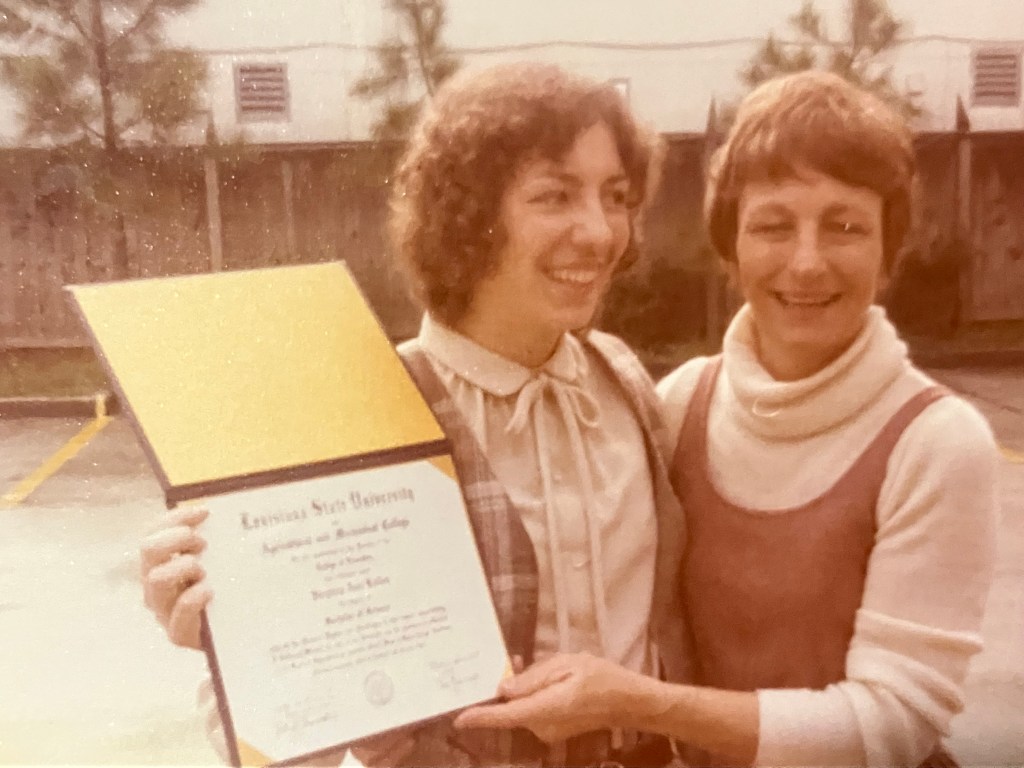
Me and Momma with my LSU diploma

Sometimes, if we’re lucky enough, we improve our talents and learn to like what we do. And maybe we land in a box built just for us. 

Posted in Confessions, Contemplations, Relationships

Mind Your Own Beeswax

            Have you ever had the misfortune of finding out something you wish you hadn’t? Sometimes the truth is more than I really want to know.  Being nosy or asking too many questions might seem fun at the beginning, but eventually, ‘oops, there it is!’ and I cannot unhear what I just heard.

            The simple, “How are you feeling?” turns into a graphic description of a lanced boil or a replay of what someone had for lunch that didn’t agree with them.  The innocent, “What did you do this weekend?” parlays into a three-part mini-series complete with Instagram reels and photos.

            When I continue to ask, prod, or coax someone to share information, I would do well to mind my own business 99 % of the time, especially when I am asking my adult children questions about their lives.  Navigating life with grown children is quite different than when they were eleven years old, and I had a right to know all about their comings and goings, friendships, what they ate, and how they were feeling.  Overstepping my boundaries was a given back then, but now it is a definite no-no if we want to stay on good terms.

            I used to think I was rather good at finding out things about our kids, but my husband, Boo, is an expert.  He is the master of ‘21’ questions.  He is the guru of gossip, and like Inspector Clouseau, he is a fact-finder to the nth degree. 

            Boo is generally a man of few words, but seat him next to a stranger on the airplane or give him a beer, and he becomes absolutely chatty and will pry into anyone’s life before they know it.  He is adept at asking questions in rapid fire.  Who, what, when, where, why, and how. He is not afraid to ask any question to anyone at any time.

            He is often frustrated by my lack of snooping into our daughters’ lives.

 “Well, did you ask her how much that was going to cost?” he says.

            “No.  It’s none of our business what they spend their money on,”  I answer.

            “Yes, it is.  I think she should save her money or invest it in some stocks. I have a list here of the best ones.”

            “Boo, mind your own beeswax,” I counter.

The expression, ‘mind your own beeswax,’ comes from the 18th century when the dreaded small pox left scars on people’s skin. To cover the pox marks, women would apply beeswax to their faces.  The story goes that if people got too close to a woman’s face or stared at her covered up spots, she would tell them to “mind your own beeswax.”  Another theory is from the practice of sealing letters with beeswax to prevent others from reading them.  Whichever theory you agree with, the end result is the same, don’t meddle.  Stay in your own lane.  Butt out. 

            Most of the time I try to fly under the radar.  I can sit quietly and entertain myself easily.  I don’t have the need to talk.  I can stay in my own hula hoop, but if there is one lonely elderly person in the grocery store, they will find me.  And, even without asking, I will find out everything they have been thinking and feeling for the last twenty-five years.  I will know their pets’ names; their personal medical diagnosis; vacation plans; their children’s names, where they live, and why they haven’t called in over a month. 

             I rarely initiate these conversations, but I must have that face that says, “Tell me everything.  I really care.”  People tell me why they got divorced; when they found Jesus; their favorite ice cream flavor and how they put on their false eyelashes.

            Once, at Buc-ee’s, I ran in to get a bottle of water while Boo waited at the gas pump.  Twenty-two minutes later I emerged.

            “What happened?” Boo asked.

“ I was paying for the water and noticed the cashier’s false eyelashes were the longest, thickest fake lashes I have ever seen.  I said, “WOW, I love your lashes!,” but I could see the girl thought I was making fun of her, so to make her feel better I said, “No, I really love your lashes.  I wish I could wear those.” 

            I don’t know why I said that.

She proceeded to tell me where she buys them, how much they cost, and step by step instructions on attaching them. Then she explained that her real eyelashes have nearly all been pulled out by the glue, and now she has to wear the false lashes all the time, so her boyfriend won’t know her real eyelashes are gone.

“Don’t get the cheap glue,” she advised. 

 By this time there was a line behind me, and I quickly said, “I’ve learned so much, thank you!  You’ve given me the courage to try it,” and she leaned over the counter and gave me the biggest hug.

 “Go big and dramatic,” she said, “You won’t be sorry.  And have a blessed day,” she added.

“You too,” I called.

            “Wow,” Boo said when I told him the story, “That’s a lot of information.”

            Oh sure, all this could have been avoided had I not said anything about the cashier’s eyelashes.  But don’t you agree that some situations just beg for a question or comment?  In the same way, we want to ask our grown children questions that we probably shouldn’t, even though we think we want to know the answer…we really don’t.  Maybe someday I’ll learn not to ask.  Maybe someday I’ll remember the secret to happiness is minding my own business.

Repeat after me:  The secret to happiness is minding my own business!

Posted in Confessions, Fears and Worries, Growing up

Crossing my Fingers as I Pray by Ginger Keller Gannaway

I like to make the sign of the cross with my middle finger atop the nail of my pointer finger. Just in case. You never know. Can’t hurt. My spirituality mixes Catholicism with superstitious tendencies.

Including kindergarten, I attended thirteen – knock on wood- years of Catholic school. After our First Communion, my classmates and I went to mass once a week and confession once a month. Our church was down a covered sidewalk next to the elementary school that was a football field length from the high school and its wooden gym which almost touched the convent where the nuns who taught us lived. Except for our eighth grade teacher Sister Mary Margaret Mary, who focused on English and math all day, everyday, the nuns squeezed in regular religion lessons, especially during Advent (before Christmas) and Lent (before Easter). We said “grace” before our cafeteria lunches where all of us had to clean our trays or the Sister on duty would send us back to finish our peas (or spinach or tuna casserole).

Catholicism was all I knew. My family said the rosary every time we drove farther than thirty miles from home. No meat-eating on Fridays and no breakfast before Sunday masses. My scores of cousins were Catholic, as were my Camp Fire Girls troop and my classmates. I still have a 2X4 inch prayer book with the Order of the Mass, the epistles, and the gospels. I remember wearing a lace chapel veil (or a Kleenex bobby-pinned to my head) and kneeling near the front of the church to follow the priest’s lead. I recited the Act of Contrition from memory while turning my book’s tiny gilded pages.


Devout as I was, I still sometimes lied during my monthly confessions. I strove for specificity over believability because I thought Father got bored hearing all the typical kid sins: “I disobeyed my parents” “fought with my brothers and sisters” or “lied to my teacher.” Wouldn’t he prefer, “I broke Momma’s no-animals-in-the-house-rule when I convinced my sisters to bring Red, our pony, into the kitchen. She seemed so hot! We just wanted to let her drink from the kitchen sink. We were rescuing Red from heat stroke!”  Isn’t there a blurry line between truth and almost the truth? Besides, Fr. Forgette always gave us the same penance after each confession: “Say five Hail Marys and go with God.”

I stayed mostly holy until I hit puberty. I smoked my first cigarette at a Catholic Girls Retreat in Grand Coteau when I was fourteen. Later cousin Gina and I stole Grandma’s cigarettes, and I sometimes skipped Sunday masses after my friend Janie started driving. In high school I adored a lovely, hip nun who played all of the Jesus Christ Superstar album during our ninth grade religion class. She made me consider the attraction of a religious life. Then the next year she left the convent to marry our parish’s young and handsome priest. My school friends and I had never heard a more romantic tale of true love, and life as a nun lost all of its appeal.

I thought I had true faith. I knelt by my bed most nights and prayed to the Blessed Virgin Mary. I may have been clueless about my town’s racial prejudices, but Mary seemed like the most accepting and understanding statue in our Catholic church.

To the left of the altar stood a life-sized calm, blue-robed Mary behind tiny candles in red glass cups and a cushioned kneeler next to a small metal receptacle for coins that paid for the candles worshippers lit. I believed my memorized words: “Our Lady, our Queen, and our Mother, in the name of Jesus and for the love of Jesus, take this cause in hand and grant it good success.”  I’d pray for help passing a test, to stop fighting with my sisters, for patience, for confidence, or for better hair. I had the faith of a naive thirteen-year-old who had not yet become a “cafeteria Catholic.” (Someone who picks and chooses which church rules to follow)

My junior year of high school tested my belief in the power of prayer and my faith in the Blessed Virgin Mary. At St. Ed’s the juniors helped plan the junior/senior prom. In the spring of 1973 the prom committee had narrowed down the entertainment choices to two Louisiana bands, one from our local parish or a Baton Rouge group called Cocodris (French for alligator). The latter featured two of my first cousins from Donaldsonville: George and his sister Boco! Closer to my age, Boco was my grooviest relative and the coolest person I had ever known. She first performed with The Fifth Autumn, her family band that toured Louisiana and beyond. Boco, her brothers George and Joe, her sister Sue, and a neighbor drummer had made up The Fifth Autumn. Once they even performed at my hometown’s only night club – the Purple Peacock.
 
Boco’s long straight brown hair, her honest connection with a song, and her smoky voice could hypnotize a room. George was (and still is) a talented guitarist and songwriter. If Cocodris could be our prom band, my quiet girl-who-never-dated wallflower persona might change to groovy-girl status.

I did not know how the prom leaders made their decisions, but I felt my tight connection with the Mother of God could pull some heavenly strings. In the church’s holy silence on weekday afternoons, I knelt in front of my favorite religious figure (after lighting a small candle) and prayed Hail Marys and original prayers that named my rock-and-roll cousins and promised that if they could wow the teens in our decorated gym with their musical talents, I’d hold off begging for anything until I turned eighteen. I had never prayed longer or harder for anything in my life. Here was a doable miracle! Mary could make this happen, and I had the hope and faith of someone who had yet to experience a major life tragedy.

George LaTour is in center, Boco LaTour is on the right

I don’t remember the day I heard the news that Cocodris would preform at our prom. I don’t remember how I asked Victor, the usher at the picture show I worked with who attended public school, to be my prom date. I’ve forgotten most of the songs they sang except “U.S.S.R.,” which George dedicated to me, my parents, and my sister Gayle (who was serving punch). However, I do remember Boco telling me at that year’s LaTour family reunion, “Ginger! You were floating off the gym floor when you walked in! Off the floor!” Dance details are forgotten, but I saved the obligatory prom pic and a 45 of Boco singing “Running the Mardi Gras.” Still, the joy of that night made me believe in the power of prayer. Mary had heard my words and granted my wish!

Does it matter that I cross my fingers when I pray? That one of my favorite lines in literature is from Truman Capote’s “A Christmas Memory”? It’s a story about a boy’s friendship with an elderly relative and their fruitcake-making Christmas tradition. The woman was so superstitious that when they were counting the money they had saved for cake ingredients and ended up with thirteen dollars, she said, “‘We can’t mess around with thirteen. The cakes will fall…Why I wouldn’t dream of getting out of bed on the thirteenth.’” So to be on the safe side, they subtracted a penny and tossed it out the window. I understood that level of superstition.

Nowadays I avoid getting out of bed at the thirteenth minute of any hour. I close my eyes for a kind of snooze button effect and say a few Hail Marys if the clock reads 6:13. During my thirty-four years of teaching in public schools, when I stayed after the last bell to prepare my room for the next day’s kids, I’d straightened my class sets of To Kill a Mockingbird on the book shelves; I’d rearrange desks and pick up stray notebooks; I’d stack the next day’s handouts on my desk and write tomorrow’s agenda on the blackboard. But I never included the following day’s date. No “tempting fate” by writing a date before it arrived.

Faith can be an unbelievable force, yet it’s no guarantee. Despite innumerable rosaries and novenas, people I loved still died from cancer or car accidents or bad decisions. I handle life’s uncertainties like a daydream I had as a teenager: I’m walking down a narrow, uneven trail through a dense wood where the sun flickers through the branches. The ground is covered in leaves, and up ahead is an unusual patch – a mixture of soft, mud-colored nettles and sand and shallow water. Quick sand or sink hole? Who knows? The path holds danger like gray hurricane clouds. But I make the sign of the cross and keep walking. I take measured steps though the cool squishiness as brown water covers my bare feet, and I keep going because at the end of the trail might be cousins Boco and George performing an acoustic arrangement of Irma Thomas’ “It’s Raining.” Life’s uncertainties may curdle my stomach, but believing in miracles keeps my head full of dragon flies instead of mosquitos

Posted in Confessions, Contemplations, Growing up

It Is What It Is

Fourth Grade

Fourth grade was not a flattering year for me.  I had just survived 3rd grade and having my teeth be bigger than my body when this happened.  I swear, no one bothered to tell me that those tight, plastic headbands were not complimentary to my face shape.  Sometimes my grandma and I would ride the bus downtown to Woolworth’s Five and Dime, and she would let me pick out something for twenty-five cents.  Perhaps that is why I had such a classic selection of headbands.

The Five and Dime Stores----ours was the Woolworth at NE shopping center… |  Childhood memories, Memories, The good old days

Grandma and I would walk up and down every aisle in Woolworths and after we made our purchases we would sit at the counter and eat lunch.  Grandma always got a tuna fish sandwich with the ‘best cup of coffee in the world.’  I would get a grilled cheese sandwich and a root beer.  Simple fare for simple folks.  After we ate, I would spin myself around and around seated on that bar stool at the lunch counter, while Grandma enjoyed her last sip of coffee.

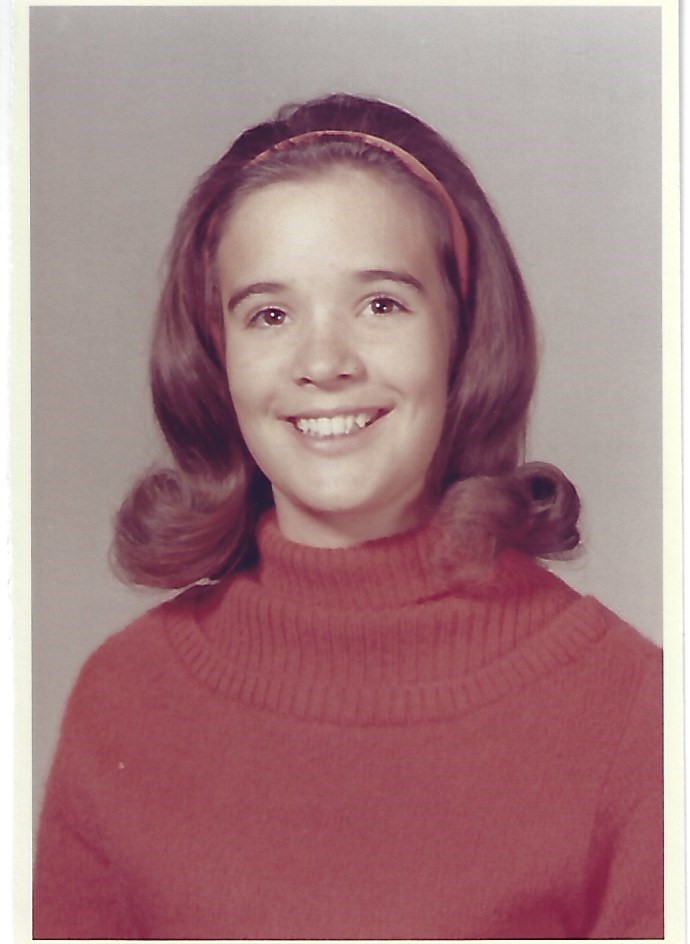
The red, button-up sweater from Sears that I loved was all kinds of wrong, yet I have the pictures as proof that I was determined to look my best. Glancing back, I clearly see my stylistic mistakes, but at the time I felt well put together.

Still, I had a delightful smile, don’t you think?  

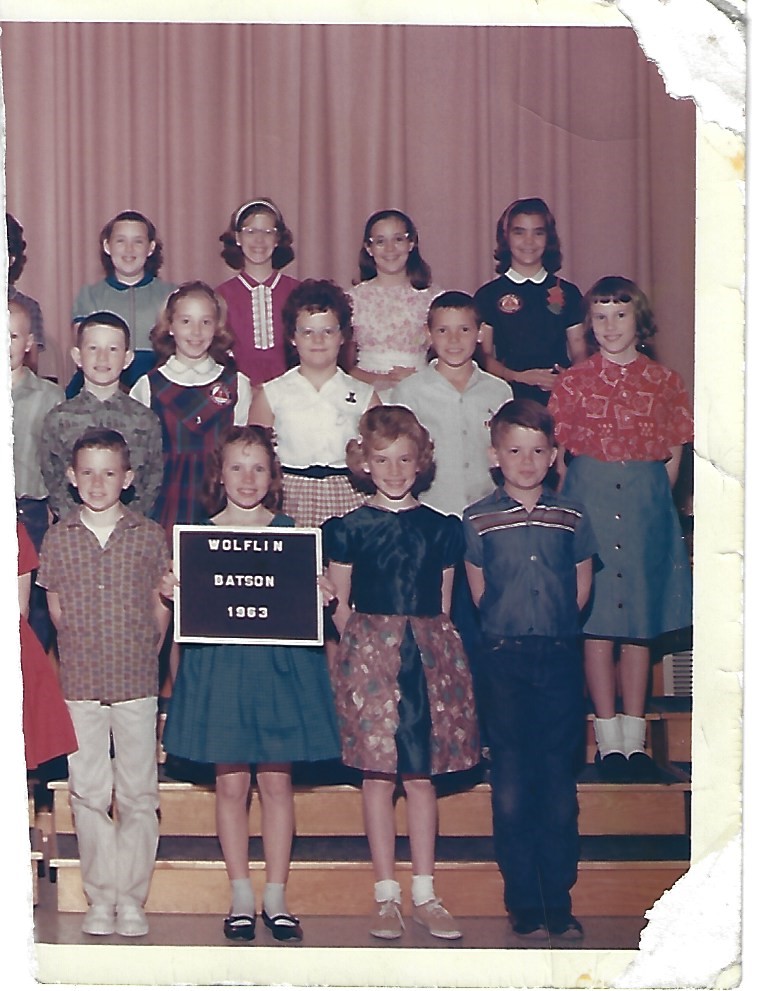
My 4th grade teacher was Mrs. Batson.   Mrs. Batson was no-nonsense all day every day.  She was a small but sturdy force, short in statue and long on obedience, and wore dark-colored, perfectly fitted suits with structured shoes.  She was tough and I was afraid of her, except that I kind of knew she liked me.  I was always the only one in my class who didn’t have a mother and because bad news travels fast, I must have been pegged as someone who needed a little more encouragement.

I knew this because even in her strictness, she would look at me and almost smile. Her eyes would tilt ever so slightly, and the corners of her frown would swing upward for only a second.  I always wondered if anyone else saw it, but I think it was just for me.  I mean, come on…. looking at this picture, Mrs. Batson was probably thinking, “Bless her heart!”

I learned during 4th grade that I had something called ‘buck teeth.’  And when I told my dad that Stanley Steinkruger called me that, he said, “Nancy Lynn, you just have an overbite.  And someday you will have braces that will help you have the most beautiful teeth in the world.  Don’t listen to the likes of Stanley Steinkruger.” 

Bless my heart.

This 4th grade photo was not to be my last ‘less than stellar’ school picture.  I had an overbite with a large space between the front two teeth, and a few more years of the plastic headbands. I even had another year of a red sweater in which I discovered turtlenecks are really not for me either. 

When I arrived at Wolflin Elementary School in Amarillo, Texas, for my first day of 5th grade, I found out I had Mrs. Batson for my teacher again.  How could this be true?  But it was.  Mrs. Batson moved up to teach 5th grade and I was in her class.  5th grade turned out to be a doozy of a grade for me.  Somewhere between the first day of school and Thanksgiving, I woke up one day needing a B-cup bra and I was 5’5” tall.  I tried all year to practice the art of slumping down, so as not to look so much taller than the boys.

Top row, second from right

One more sad little piece of information was that as a baby I had had ankles that turned in toward themselves and because of that, I wore orthopedic shoes, even into the 5th grade,  like these black velveteen saddle oxfords.

Those shoes were heavy on my feet and so sturdy/clunky that as much as I tried to scuff or wear them out, they wouldn’t.  Nothing could penetrate those toes of steal.

 Just when I thought it could never get worse, the 5th grade girls had to see “the film” and as my luck would have it, this was also my year to become a ‘woman.’

Culminating my 5th grade school year, I was a full 5’6” tall.  I also found out I needed glasses. My dad let me pick out my glasses which were brown sparkly glitter, cat-eye frames.  I adored them and took special care to keep them in their case when they weren’t on my face.

 Next, came the years with braces and tight-lipped smiles to hide them.  It is what it is, y’all, and I have the pictures to prove it!  The day we got out for Christmas break my 6th grade year, Stanley Steinkruger was deep in his throws of flirting with me.  But bless his heart, he teased me by grabbing my glasses and using them to play catch with another boy.  You can guess the end of the story.  Broken glasses and hurt feelings. My father admonished my carelessness, and I was never friends with Stanley Steinkruger again.  The good news was I finally got a pair of slip-on flats and was allowed to give up my orthopedic saddle oxfords.

My later elementary grade years left me with a few scars, as much of growing up usually does.  Often, the ‘awkward’ years last longer than one would wish, and in the throes of adolescence, we do not see our own light.  We let other people tell us who we are and hush the swan’s song inside of our ugly duckling.

But Hans Christian Andersen knew what was true for all of us when he wrote:

It is only with the heart that one can see clearly, for the most

essential things are invisible to the eye.

The Ugly Duckling

Ugly Duckling
Posted in Confessions, Contemplations

Kitchen Window by Ginger Keller Gannaway

My favorite Hitchcock movie is Rear Window, a perfect mix of mystery, romance, social commentary, and humor.  (And that’s not even including Grace Kelly’s beauty and costumes!)  Jimmy Stewart spies on his neighbors from his NYC apartment during a summer when he’s stuck in a wheelchair with an up-to-his-hip plaster cast. As a photojournalist he has fancy zoom lenses to complement the basic snooping tool – binoculars. Jimmy and his diverse neighbors’ rear apartment windows all open up to a courtyard where residents plant gardens, make sculptures, do exercises, and entertain guests. Jimmy spends so much time observing his neighbors, he learns their occupations, their personalities, and their secrets. 

I can relate to the thrill of spying on others.  When as a kid I rode in the back seat of our car as Dad drove down two-lane country roads, I loved looking into the windows of strangers’ homes. Early evening lighting made for the best views and entertaining speculations. Was the blue glow from a TV soothing a lonely widow or an exhausted parent? Did dim yellow light mean a candlelit dinner for two? What about glaring white lights that flooded several rooms? Could it mean a birthday celebration or a kid home alone and afraid of the dark? Every window held different story possibilities.

Now we live in a condo, and our second floor kitchen window has a front row view of the courtyard and pool, a laundry room, and the mailbox area. I watch my neighbors go to and from work, walk their dogs, lounge at the pool, or chat near the mailboxes. I have, like Jimmy Stewart, given them nicknames as I guess about their private lives. There’s “T-Squared,” a young guy who spends hours tanning and texting at the pool in hopes of winning the George Hamilton Lookalike Award. There’s “BB,” an older well-endowed, talkative busybody who goes braless and knows all the condo scoop, and “Solo,” a longtime resident who lurks poolside with his ever-present red plastic cup. And “Cookie Monster’s Owner” whose dog snarls at pets and people alike. (BB told me Cookie Monster once bit the guy who lives right below me). There’s soft-spoken “Poodle Man”, a smiling, kind guy with a well-groomed dog. “ER” has the apartment across the courtyard from me. He uses a walker, doesn’t respond to health workers knocking on his door, and gets wheeled out on ambulance stretchers twice a month. 

Although I’ve never suspected anyone in our complex of killing his/her spouse (as in Rear Window), a guy did die during the pandemic lockdown. His death went undiscovered for days! Also, the day we first moved into our unit, an angry couple screamed at one another from the sidewalk outside our condo fence until a resident  called the cops. As I lugged boxes of photo albums and kitchenware up my stairs, I heard a female from the sidewalk yell, “Hide behind your damn gate, assholes!” I had a small pang of worry that day; however, our apartments apparently hide only tiny dramas.

I like to wash dishes and survey the area outside my window. I notice when a resident has her grandkids visit and they take over the pool area. I take note of who swims laps on a regular basis, who reads in the loungers, who barbecues. I remember when Solo put tiny strips of paper on all of our door clips inviting us to his poolside birthday celebration one Sunday afternoon. It was a BYOB affair with chips and dip provided. Several of us showed up while Solo held court and someone in the pool blasted oldies from phone speakers. For a little while those of us there acted like neighbors who knew and cared about each other, yet most days we do little more than wave howdy. 

Sometimes I create back stories for those I see from my window. Did Solo once have an affair with BB but broke up with her after she told her next-door neighbor about his collection of bizarre Troll dolls? Is T-Squared texting conspiracy theories to Alex Jones’ Infowars? Will Poodle Man plot to poison Cookie Monster?

Just silly scenarios that stem from too many Netflix nights. Too many thrillers and true-crime dramas. As we start venturing out beyond our homes and apartments, will we get to know our neighbors better, or will we maintain our safe, private ways? Is it not easier and less messy to view others from a distance, choosing mystery over fact, imagination over reality?

My kitchen window

Posted in Confessions, Dreams, Gratitude

Funny Girl Fanatic by Ginger Keller Gannaway

“I’d Rather Be Blue” song

I grew up a faithful patron of the Liberty Theater and the Queen Cinema in Eunice, Louisiana where I saw almost every movie shown from 1960 through 1972 (beginning of ratings system).  But I did not become an obsessive film fan until I saw Funny Girl in 1968.

Barbra Streisand’s unique voice and dramatic delivery made me want to stay for the 8:30 feature that followed the 6:00 p.m. one I’d just seen. At first “The Greatest Star” and “Don’t Rain on my Parade” were my favorite songs. My sisters and I pantomimed these tunes at home while Momma’s hi-fi in the den blasted through the ceiling speakers in the living room. After fourteen viewings, “My Man” (the one song filmed before a live audience) became my favorite. Barbra’s cool short haircut that framed her anguished face and her long drop pearl earrings were spotlit. All but her fabulous face, sleek hands and long fingernails seemed to disappear into the blackness of the stage. She began the torch song fighting back tears with a halting delivery. But her strength grew as her voice got steadier and louder until she threw out both arms and belted the last line with a power that made me hold my breath while my thirteen-year-old heart ached for reasons it could not yet comprehend.

The movie earned eight Oscar nominations and Barbra got the film’s one Best Actress win for her portrayal of the incredible Fanny Brice. Her self-deprecating humor and durable-as-rubber-tubing ambition spoke to my wallflower teen angst, and her rise to stardom despite her nontraditional beauty gave me hope. 

I was an extra shy girl with a limping left leg and a skinny, spastic left arm. I hid my mild cerebral palsy from most folks until a situation required the use of two healthy limbs. In my mind, I clapped with a hand and a claw. If I had to hold two paper cups at the same time, I’d touch the sides together in hopes my steady right hand could keep my shaky left from spilling the cups’ contents. Yet even if luck shone on me and very little water splashed over the rim, my CP hand could involuntarily squeeze the stupid flimsy cup and dump half its contents onto the floor.

Watching Funny Girl gave me hope of reaching my life goal of being the first big movie star to emerge from Eunice, Louisiana or become Barbra Streisand’s new best friend – two equally worthy aspirations.

So I spent nights at Grandma’s house where I could walk to the Queen Cinema three blocks away, and no adult needed to drop me off or pick me up. In the dark theater with my long-lasting Toostsie Roll, I could watch Barbra sing and roller skate her way to fame and later have Omar Sharif kiss her neck while he seduced her with dinner and song.

My naive self believed that I (like my movie idol) could conquer all challenges. My small Cajun existence could tell me I was weak and awkward and invisible to the boys I had crushes on. But in my mind I’d be wearing a red and black sailor top with black bloomers and stockings, and I’d have two long graceful arms of the same length extended while I threw my head back and twirled on an empty stage and sang, “Have you guessed yet/ Who’s the best yet/ If you ain’t I’ll tell you one more time/ you bet your last dime./ I am the greatest, the greatest star!”

“The Greatest Star”

The Liberty and Queen were like my second home, and Funny Girl made that home a portal of possibilities. Barbra inspired me to be braver. Maybe I had a crooked left side and I wore uncool corrective shoes. Maybe my hair frizzed out and my pimples surprised me on the most inconvenient days. My parents misunderstood me, my sisters ganged up against me, and the boys at school made me wish I could crawfish my way into a mud home whenever they were near. But Barbra had not listened to critics or let rejection stop her from conquering Broadway and Hollywood in her early twenties. She faced off with anyone who tried to rain on her parade. Her talent astounded me, but more importantly her confidence and tenacity made the teenage me feel less like a loser. Barbra Streisand’s movies and albums made me believe I was one of those “luckiest people in the world.”

Posted in Boo, Confessions

There’s Nothing Wrong With That

            “Try these,” my husband said.  “Try on the Brooks or Saucony shoes; they’re really good brands.”

            “I  like ASICS,” I said.  “They feel great on my feet, and I don’t have to think about trying on something else.  They always fit.”

“Try something new, for Pete’s sake!  It’s good for you,”  Boo preached.

“Mother, you always get Cajun Shrimp on your toes, every time we get pedicures.  There are hundreds of other colors, and you pick the same one,” my daughters chide me.

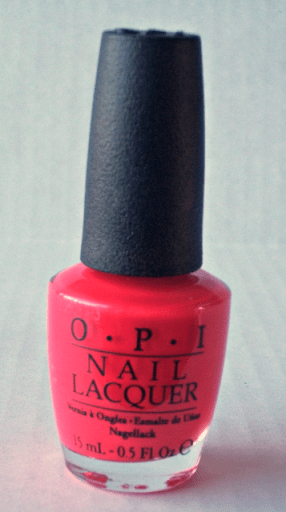
            “I like Cajun Shrimp,” I said.  “There are too many choices and besides I know I already like it.  It’s my signature color!”

            When I go to the grocery store, I try to park in the same aisle, in approximately the same place so I’ll always remember where my car is.  I’m a creature of habit and maybe a little OCD, but there’s nothing wrong with that.  I don’t want to be that person searching the parking lot, looking for my black Honda Accord among all the others.

            Once, on a trip home from seeing the grandkids, we stopped at Buc-ee’s for a snack and some gasoline.  We’ve stopped there many times before, so I utilized the pristine restroom and then perused the many aisles of snacks, chips, nuts, candy, sandwiches, and jerky.  Boo waltzed by and called, “I’ll meet you at the car.”

            When I finally paid, walked out to the car, and plopped down in the front seat, I heard him say, “Ah ha!  I knew it!  I knew you would get Chex Mix.”

            I felt a little sheepish, but before I could defend myself, Boo started in, “Every time we stop for a snack, it doesn’t matter where we are, you take forever to look around and then you buy a water and Chex Mix.  I don’t understand you.  Why don’t you just go straight to the Chex Mix?”

            “I might miss something good if I don’t look around.”  

            “If you ask me, you did miss something good, EVERYTHING except Chex Mix.”

            “I didn’t ask you,” I lamely injected.  “But not that it’s any of your business, I did shake it up this time.  I got the Bold flavor.”

            “Oh Boo,” he said with a tsk tsk.

            “Oh, Boo yourself,” I snapped.

            I admit only to you and myself that I am set in my ways.  Life is full of so many decisions, do I really need to add more?  I like what I like.  Does that make me mistaken or worse, boring?  Maybe, but there’s nothing wrong with that.

           In my mind, I am spontaneous and adventurous.  I try new things and live on the edge, but the truth is I appear to be stuck in my ways. Don’t get Boo started on asking me where I want to eat out.  For some reason, I always say I don’t care, but if he mentions a place, I usually don’t like it.  Ugh.    I have my favorites for just every day, and I am pretty set on what I eat at certain places.  Chick-fil-A: Market Salad. Panera: Chicken noodle soup or Strawberry Poppyseed salad. and Luby’s: Roasted chicken or fried fish, broccoli, and cornbread.  Just saying this makes me cringe.

Am I just an old, retired schoolteacher too addled to try something new?  Have I become boring and comfortable like melba toast and an old brown sweater?  I prefer to think of it as ‘Don’t fix what ain’t broke,’ but seeing the truth about myself is a hard pill to swallow.

            Not too long ago, we went out to eat at Cheddar’s after church. “What looks good to you, babe?”  I asked. 

 “Oh, I don’t know what I’m hungry for.  What about you?” he asked.

            “You tell me first,” I said.

            “Nope, I want to see if you try something new.”

            “Oh, don’t worry about me, I will!”  I defied him.

I scoured the menu pretending to think about what I might want, but I already knew what I would get.  I ordered a predictable standby: Miso salmon, broccoli, and green beans, while Boo ordered something new.   He made his choice from a separate menu insert labeled “Three NEW Shrimp Feasts.”  And they used words like ‘Ultimate’ and ‘New twist on old favorites.’  His choice was a delicious looking shrimp pasta dish that was absolutely beautiful.
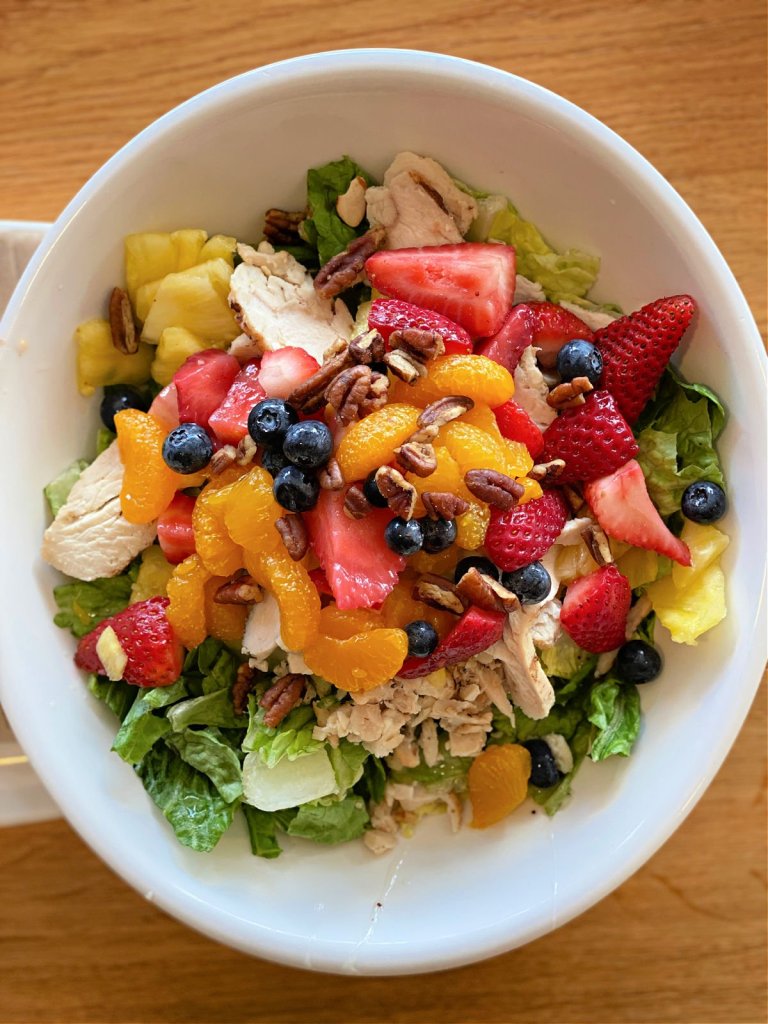
When our lunch came, I was already jealous.  

He looked at my salmon and broccoli and I drooled over his shrimp dish.  

“Can I have a bite?”  I asked.  “I can’t help it.”  

“Oh, Boo,” he tsked.
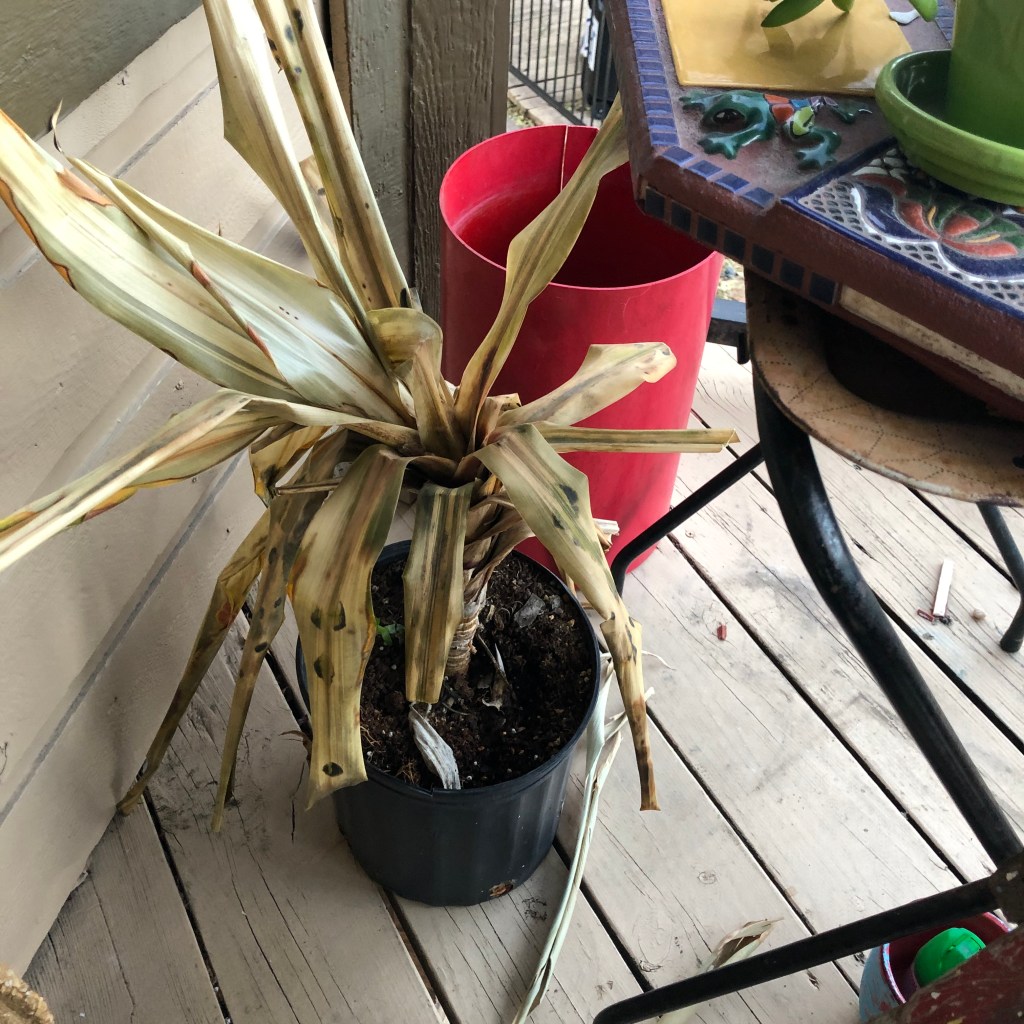
As of late I have really been trying to shake things up.  I now wear Brooks tennis shoes exclusively and even admitted to Boo that he was right.  I do like them better than ASICS.  I branched out at Panera and got one of their new ‘bowl’ lunches with chicken and quinoa. I’m also thinking about getting something different at Buc-ee’s next time we stop, and I painted my toe nails a Caribbean Blue, even though I felt conspicuous.

 Change is very hard for some of us and although I like the idea of being ‘out there’ to some extent, I am mostly a brown sweater with melba toast kind of girl.  I don’t mind being predictable and safe.  It’s just who I am.  And there’s nothing wrong with that.

Posted in Confessions, Friendship, Nature

I Kill Plants

I Kill Plants
by Ginger Keller Gannaway

Bless me, Mother Nature, for I have sinned.

I kill plants.

No matter the species, I can strangle any root system or poison any shoot system in the modern botanical nomenclature.

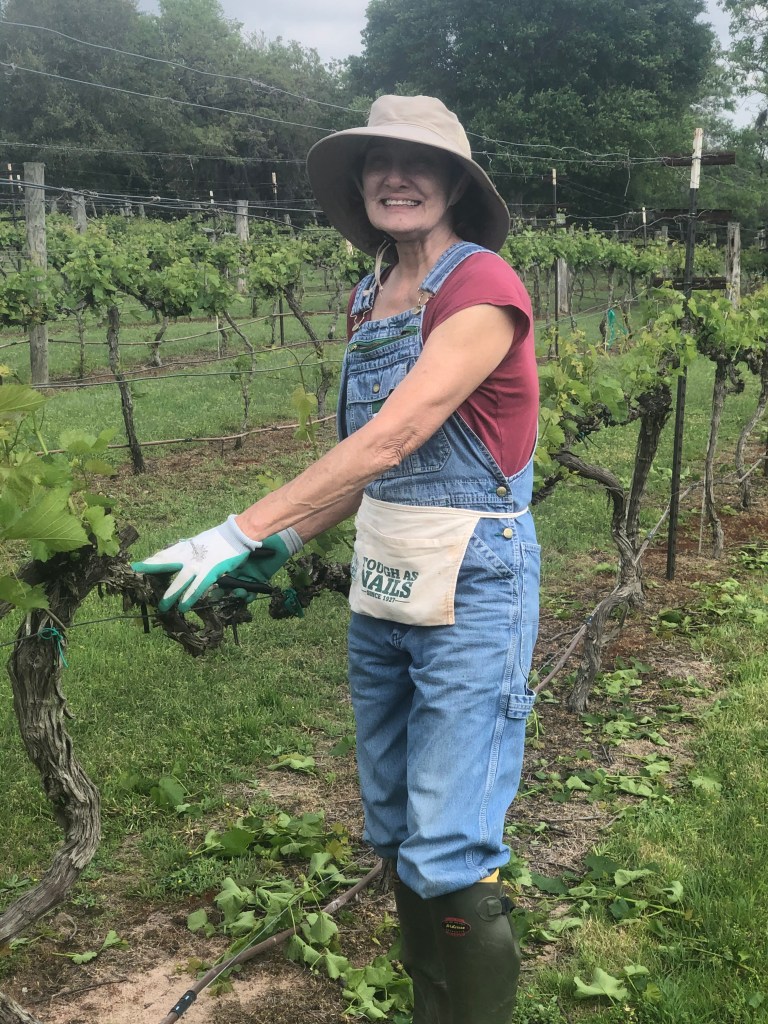
I do enjoy plants, especially herbs like mint and basil and flowers such as magnolias and azaleas. I have tried for decades to keep small cacti and large-leafed friends alive, yet like a demented serial killer I can destroy what I admire.

Relatives and friends have tried over the years to break the curse of my plant murders. Just last year Cousin Claudia, who can work magic in any yard with her easy-going optimism, gave me a “condo warming” gift: an air plant. “You can’t kill it,” she said as she set it atop my great-grandma’s pie safe where it gasped its final breath thirteen days later.

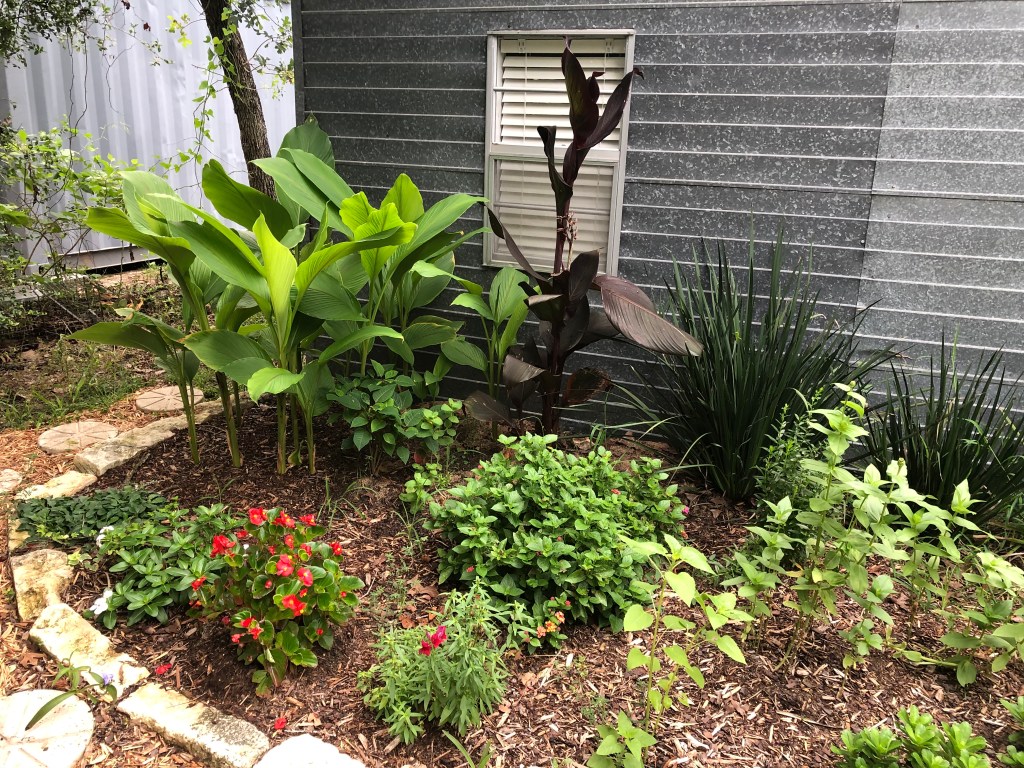
Master Gardener Cynthia

I have a knack for overwatering or under-watering green things. In 2018 when we planned to sell our house, I needed indoor and outdoor plants to help give our place a welcoming vibe, so my Master Gardener friend Cynthia showed up to help. She is a modern day Artemis who is in tune with nature’s trees and flowers as well as the woodland creatures. She chose hearty plants from Home Depot for us and wrote detailed directions for their care before she left me alone with the blooming babies. Cynthia also got me a teen-aged ficus for staging the place for prospective buyers. She decluttered our home and had chrysanthemum “pops of color” for the front yard. My place was as neat and clean as a young private awaiting her first morning inspection from a hard-nosed drill sergeant.

Thankfully, our house sold in less than a week, and Cynthia swooped in to rescue the nervous yet brave plants from my clutches because she’s known me for many years and has witnessed my starving, drowning, or burning of healthy plants. Even if she believes the deaths were caused by neglect and not premeditated crimes, I wonder if she’d let me off with involuntary manslaughter if she were a juror at my trial for killing more plants than a low-grade natural disaster. Against her better judgement, Cynthia entrusted me with the ficus after she ran out of room in her Nissan Cube when she packed up the staging plants to offer them a safer home .  

Cynthia’s Own Garden

That spunky ficus managed to stay alive for eighteen months. When this year’s February snow surprised Texas, I brought the plant inside, hoping it had more life to live. Yet in days its leaves developed black spots as it shriveled in the corner of our guest bedroom/office and bid adieu to the cold, cruel world. I soon discovered I had horribly over-watered it when after the snow had melted, I hauled it outside and heard water sloshing around in the heavy planter it was set inside.

I used to feel guilty about dismembering, suffocating, maiming, and torturing innocent plants that came under my care. So many people love digging in the dirt, planting seeds, and tending their flowers and vegetables so that they later enjoy the beauty and bounty of their gardens. 

In 1970 my favorite movie was Barbra Streisand’s On a Clear Day You Can See Forever. Her Daisy Gamble character coaxed flowers from the soil by singing to them. The movie’s opening begins with “Hey, buds below! Up is where to grow!” as Barbra sings, skips, and swirls around an expansive rose garden while hundreds of flowers bloom with the help of the camera’s time-lapse magic. I loved that song (“Hurry, It’s Lovely Up Here”) almost as much as I loved the  66 groovy outfits that costume designer Cecil Beacon had Barbra changing into during the movie. Her flowered babydoll p.j.s matched her flowered sheets which matched the flowered wallpaper of her bedroom!

“Hurry, It’s Lovely Up Here” from On a Clear Day You Can See Forever

I digress.

Drowning or starving plants is not the worst confession I could make. It’s not like I throw every curse word I have ever heard at my cat when she meows incessantly at three a.m. for food. Or I fear newborn babies because they look like fragile, unpredictable aliens. I’m not a monster!

Crystal and her Orange Tree

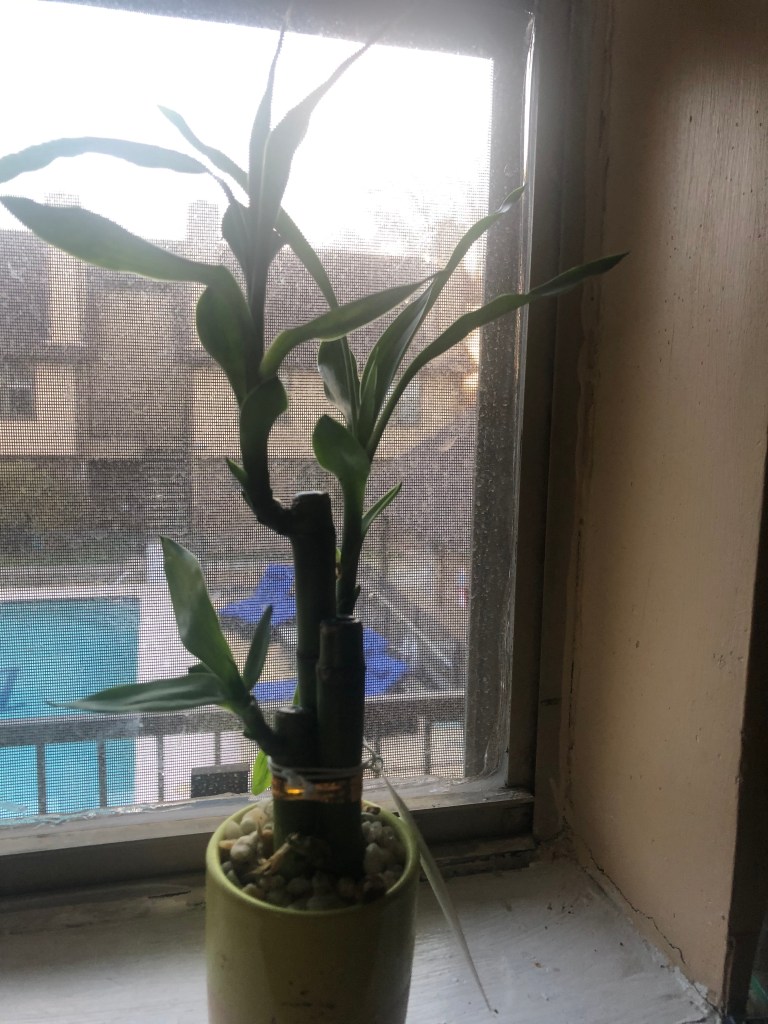
And to be honest, I have not killed every plant I have ever owned. I still have a weak ivy Cynthia left behind when she staged my house. A perky good luck bamboo from Crystal lives on my kitchen window sill. Crystal follows the law of averages rule when it comes to plants. She once told me, “I plant so many plants, trees, and vegetables, something is bound to survive!” 

Crystal’s Law of Averages Yard (and Ripley)

So my murder rate is close to 87% if I consider all the plants I have ever known. 

Does a lawn count? The front yard of the home we sold had more St. Augustine grass than bald, brown patches two years ago. Also, the backyard had winter rye grass whose soft green blades stayed alive long enough for us to close the deal on the house. However, my son Evan was responsible for readying the backyard and planting those grass seeds. He even called to remind me to water the yard regularly until the tiny green shoots poked out of the dirt as if Barbra Streisand’s voice beckoned them to a world of promise.