I think I’m a good person. I play fair, clean up after myself, wash my hands before I eat, and I don’t take things that aren’t mine. I think I turned out okay even though I never got to go to kindergarten.
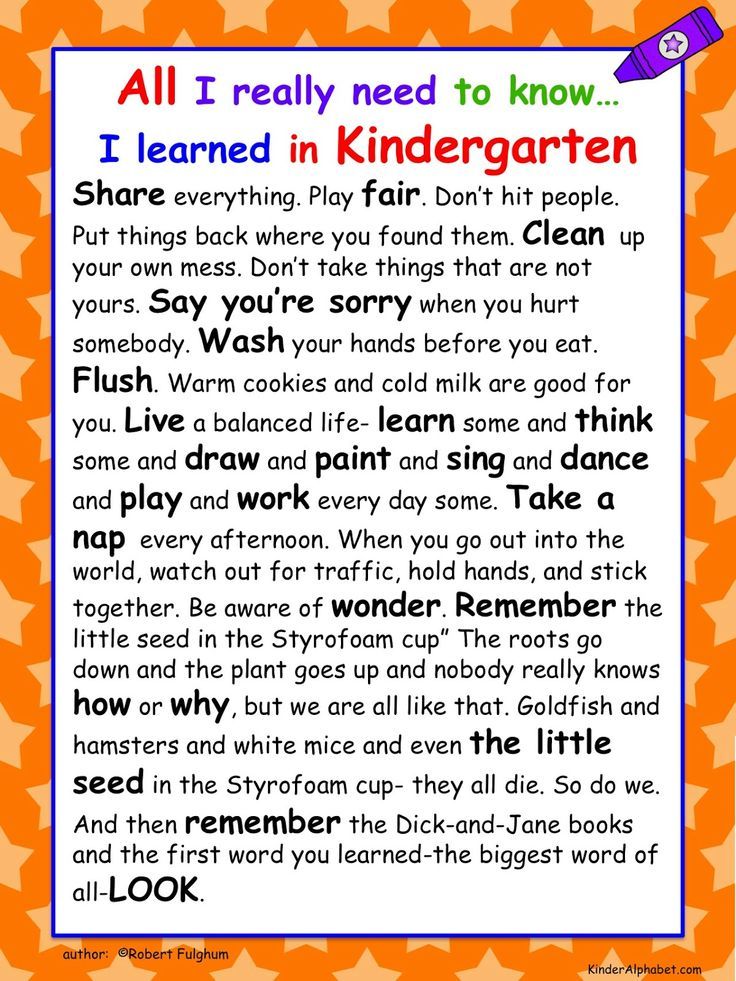
Robert Fulghum wrote a little book entitled, “All I Really Need to Know I Learned in Kindergarten.” He advises that we all learn lessons about life in kindergarten. My lessons might have come a little later, but their importance is still the same.
When I was four years old, my mother died from a brain tumor. My father, brother and I were left in the sad and lonely predicament of trying to live our lives without her. During the long summer following her death, I turned five, and my dad made the decision to keep me home and not send me to kindergarten when the fall came. Later in life, when I asked him about this resolution to keep me home, he said, “I thought it would be too much change for you, after losing your mama.”
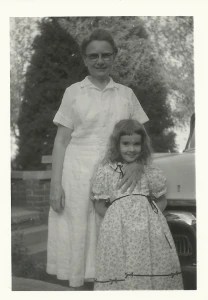
Fishie and I
And change it was. That summer he employed a live-in-housekeeper, Mrs. Fish, and when September rolled around, my brother went off to 4th grade while Fishie (as I called her) and I stayed home.
I remember very little about that year at home except our black and white tv and Captain Kangaroo. Captain Kangaroo would read me a story every day. He had puppet friends like Mr. Bunny Rabbit, Mr. Moose, and Miss Frog. Even though I was not alone, I felt lonely because our neighborhood friends were all at school and I was left behind. So, I colored page after page in my coloring books, played outside on my red swing set, and had my hour with Captain Kangaroo and his sidekick, Mr. Green Jeans.
Captain Kangaroo and Mr. Green Jeans
Time did pass, as it always does, and when the next September came, I went to first grade. I was as shy and awkward as a new fawn, yet when I met my teacher, Miss Ruth Hooper, I knew I would be safe. She was a handsome woman, standing six feet tall in her functional black flats. A ‘spinster,’ as my dad would say, and more than capable of corralling a feisty group of six-year-olds. In fact, Miss Ruth Hooper ruled with an iron hand and a soft heart.
Miss Hooper understood my gangly ways. Having been a tall girl herself, she could feel my angst at being the tallest child in the class. She knew what I was going through with my abnormally long arms and legs. She was able to nurture that motherless part of me that needed extra care, while attempting to never show favoritism. And even though Miss Ruth Hooper never married or had a child of her own, she was just what I needed when I needed it the most.
At seventy-two years old, I can now look back and confidently say that I turned out okay for never going to kindergarten. Somehow, I caught up with my colors, and numbers and memorizing the months of the year, but occasionally I like to use it as a crutch. At family gatherings if I am slow to catch on to a joke, or have trouble finding 18% of a number or even when I just plain need an excuse… “well, after all, I didn’t get to go to kindergarten,” and everyone will just nod and accept that as the reason I am the way I am.
I find it no coincidence that during my professional career in education, I was lucky enough to teach kindergarten for seven years. In spite of the fact that I never got to go myself, I enjoyed every part of teaching that formative year. I relished the songs, found wonder in a growing lima bean seed and learned right along with the children about community helpers, insects, and farms. I have taught hundreds of children the alphabet and seen their faces light up when sounding out a word. I have held many a tiny hand in mine as we attempted to walk in a straight line in the hallway. I have more than made up for that one year I spent at home with Fishie and Captain Kangaroo. Lucky me, in so many ways.
“Warm cookies and cold milk are good for you. Live a balanced life. Learn some and think some and draw and paint and sing and dance and play and work every day some. And when you go out into the world, watch out for traffic, hold hands, and stick together.” Amen.
For one long-fast year of my life, I taught kindergarten in Chapel Hill, North Carolina.
Estes Hills Elementary School was nestled in a mixture of pine and oak trees and was an older school with character, and lots of other characters who worked there. Each of the classrooms had a back door that opened into a lush courtyard and a front door that lead to a winding sidewalk that circled the school.
The year was 1991 and was one of the most interesting, AKA hard, years of my adult life. 1991 involved a marriage, a move to North Carolina from Texas, a job change and a pending divorce. 1991 was dashed dreams, sour grapes, and a river of tears all rolled into one. Twelve months of shock and awe. 365 days of “What the hell?”, yet there was a calm, deliberate sweetness that awaited me every morning when I greeted my 25 little charges. Estes Hills and the 25 Honeybees (our class nickname) gave me purpose and life.
Estes Hils was a neighborhood school that was also near The University of North Carolina. Many professors’ children attended our school and for that reason, most of the teaching staff was a mature, seasoned group, able to provide the level of learning our clientele demanded. Each teacher was assigned a teacher assistant to help facilitate classroom learning and discipline.
I was one of several kindergarten teachers that year, and we were each assigned 25 students. While you may not think 25 students is a lot, 25 five-year-olds is.
My students were eclectic, coming from varied backgrounds and nationalities. One such student, a handsome little boy named Xolani, came from Africa and had a click language dialect. While he spoke perfect English, his P sounds had a click, which made his language both fascinating to listen to, and hard to understand.
My teacher assistant, Violet, had her master’s degree in art. Every day she planned an art project for our students and during that hour, she took over and I assisted. She was talented, creative, and best of all, patient with a great sense of humor.
Being new to this school that was so steeped in tradition and culture was like being drop kicked through the goalpost of life into another era. It didn’t help that I was from Texas. The North Carolinian women were Berkenstock wearing, clean faced southerners who sounded like they used a question mark at the end of every sentence, with slow paced, elongated v o w e l s. And even though I had the usual slow, Texas drawl, they proceeded to make fun of my y’all’s and fixin to’s, like I was the one with an accent.
It didn’t help that in 1991 I was still sporting big hair, red lipstick and against the wholesome scrubbed look of the other teachers, I looked, well… a little on the trashy side. A little too made up for their taste.
“You Texans,” and they would just shake their heads.
“You Texans think everything is bigger in Texas.”
Quite frankly, my self-esteem was already in the toilet because of my horrible, no good, very bad year. But it was hard to make friends, and by the third day of school, I was feeling like the Lone Texas Ranger and would probably be eating lunch by myself for the rest of my life.
But on the fourth day, my back door swung open and the teacher from two doors down popped his head in.
“Hey, Miss Texas, want to join us for lunch?” Bryon asked.
And a friendship was made.
Bryon and Chris were the two gay teachers from two doors down. They were charming, hysterically funny and comforted my shaky soul like a bowl of chicken and dumplings. We ate lunch together, chatted at recess and they even invited me to some of their fabulous weekend parties. At a time when I felt very little mercy from life, they gifted me friendship and laughter. And when the end of school came, and the end of my marriage, Bryon and Chris helped me load my U-Haul trailer for the long drive back to Texas.
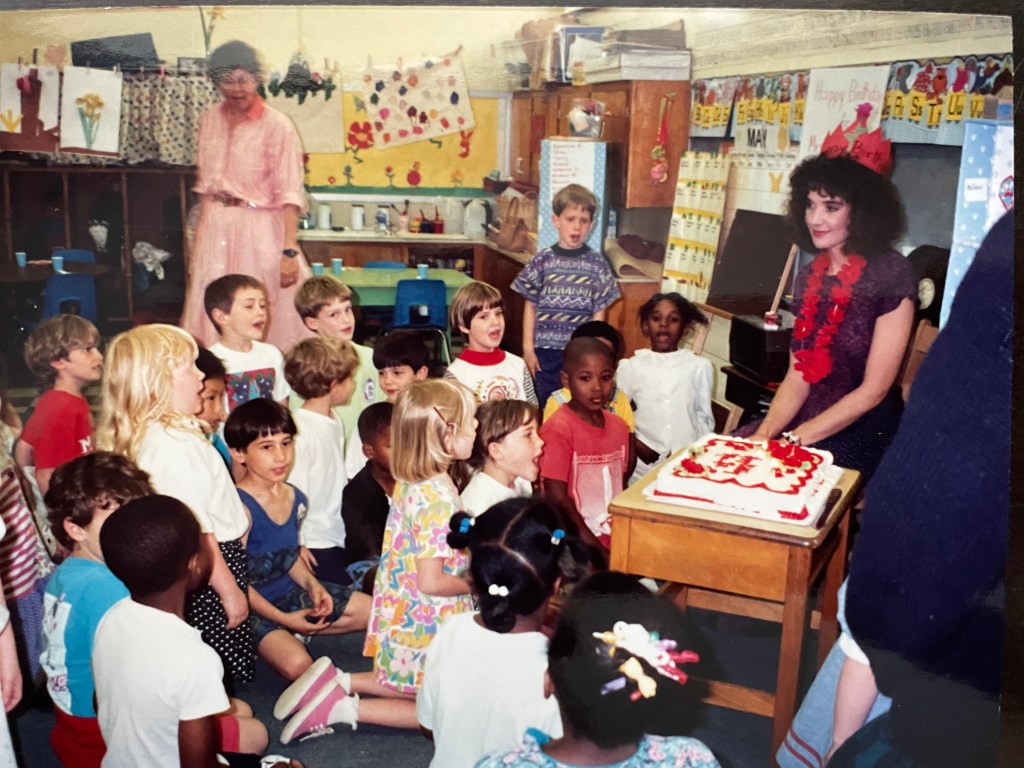
My 25 Honeybees were sweet with not a stinger among them. The parents and students even surprised me with a cake and gifts on my thirty-ninth birthday, and as their joyful voices sang happy birthday, I held back tears from the sheer preciousness of that moment.
One particular day I was leading a lesson about North Carolina as a state, and we were coloring pictures of the flag.
One student raised his hand and asked, “Teacher?”
“Yes, Samuel,” I said.
“Are you a Democrat or a Puerto Rican?”
“You mean Republican?” I asked.
“No,” and he shook his head, “I’m pretty sure its Puerto Rican.”
“Well, which one are you?” I asked.
“Oh, I’m black,” he said
“Cool.” I answered. And I gave him a big hug.
The hug seemed to suffice him as an answer, and we finished coloring in silence.
My long-fast year in North Carolina was a blessing in so many ways. I found out that some people aren’t who they say they are, and that actions really do speak louder than words. I learned it’s ok to be from Texas and proud of it. I marveled at the resilience of the human spirit and the inherit kindness that restored my faith in man. And with great fondness, I remember 25 little Honeybees who needed me as much as I needed them.
It was April, nearing the end of school, and the air hung low while the tensions ran high. The humidity outside made sweat bead up on my top lip and my clothes feel like I was wearing a wet diaper. And while I tried to start each day fresh and dressed to the 9’s, I ended these muggy days as barely a 3.8.
Lunchtime is always hectic at a large urban high school, and on this day at Crockett High School, as an Assistant Principal, I was outside patrolling the back of the school. Only seniors were allowed to leave for lunch, but of course we knew that was a rule followed by few. Complaints had come in from teachers hearing cars spinning out from that back parking area by the tennis courts, along with loud music and the occasional waft of smoke; cigarettes and other smokables.
Crockett high school is a beautiful campus and backs up to Garrison Park, a neighborhood park with baseball fields and a swimming pool. Unfortunately, some students liked to take long lunches or skip classes and hang out in the park where nothing, but no-good shenanigans would take place.
On this particular day, the SRO, School Resource Officer, had suggested that two AP’s be on the lookout for a late model, rusty blue chevy, with three male, non-students, inside. It had been reported that these guys were trying to pick up girls from that parking area behind the school. It had also been reported that they were blasting their music with loud, low bass thump, thump, thumps, disturbing classes while they waited for the girls to come out.
Another female AP, Ms. Wilson, and I were positioned in that back area by the park. We walked around, turning under-classmen back toward the school, while keeping an eye out for our rusty blue chevy. As we circled around, we spotted our three guys, parked under some trees, music thumping and a faint smell of marijuana floating through the air. They didn’t see us as we lurked behind the dumpster.
“Officer Smith, we spotted the blue chevy,” I whispered over the radio.
“10-4. I’ll be right there,” the SRO answered.
When he arrived at the dumpster, the SRO, Ms. Wilson, and I made our plan of attack.
“The bell rings in 4 minutes, we should wait until the bell rings then nab them just as the girls are approaching the car,” Ms. Wilson said.
“No, it might be too crowded with kids coming out for lunch. Besides, they’re smoking joints right here on school property. We should call for back up,” I suggested.
And before we could finalize a plan, all hell broke loose.
Two girls came out of the back door of the school three minutes before the bell rang and were looking left and right for the car. The blue chevy boys saw the girls and turned up the thump, thump music and put the car in drive.
Without a real plan, the SRO, Ms. Wilson, and I sprang into action. The SRO took off toward the opposite end of the drive to set up a road block. Ms. Wilson and I waited by the dumpster because the car had to come down that way to turn around and get out of the driveway. As the car approached, we stepped out yelling for the car to stop.
“Hey guys, stop right there,” I yelled, and I saw out of the corner of my eye, the girls start running toward the park. I heard Ms. Wilson say, “Well s!*#”, and take off running after them. Now, Ms. Wilson was a tall, big boned woman, dressed in a smart looking, purple colored knee-length shift, wearing mid-heeled espadrille sandals, so this was no track star chasing the students, but her commitment to the challenge was unmatched.
I knew I had to get this car to stop, so I stepped in front of it.
“Are you crazy lady? Get out of the way,” one of the boys yelled.
“Hey man, let me see your school ID,” I told the driver, knowing full well these three hooligans were not students.
“We’re just picking up my sister,” he said as he started to turn the car away from me.
In a reflex action, I grabbed his arm, which was hanging out of the smoke filled, thump, thump, rusted blue chevy. “Stop!” I yelled and for some unknown reason, he did.
I still had my hand on his arm even as the car slowed and finally stopped, and as I glanced down at his arm I saw a yellow band on his wrist with “WWJD?” And I lost it!
“What would Jesus do?,” I hollered at him. “What would Jesus do? Not smoke pot and pick up underage girls!!!” I hissed. “Jesus would definitely not do that.”
“Let go of my arm, lady, you’re crazy!” And the car started to go.
In a split second, I knew I had a decision to make. I couldn’t hold on to his arm and run beside a speeding car, but for some reason I didn’t let go of his arm. I started to jog beside the car and then finally let go as he tried to roll the window up. When I suddenly looked up I saw a police car parked, blocking their exit. (Not a minute too soon.)
I don’t know how she did it, but Ms. Wilson brought the girls back to campus and we called their parents. The boys went with the police, and the smoke filled, rusted, thump, thump blue chevy got towed. April turned into May and school was finally out, but not before I had a little time to reflect on that yellow wrist band.
Maybe our wanna be thug/pot smoker had a devil and an angel sitting on his shoulders. On one hand he wondered, what would Jesus do, and on the other he just wanted to live his best life out on the streets. It’s definitely a conundrum as old as the ages, and it was definitely one day in my life as an assistant principal that I will never forget.
In the 1970’s, education experts decided we needed to insert a values curriculum into our daily course work. Through the years there were various curriculum packages, but one I remember was called, “Values Clarification.”
Within the school day, usually homeroom period, teachers would use certain guided lessons to help students broach tough topics or situations, and moral dilemmas. We were encouraged to help students get to know each other on a more personal level, building relationships and creating community.
The year was 1982, and I was teaching high school Home Economics. My classes were filled half with students wanting to learn to cook and hoping to sample what was made, and the other half were football players needing an ‘easy’ credit.
It was the beginning of the semester, and as part of my Values Clarification curriculum, I had asked the students, one at a time, to stand beside their desk, introduce themselves, and tell one special thing about themselves that nobody else knew.
“My name is Alicia, and I can say the alphabet backwards. Z, W, X, V, U, T…..” And the class politely clapped.
“I’m D’Madre, and I can bench press one hundred pounds.” And he flexed his muscles while attempting to pick up an empty desk and push it into the air.
“Whoa, D’Madre,” I said. “We believe you!”
“My name is Celeste, and I can speak English, Spanish, and Portuguese. Mi ombre es Celeste. Meu nome e’ Celeste.” And everyone applauded.
As we neared the end of the class period I said, “We have time for one more. Bobby, will you make your introduction and tell us something special about yourself?”
Bobby Smith stood up. He was tall, with an athletic build and dark brown eyes. He had the kind of personality that attracted friends like an ant to a picnic sandwich.
“My name is Bobby Smith, and I know all the words to the song, ‘Sexual Healing,” by Marvin Gaye. Do you want me to sing it?”
And before I could take a breath, the class erupted into cheers. He started to dance and hold his ink pen like a microphone.
“Oh baby, let’s get down tonight.”
“Oooh baby, I’m hot just like an oven. I need some lovin.”
“Bobby!” I said. “I think…..”
“Oh Miss, let him finish! We l o v e this song!” And two girls jumped up to chime in as backup singers, “wake up, wake up, wake up…”
“Class! Stop! This is really …”
“I can’t hold it much longer….It’s getting stronger…”
And just when the class broke into the chorus, “And when I get that feeling…I want sexual healing.”
The bell rang.
The class filed out of the doorway, and I motioned for Bobby to stay back.
“Bobby, I think that song was inappropriate for the classroom, don’t you?”
“Ah, Miss, I understand. I won’t do it again, but you have to admit, everyone liked it.” And he gave me a winning smile as he left the room.
I did have to admit, to myself, that it was original, but I silently prayed no one went home saying, “Guess what we learned in Home Economics today?” And I’m sure I wasn’t the only one who silently played that song over and over in my mind for the rest of the day.
I have been retired from education for almost fifteen years, yet there are many things about teaching school that seem like it was yesterday. One such sensory memory is walking into the school, early before the students arrive, and smelling a combination of floor wax, chalk dust and those delicious, fluffy, melt-in-your-mouth, stick-to-your-hips yeast rolls baking in the cafeteria kitchen. Balm for the soul.
The last two years I taught kindergarten; our lunch was scheduled for 10:20 a.m. Imagine going through that cafeteria line smelling some semblance of tacos or pressed chicken patty on a day-old bun. In reality, I had been smelling this aroma since 7:15 a.m. when I arrived at school. The cafeteria staff was already busy at work prepping for a sumptuous day of school breakfast and lunch.
In late August when school began, the children would not be hungry at 10:20 and would often leave half of what their mothers packed or what was on their lunch tray. By September 15th, we were all hungry by 10:20 a.m. and then practically starving when snack time rolled around mid-afternoon. Somehow, we all adjusted.
In 1978, I was pregnant with my youngest daughter, and teaching middle schoolers on Fort Hood, Texas. Everyday I packed the same lunch. Everyday I ate the same things: tuna salad, cup o’noodles soup (aka sodium explosion), and a naval orange. Oh, and I drank a TAB. No variations. It was the ‘70’s, what can I say? The combination of lead from the canned tuna, sodium from the soup, and chemicals from the TAB were what kept me going!
As a side note, this was also the year one of my middle school students brought a set of handcuffs to school and tried to cuff my ankle to his. But that’s a story for another day.
One year, I ate a package of peanut butter crackers and drank a Diet Coke for lunch every day, both from the school vending machine. I’m not proud of it, but it was easy.
The first year I was an administrator at a high school, there were three lunches scheduled to accommodate the nearly 2,500 students. I had lunch duty starting at 11:00 a.m. until 1:55 p.m. In the beginning of the year, I would bring my lunch, but I soon tired of the soggy turkey sandwiches forgotten from the day before. My secretary made it her mission to find us something we could eat from the cafeteria and professed that the pressed chicken patty sandwich was the most nutritious and easiest to digest on the go. So, you guessed it, that year my lunch was chicken patty sandwich and a Diet Coke.
As an educator, your lunch hour is never an hour. It is often 30 minutes with the potential for many interruptions. You learn to eat your sandwich while xeroxing papers. You drink the same cup of coffee or bottle of water for hours. You sometimes gulp down your lunch so fast you don’t even remember what you ate, and often you eat your lunch under the prying and sometimes teary eye of a student.
As a high school teacher, lunch periods were notoriously times for skirmishes, fights, and less-than-ideal behaviors, so the concept of an uninterrupted lunch seemed foreign. Students wanted to come into your classroom on their lunch period, which was your lunch period, and make up work.
At middle school, a teacher’s lunch is never her own. There is always a student who needs extra help or simply needs to talk. There is always lunch duty. There is always a meeting to go to. There is always something else to do besides eat…always.
And elementary teachers? Well, they sometimes run on fumes. Once, when I was teaching kindergarten, my students had just gone to PE, so I was going to eat my lunch in the quietness of the classroom. I had just opened my lunch sack when I looked up to see a little face peeking in the door.
“I fell down,” she said, and promptly took a step inside the door to show her bloody knee.
I opened my arms and said, “Come here, let me look at it,” and she fake hobbled over to my desk.
“I was just about to eat my lunch,” I said, “but I can wait until I find a Band-Aid for you. Did you eat all of your lunch?” I asked.
With tears in her eyes, she nodded yes. “But I sure do like chips,” she said.
I slid my baggie of Lays potato chips over to the edge of my desk and a faint smile appeared on her tear-stained face.
I wiped off her scraped knee and placed a star covered Band-Aid over the hurt. Tiny fingers inched open the baggie of chips while I got her a cup of water. I sighed a little as I glanced up to the clock on the wall telling me my thirty minutes was just about up. “Maybe I can eat my sandwich on the way home this afternoon,” I thought, and just before the bell rang, my little student looked straight up into my eyes and said, “I love you, teacher.”
Just like everyone in the corporate world wants a corner office with widows, every school teacher wants the perfect classroom. Perfection is of course, according to the individual, but I can guarantee that every teacher wants a classroom with a working thermostat, the correct number of tables and desks, a filing cabinet that locks, and is in close proximity to the restrooms.
My career in education lasted thirty-six years, seven of which were teaching kindergarten. During my seven years in kindergarten, I was lucky enough to have the perfect room two years in a row. Room 102 was the most coveted room of the school and had not even come available until the tenured teacher who inhabited that room finally retired.
Even though I’m pretty sure it was luck, I felt like royalty the minute I found out I would be moving into room 102. It was like Kensington Palace and The Taj Mahal met Clifton Park Elementary School. I felt like the Queen, or at very least, a lottery winner.
As you stood in front of the school, it appeared to be in L shape. My classroom, number 102, was the second room at the beginning of the L. By school standards, it was spacious. My classroom had one whole wall of windows with a wide window sill and bookshelves underneath. The windows looked out onto the front of the building, and we could see the flagpole, and every visitor who parked and walked into the front office. The light coming in from the windows was so fantastic that I rarely had to turn on those loud, garish fluorescent lights.
Room 102 had a wall full of closet storage opposite the bank of windows and shared a boys and girls restroom with classroom 101. Our rooms were close to the cafeteria, easy outside access for fire drills, close to the custodian’s closet for those accidental accidents, and close to the outside door for recess. For a kindergarten teacher this is prime real estate on the boardwalk of life.
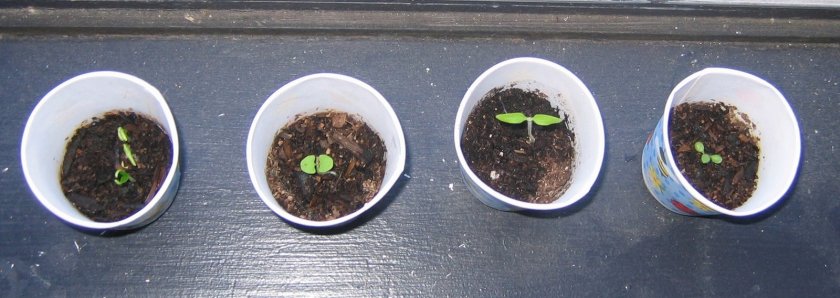
I had big plans for room 102 and the huge window sills. During the spring seed unit, I could envision twenty lima bean seeds, planted in Dixie cups, lining the sill. My students would have the tallest sprouts, and every child’s plant would grow with all of the natural light. Spring seed unit would be every child’s favorite, and I would be smug knowing our classroom ruled!
In the fall when the firemen came to teach us ‘stop, drop, and roll,’ we would be the first classroom to see the fire engine pull into the parking lot. In fact, when anyone arrived or left school we could potentially be the first to know.
However, in life there is a yin for every yang, and a pro for every con, and room 102 turned out to be such a contradiction. If room 102 could talk, it would remember the day Mrs. Flintcraft parked her big, peach colored Buick in front of the school to bring her son’s forgotten lunch box. She parked and hopped out of the car and as she walked down the long sidewalk, past the flagpole, and into the building; five other students and I, who were in my reading circle, saw that Mrs. Flintcraft had the back of her yellow, spring dress tucked into her pantyhose, exposing all of her goods, so to speak.
My reading center was a horseshoe shaped table with five chairs.
I glanced at my five ‘readers’ and all of us had wide, surprised eyes.
“Her underwear is showing,” one little girl reported.
“It sure is,” I said. “Maybe I should go tell her.”
And about that time, Mrs. Flintcraft came back out of the front door, down the sidewalk, past the flagpole, to her car with her yellow spring dress untucked.
“I think someone told her,” another student said. And we all got back on task.
The allure of classroom 102 and being close to the front office, wore off pretty fast. I realized the principal liked to pop by with visitors wanting a tour of the school. I would look up during a lesson, and my principal would be standing in the doorway with a school board member or a parent. “Do you mind if we observe for a little while?” he would ask.
“Of course not. Come on in.” I would say, while I silently prayed I could keep my twenty, five-year-olds under some semblance of control.
“Organized chaos!” my principal would say. “Your classroom is so much fun to visit.”
My dream of the superior lima bean plants disappeared one Monday when we arrived at school to find half of the plants had grown too much and toppled over, while the other half burned up because of too much sun. Upon this terrible discovery there were many tears, questions, and meltdowns. The wall of windows turned out to be too much heat for our delicate seeds and we had to start over, which meant planting seeds during the spring farm animal unit. I was losing momentum.
Have I mentioned the ant farm? Let me say that sometimes a five-year-old is not as responsible as we might wish. Sometimes little fingers touch things or move things and do not put them back. Like the top of the ant farm. On our classroom chore list, one item is labeled: Ant Farmer. The Ant Farmer is to check the ant farm every day to make sure everything is running smoothly. No escaping ants, no dying ants, etc. However, one day..
“Teacher!! Come quick! Somebody took the lid off and didn’t put it on all the way. The ants are gone!” my Ant Farmer said.
“Maybe they are sleeping or hiding in the dirt,” I suggested.
“I don’t think so,” another student said. “I see them going out the window. See? Look! Our ants are lining up to go outside!”
My first instinct was to grab the bug spray, but I knew this might be a delicate situation, so we built a suspension bridge out of popsicle sticks and lured the line of ants, or what was left of them, back into their glass farmhouse.
I made a vow to myself that next year I would try a worm farm instead of ants.
That outside door that was so near our classroom became a source of contention. We could hear all the classrooms going out to recess and coming in from recess. At various times during the day, we could hear that heavy, metal door clink shut. It was just a reminder that someone was having recess, and we weren’t.
The huge wall of windows that I loved so much were hard to cover when we were showing a film strip. They were drafty in the winter and smoldering in the spring. And as much as we enjoyed looking out at the comings and goings of the school…they enjoyed looking in on us. Occasionally we would look up to kids waving to us from outside. Or we would see the face of an older sibling pressed flat into the window looking for their brother or sister.
There were good days and bad days in room 102 but by and large I did feel like a rock star for those two years. I was living the dream, challenging young minds, creating a strong foundation for learning, and I had a room with a view. It doesn’t get much better than that.
My illustrious teaching career began in August of 1975, at Fairway Junior High School in Killeen, Texas. I was barely twenty-two years old, fresh out of Baylor University with a degree in Home Economics, married, and had a daughter. I was ‘adulting’ big time. My then husband was still in law school, so it was imperative that I find a teaching position as soon as possible. Two weeks before school started, I felt lucky that the junior high school would have an opening for an 8th grade Homemaking teacher. In all of my false bravado and rose-colored glasses ideals, I never thought my first year of teaching would be anything other than magical.
Fairway had been the only high school in Killeen until a new campus was built and then it became a junior high school. So, Fairway had seen better days, but it held wonderful memories for the Killeen community and the students it served. Most of the junior high students were from military families whose parents were stationed at Fort Hood Army Base.
The day I was hired, the principal’s secretary handed me a gradebook and a large wooden paddle. “In case you need to give swats,” she said.
I followed her into the storage closet, and she handed me a stapler, a box of staples, and two number two red pencils for grading, a box of chalk and two chalkboard erasers. I felt so official. Never did it occur to me to be apprehensive. At no point did I get a sick feeling in my stomach. I was the breadwinner of our little family now, and I was in ‘full steam ahead,’ mode. I was going to make this happen. How hard could this teaching thing be?
Truthfully, I do not remember my first day of teaching. By the time I made breakfast, my lunch, took my daughter to the babysitter, drove to school and met twenty-five new students each period for seven periods in a day, I was somewhere between hyperventilation and zombie land.
By the third day of school, I was beginning to see that because I was teaching Home Economics, and it was considered an elective course, the counselors would sometimes use elective classes as an opportunity to ‘place’ students who might not otherwise fit into the regular stream of academic classes. Also, in 1975, homemaking classes were only for girls. Five days a week, seven periods a day, twenty-five girls per period comes out to an amount of estrogen that perhaps is impossible to calculate. Imagine, if you will, approximately one hundred seventy-five girls in various stages of their menstrual cycles.
My two classrooms consisted of a sewing room with twenty sewing machines in various stages of repair, large tables to lay out fabric and patterns; and a huge room with five separate little kitchens, each with a kitchen table, stove, and cabinets filled with all kitchen utensils and dishware. So, while some may say homemaking is an easy class to teach, there is a certain level of safety and training that comes with using sewing machines, sharp scissors, hot stoves, butcher knives, open flames, and electrical appliances.
The sewing project for that first semester was a simple, pull over blouse called The Poppet. This easy Simplicity pattern took nearly all semester for my beginning seamstresses, and still, some did not finish. As far as safety was concerned, we talked for days about pointing scissors down and away from the body (yours or anyone else’s). We talked about the sewing machine and its parts, and the importance of keeping your fingers away from the needle while it is engaged. The iron was another problem as I strived to remind students to turn it off and try not to burn any fingers, fabric, much less burn the building down.
Elective courses were seen as a safe and fun way to expand the day for students with special needs. The Monday morning of my second week of school, I received a new roster for my second period. Four new special education students were added to the role and began arriving mid class. We had introductions and I assigned each of the four girls a buddy. As utterly horrible as having a classroom of pre-teen girls was, I must admit they were kind and helpful to our new classmates. I did not know then that one of those new students would be a child I would remember for the rest of my life.
Tsunami Martinez had a beautiful light brown complexion with large, dark, slanted eyes. She wore her hair down, pulled back by a plastic headband or sometimes in a long ponytail that reached halfway down her back. She had a tentative smile that never showed her teeth and from the first day we met, she and I shared a bond that was hard to describe. Our smiles and our eyes melted into each other, and I felt I had known her before, maybe in another life. She wore plain blouses and polyester knit pants, always clean but often too big, and there was one more thing…
Tsunami did not speak. Only her eyes told the story.
Sometimes Tsunami would be absent for two or three days in a row. I would greet her when she returned and ask, “Were you sick, Tsunami? We missed you.”
She would smile and her eyes would be searching mine, like they wanted to tell me, but she never uttered a word. The most I would get would be a slight nod of her head, and even then I wondered if she understood me.
After several more absences, I spoke with the special education teacher about Tsunami’s attendance. She said, “Tsunami’s mother keeps her home when she needs help with the younger children. There are four younger siblings. Also, just so you know, Tsunami’s mother only speaks Korean, so you won’t be able to call unless her dad is home.”
I continued to speak to Tsunami and include her in our learning process. As is protocol for any school in a military community, asking for students to have supplies of any kind must be correlated with military payday. Still, Tsunami was two- and one-half weeks later than the other students in bringing in her fabric and patterns. Her face lit up when she walked in with her bag from the PX Post Exchange, and I knew she felt so proud that she had her own supplies. I wondered if this extra expense was a hardship for the family or if maybe her mother did not drive, but I never knew the reason.
When it was time for Tsunami to begin using the sewing machine, I sat beside her and demonstrated exactly what she should do. My fingers would hold the fabric and guide it through the machine. Then I would put her fingers in the same place and help her guide the fabric through. It was slow going. When we would finish a row of stitches, she would smile, and her eyes practically danced as they crinkled upward. Of course, with twenty-four other students, I was not always able to just focus on Tsunami, but it was clear that someone needed to sit beside her in order to move forward.
One day, in the middle of class, a student started to yell, “Miss, Miss, come quick! Tsunami got her finger caught in the sewing machine!”
Practically the whole class gathered around Tsunami’s table, and I pushed my way through the girls to sit down beside her. She never uttered a word, but her eyes were large and overflowing with tears. In one motion I turned the wheel to raise the needle up out of her left index finger and instantly blood began to spurt. She held her finger up and looked at me with such a wide-eyed, almost surprised look. From the crowd, a student handed us two rough, brown paper towels and I wrapped her finger tightly to stop the bleeding. “You’re going to be ok, Tsunami. We’ll go to the nurse’s office.” And I immediately dispatched another student to escort her to the nurse.
The next day Tsunami returned to class with a large bandage on her finger, but she did not want to work the sewing machine herself. The other students took turns helping and encouraging her as they did most of the work on her blouse. After a few days, things got back to a normal rhythm and Tsunami began to try sewing on her own.
But in two weeks, Tsunami was absent again. Days later, when she had not returned, I received a note from the office that she had been withdrawn from school. And just like that, Tsunami Martinez, who had won a classroom full of hearts, was gone from our protective love and guidance.
The students and I speculated about the many reasons why she might have gone.
“Maybe she’s sick,” one girl said.
“I bet her dad got orders, and they have to move,” another one said.
“Her parents are probably getting a divorce. That’s what happened to me,” a student offered.
Finally, I got confirmation that her father had been transferred to Germany. No one came for her sewing supplies or her blouse which was half way through completion. She seemed to have disappeared over night, and our class was quiet that next day as we separately thought about our friend.
I carefully took all of Tsunami’s sewing supplies and fabric and put them in a plastic bag labeled, Tsunami Martinez. I then put it on the top shelf of my supply cabinet, just in case.
Of all the things I learned from my first year of teaching, perhaps the most important thing was that sometimes my heart would break, and there would be nothing I could do about it. My heart would break because I dared to connect or ventured to care a little more than I should. But as I look back on my thirty-six years of teaching, I have never regretted the connections or heart break, and I have always remembered a student whose eyes said it all.
Here’s To Auntie Sue!!!!!!!!!!!!!!!!!!!!!!!!!!!!!!!!!!!!!!!!!!!!!!
In the early morning hours, before anyone else is up, while the cat is still stretching languidly in her chair, I begin my day. In this quiet early hour I can hear the thud of the newspaper being thrown on the sidewalks, the coffeemaker finishing the last few drops and I hear the tick of our clock on the mantle. This is my selfish hour. This is my cherished solitude. I must have it!! This is my time to drink my coffee and absolutely, unequivocally “sit ugly”.
Sittin’ Ugly is a family tradition passed on by my 88 year old Auntie Sue. Her mother did it, she does it and now I do it. I’m sure lots of other people on earth are doing it, but to do it correctly is an art. The art of sittin’ ugly is learned and perfected through years of practice. There are rules of course, and above all, one must respect another’s’ right to sit ugly. There should be no judgment about sittin’ ugly. The fact is, one just simply does…..sit ugly. No judgment, no shame.
Everyone has their own way to sit ugly. But there are guidelines that I find very comforting and helpful to follow. Anyone that is new to the art will surely want to comply. The rules are as follows:
1. There must be coffee. Preferably freshly brewed with everything extra that you need, (cream, sugar etc.) and of course the favorite mug. I’ve never known a tea drinker to sit ugly, but I suppose it could be done.
2. No talking!! No one speaks to you-you speak to no one. Sometimes it may be necessary to point or grunt especially if you have small children and they absolutely must encroach on your time. But, the only talking truly allowed is to yourself.
3. You must sit. My favorite spot is an oversized chair by the window. Above all else, you must pick a comfortable, familiar place to sit. It is always good to be able to put up your feet and have a little table nearby. Your sittin’ area should be away from anyone else who might be awake.
4. You may be asking yourself, now what? I have the coffee. I’m sitting quietly. Now what? The “what” to do part is really up to you. Sometimes I just sit and stare while sipping my coffee. Staring is perfectly allowable and even encouraged. I also read my daily devotionals and have long conversations with God. I contemplate my day and my life. I think. I don’t think and then I may stare some more, all the while continuing to drink my coffee. This part may go on for a long as necessary. One hour is perfect for me.
5. Lastly, about this “ugly” part. Sittin ugly simply means that you come as you are, straight from bed. No primping allowed! One must be ones’ self. Tattered nighty? That’s ok! Acne medicine dotted on your face? Beautiful! Scruffy old favorite robe and slippers? The older the better! Sittin’ ugly is actually a super-natural phenomenon that makes you more good looking. The longer time you have to sit, the better you will look and feel. Try it and see!
Sittin’ ugly is my personal time. It is my favorite time of the day. Sometimes I can hardly wait to get up in the morning just to sit ugly. I am always at my best while sittin’ ugly, mainly because no one is speaking to me or me to them. What a joyous, peaceful time! What a perfect way to start your day, infact for me, it is a necessity.
Some mornings my little Auntie will call me and ask, “Honey, are you sittin’ ugly or can you talk?” It is always good manners to ask first encase one is not fit for conversation.
So here’s to “Sittin’ Ugly”, to having this special time each and every day and to the millions of us who find it necessary for the sustainment of sanity. Here’s to my precious Auntie Sue and all the beautiful ones who “sit ugly”.
On the surface, Boo looks like a mature sixty-eight-year-old man; confident, charming and witty. His shiny head with grey fringe whispers over-the-hill in a subtle way. But, underneath the suave exterior is a twelve-year-old boy running the show and calling the shots.
Boo is sweet and sincere, then obnoxiously loud and sarcastic. “Did you see that guy’s shirt? The bright green one with Padre Island on it?” he says loudly at the grocery store where almost everyone can hear. “I have one just like it, but you won’t let me wear it out in public.”
And just like a twelve-year-old boy may be developing peach fuzz on his upper lip, Boo’s moods and patience are developing on many different levels and not always in a smooth way. I can never predict whether Boo will feel sorry for someone or call them ‘a complete fool.’
Have you seen the Instagram post where the husband is standing over the casket of his deceased wife, sobbing into a handkerchief?
“But honey, what’s the Wi-Fi password?”
That will be Boo.
In spite of my efforts to educate him on the whereabouts of important papers, Wi-Fi password, ‘end of life’ notebook, and even the extra flea and tick control medicine for the cat, he still says he can’t find them. Can’t or won’t? He can’t even find the new bottle of ketchup sitting front and center in the pantry. Again, can’t or won’t? That’s the million-dollar question.
Boo’s sophistication is at times subzero. He occasionally surprises me when we are attending a party at someone’s house. He’ll insist on purchasing a really nice bottle of wine or a fancy, scented candle for a hostess gift and then tell a wildly inappropriate fart joke as soon as we get there.
As a grandparent, Boo is top of the line. He loves our grandkids unconditionally and proves it by his outrageous and grandiose expressions of affection. He will build a ninja warrior course in the backyard, plan and execute elaborate fishing trips, play dress-up complete with Beauty and the Beast costumes, and bake their favorite chocolate chip cookies in mass quantity. If it can be done, he will do it. His ability to have fun is his super-power as a grandpa.
Boo doesn’t care about what he wears, whether it matches or even if it has holes or stains. “That’s why I married you. No one’s really looking at me.”
Was that a compliment?
One of Boo’s little known twelve-year-old talents is something I was unaware of while we were dating. Not until we were married did he display this skill. One weekend we were walking Town Lake. Mid-point in our trail he stepped over to the bushes, and without using a tissue, blew his nose and kept walking.
“What are you doing?” I howled, looking around to see who saw this happen.
While still walking and blowing he answered, “It’s a snot rocket. Don’t knock it till you try it.”
“I assure you I will never try it,” I said.
“Well, that’s a shame. It’s really very satisfying if you’ve been stopped up.”
Not all of his twelve-year-old antics are as ‘out there’ as a snot rocket, but subtle or not, they are real.
As character defects go, mine mainly revolve around being too serious, worrying over little things, and trying to control the universe. While Boo prefers to roll his eyes when I say something he doesn’t like or laugh when someone falls down.
Of course, Boo is way past puberty, but he still runs the gamut from childish to mature, confident to insecure, rebellious, and impulsive to someone I can always count on. In fact, that is one of Boo’s most wonderful qualities, he is a man of his word. He always does what he says he will do, and generally with a good attitude. And while Boo still has his ‘pull my finger’ jokes and toddler table manners, he’s a definite diamond in the rough. My husband is twelve, but it’s really working out for us.
Have you ever had the misfortune of finding out something you wish you hadn’t? Sometimes the truth is more than I really want to know. Being nosy or asking too many questions might seem fun at the beginning, but eventually, ‘oops, there it is!’ and I cannot unhear what I just heard.
The simple, “How are you feeling?” turns into a graphic description of a lanced boil or a replay of what someone had for lunch that didn’t agree with them. The innocent, “What did you do this weekend?” parlays into a three-part mini-series complete with Instagram reels and photos.
When I continue to ask, prod, or coax someone to share information, I would do well to mind my own business 99 % of the time, especially when I am asking my adult children questions about their lives. Navigating life with grown children is quite different than when they were eleven years old, and I had a right to know all about their comings and goings, friendships, what they ate, and how they were feeling. Overstepping my boundaries was a given back then, but now it is a definite no-no if we want to stay on good terms.
I used to think I was rather good at finding out things about our kids, but my husband, Boo, is an expert. He is the master of ‘21’ questions. He is the guru of gossip, and like Inspector Clouseau, he is a fact-finder to the nth degree.
Boo is generally a man of few words, but seat him next to a stranger on the airplane or give him a beer, and he becomes absolutely chatty and will pry into anyone’s life before they know it. He is adept at asking questions in rapid fire. Who, what, when, where, why, and how. He is not afraid to ask any question to anyone at any time.
He is often frustrated by my lack of snooping into our daughters’ lives.
“Well, did you ask her how much that was going to cost?” he says.
“No. It’s none of our business what they spend their money on,” I answer.
“Yes, it is. I think she should save her money or invest it in some stocks. I have a list here of the best ones.”
“Boo, mind your own beeswax,” I counter.
The expression, ‘mind your own beeswax,’ comes from the 18th century when the dreaded small pox left scars on people’s skin. To cover the pox marks, women would apply beeswax to their faces. The story goes that if people got too close to a woman’s face or stared at her covered up spots, she would tell them to “mind your own beeswax.” Another theory is from the practice of sealing letters with beeswax to prevent others from reading them. Whichever theory you agree with, the end result is the same, don’t meddle. Stay in your own lane. Butt out.
Most of the time I try to fly under the radar. I can sit quietly and entertain myself easily. I don’t have the need to talk. I can stay in my own hula hoop, but if there is one lonely elderly person in the grocery store, they will find me. And, even without asking, I will find out everything they have been thinking and feeling for the last twenty-five years. I will know their pets’ names; their personal medical diagnosis; vacation plans; their children’s names, where they live, and why they haven’t called in over a month.
I rarely initiate these conversations, but I must have that face that says, “Tell me everything. I really care.” People tell me why they got divorced; when they found Jesus; their favorite ice cream flavor and how they put on their false eyelashes.
Once, at Buc-ee’s, I ran in to get a bottle of water while Boo waited at the gas pump. Twenty-two minutes later I emerged.
“What happened?” Boo asked.
“ I was paying for the water and noticed the cashier’s false eyelashes were the longest, thickest fake lashes I have ever seen. I said, “WOW, I love your lashes!,” but I could see the girl thought I was making fun of her, so to make her feel better I said, “No, I really love your lashes. I wish I could wear those.”
I don’t know why I said that.
She proceeded to tell me where she buys them, how much they cost, and step by step instructions on attaching them. Then she explained that her real eyelashes have nearly all been pulled out by the glue, and now she has to wear the false lashes all the time, so her boyfriend won’t know her real eyelashes are gone.
“Don’t get the cheap glue,” she advised.
By this time there was a line behind me, and I quickly said, “I’ve learned so much, thank you! You’ve given me the courage to try it,” and she leaned over the counter and gave me the biggest hug.
“Go big and dramatic,” she said, “You won’t be sorry. And have a blessed day,” she added.
“You too,” I called.
“Wow,” Boo said when I told him the story, “That’s a lot of information.”
Oh sure, all this could have been avoided had I not said anything about the cashier’s eyelashes. But don’t you agree that some situations just beg for a question or comment? In the same way, we want to ask our grown children questions that we probably shouldn’t, even though we think we want to know the answer…we really don’t. Maybe someday I’ll learn not to ask. Maybe someday I’ll remember the secret to happiness is minding my own business.
Repeat after me: The secret to happiness is minding my own business!






























 Sittin' Ugly Sistahs