Posted in #Confessions, #Teaching, Growing up, Relationships, Teaching, Truth

Understanding  by Ginger Keller Gannaway

After I secured my MA in English at LSU in 1980, I took a teaching position at an un-air-conditioned elementary school north of Baton Rouge. As a Language Development teacher I was part of a state program that helped children who were “culturally deprived.” I gave no grades and used puppets and a small record player to sing songs as we worked on vocabulary building, letter recognition, and basic reading skills. I worked with small groups of kids between 5-7 years old who came to me for 30-minute classes each day.

My Elementary School Kids


The school was a long building in the countryside with one classroom for each grade (K thru 8). Recess time for kindergarteners was in a small field next to a fenced area of cows. The mooing of our bovine neighbors mixed with the whirr of electric fans. The population was 98.9% African-American. I remember an extra tall kindergarten boy who was “mixed” and one pale, blonde second grader.

My students spent most of their lives in the rural area they called home. When we took the kindergarteners for a field trip to Baton Rouge, the biggest Wow! was the escalator at the mall where we had lunch. A few five-year-olds needed help getting on and off the moving stairs, but others wanted to ride up and down more times than they could count.

I became friends with Molly, the kindergarten teacher, because I worked with her whole class, and we shared lunch while her kids napped on dark blue mats. I helped her color 3-foot high cardboard cut-outs of the Alphabet Kids. I loved coloring as we chatted. I knew the kindergarten class best since I only worked with a few first and second graders.
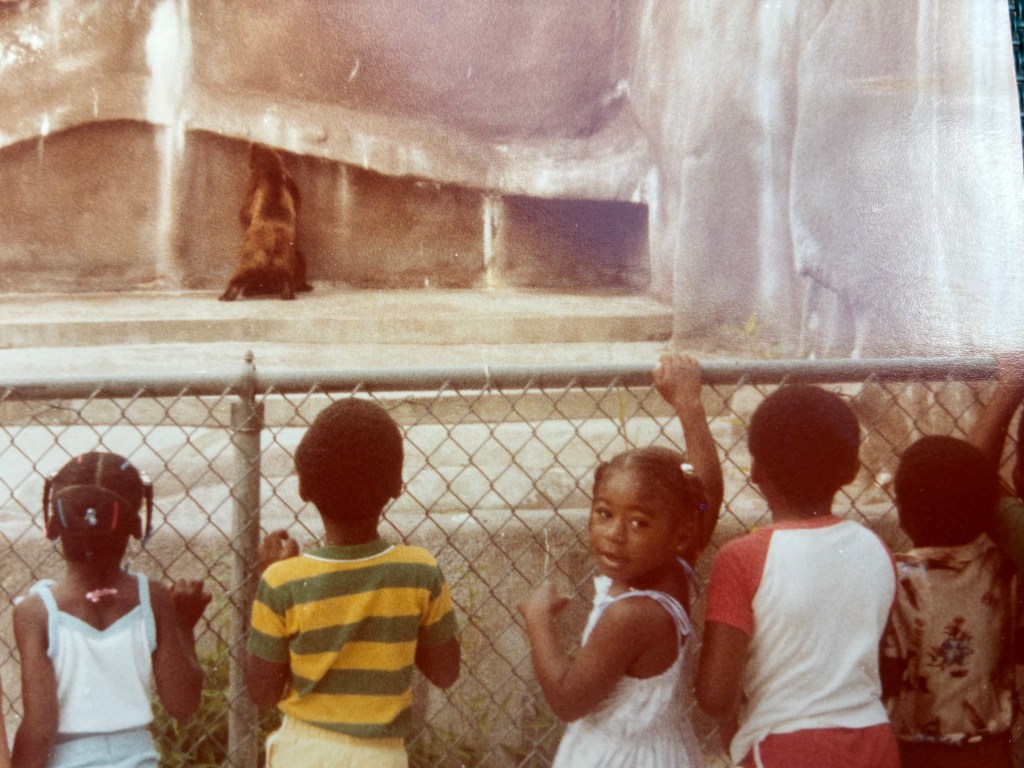
Our zoo field trip

I remember David who rarely slept on his blue mat. He stayed quiet while  squirming and searching the room for another wakeful peer; however, all the other kids had entered the Land of Nod. I smiled often at Sammy, a chubby boy who was first to fall asleep flat on his back with his mouth half- open to make him appear more vulnerable than those who curled into balls or hugged a treasured stuffed animal from home. Sammy was a cute, yet tough bundle of energy when he wasn’t napping. He had a husky laugh and lots of friends. When I had Sammy in my class he sang confidently during the puppet songs and I believed we got along like cheese and crackers.
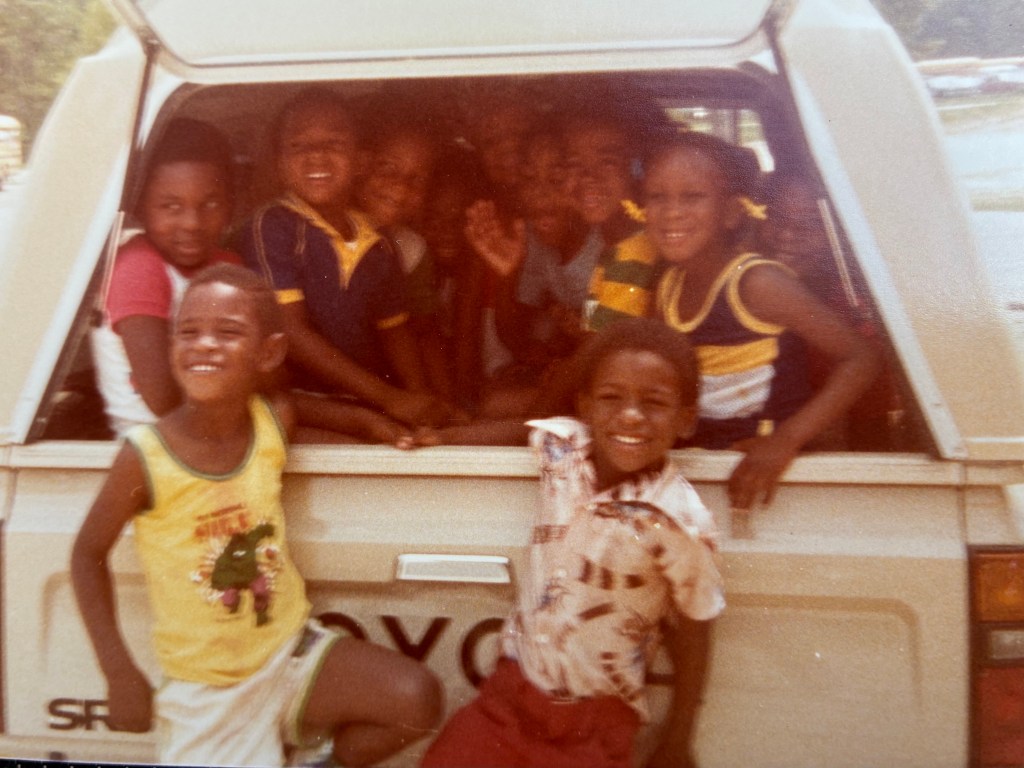
One humid afternoon I helped Molly with a line of five-year-olds as they waited for the school bus or a parent to take them home. (Kindergarten got out an hour earlier than the rest of the school). Each child had a note pinned to his/her shirt with details about our upcoming field trip. Sammy was kicking up gravel as he waited. I smiled at him and squatted to be eye-level. “Sammy, you excited about going to Baton Rouge next week?”


He continued kicking pebbles and surprised me with, “Momma told me don’t trust a white person farther than I can throw ‘em.”

Maybe he had seen his mother’s car pull up and didn’t want to be caught talking to me. Maybe I had corrected his pronunciation in my class earlier that day. In a moment Sammy went from being a student I felt comfortable with to someone I didn’t know.

For the first time I felt a smidgen of judgement based on the color of my skin. I never had a run-in with any parent that school year. I got only positive feedback from my principal. I thought I was a decent elementary teacher, even if my diploma said “Secondary School English.” But Sammy made me face the separation of races in Louisiana in the 1980s. I did not think I held prejudice in my heart. However, I grew up around racism in my hometown. Sammy’s mother’s beliefs came from her own experiences, and she was teaching her son how to navigate the world she lived in. 

Back then no one used the triggering term “woke,” but Sammy opened me to living Atticus Finch’s advice in To Kill a Mockingbird– “You never really understand another person until you consider things from his point of view…until you climb into his skin and walk around in it.” 

I had a sheltered upbringing when it came to other cultures. My segregated hometown and a Catholic school education kept me ignorant in some ways. I thought I trusted, accepted, and understood people from different races. But teaching in several schools with diverse populations, I got “schooled” by my students and their families. And teaching teens with lives so unlike my own made me a better person.

The quote “Be a person on whom nothing is lost” by Henry James helps me seek new ways to understand other people and to accept our differences.  I will never understand prejudice the way those who lived it have, yet I can be open-minded to their ideas and accept them for who they are…..even if they don’t trust me.


Posted in #Confessions, #Teaching

WWJD

            It was April, nearing the end of school, and the air hung low while the tensions ran high.  The humidity outside made sweat bead up on my top lip and my clothes feel like I was wearing a wet diaper.  And while I tried to start each day fresh and dressed to the 9’s, I ended these muggy days as barely a 3.8.

            Lunchtime is always hectic at a large urban high school, and on this day at Crockett High School, as an Assistant Principal, I was outside patrolling the back of the school.  Only seniors were allowed to leave for lunch, but of course we knew that was a rule followed by few.  Complaints had come in from teachers hearing cars spinning out from that back parking area by the tennis courts, along with loud music and the occasional waft of smoke; cigarettes and other smokables.

            Crockett high school is a beautiful campus and backs up to Garrison Park, a neighborhood park with baseball fields and a swimming pool.  Unfortunately, some students liked to take long lunches or skip classes and hang out in the park where nothing, but no-good shenanigans would take place.

            On this particular day, the SRO, School Resource Officer, had suggested that two AP’s be on the lookout for a late model, rusty blue chevy, with three male, non-students, inside.  It had been reported that these guys were trying to pick up girls from that parking area behind the school.  It had also been reported that they were blasting their music with loud, low bass thump, thump, thumps, disturbing classes while they waited for the girls to come out.

            Another female AP, Ms. Wilson, and I were positioned in that back area by the park.  We walked around, turning under-classmen back toward the school, while keeping an eye out for our rusty blue chevy.  As we circled around, we spotted our three guys, parked under some trees, music thumping and a faint smell of marijuana floating through the air.  They didn’t see us as we lurked behind the dumpster.

            “Officer Smith, we spotted the blue chevy,” I whispered over the radio.

            “10-4.  I’ll be right there,” the SRO answered.

            When he arrived at the dumpster, the SRO, Ms. Wilson, and I made our plan of attack.

            “The bell rings in 4 minutes, we should wait until the bell rings then nab them just as the girls are approaching the car,” Ms. Wilson said.

            “No, it might be too crowded with kids coming out for lunch.  Besides, they’re smoking joints right here on school property.  We should call for back up,” I suggested.

            And before we could finalize a plan, all hell broke loose.

            Two girls came out of the back door of the school three minutes before the bell rang and were looking left and right for the car.  The blue chevy boys saw the girls and turned up the thump, thump music and put the car in drive.

            Without a real plan, the SRO, Ms. Wilson, and I sprang into action.  The SRO took off toward the opposite end of the drive to set up a road block.  Ms. Wilson and I waited by the dumpster because the car had to come down that way to turn around and get out of the driveway.  As the car approached, we stepped out yelling for the car to stop.

            “Hey guys, stop right there,” I yelled, and I saw out of the corner of my eye, the girls start running toward the park.  I heard Ms. Wilson say, “Well s!*#”,  and take off running after them. Now, Ms. Wilson was a tall, big boned woman, dressed in a smart looking, purple colored knee-length shift, wearing mid-heeled espadrille sandals, so this was no track star chasing the students, but her commitment to the challenge was unmatched.

I knew I had to get this car to stop, so I stepped in front of it.

            “Are you crazy lady?  Get out of the way,” one of the boys yelled.

            “Hey man, let me see your school ID,” I told the driver, knowing full well these three hooligans were not students.

            “We’re just picking up my sister,” he said as he started to turn the car away from me.

            In a reflex action, I grabbed his arm, which was hanging out of the smoke filled, thump, thump, rusted blue chevy.  “Stop!” I yelled and for some unknown reason, he did.

            I still had my hand on his arm even as the car slowed and finally stopped, and as I glanced down at his arm I saw a yellow band on his wrist with “WWJD?”  And I lost it!

            “What would Jesus do?,” I hollered at him.  “What would Jesus do?  Not smoke pot and pick up underage girls!!!” I hissed.  “Jesus would definitely not do that.”

            “Let go of my arm, lady, you’re crazy!” And the car started to go.

            In a split second, I knew I had a decision to make. I couldn’t hold on to his arm and run beside a speeding car, but for some reason I didn’t let go of his arm.  I started to jog beside the car and then finally let go as he tried to roll the window up.  When I suddenly looked up I saw a police car parked, blocking their exit.  (Not a minute too soon.) 

I don’t know how she did it, but Ms. Wilson brought the girls back to campus and we called their parents.  The boys went with the police, and the smoke filled, rusted, thump, thump blue chevy got towed.  April turned into May and school was finally out, but not before I had a little time to reflect on that yellow wrist band.

            Maybe our wanna be thug/pot smoker had a devil and an angel sitting on his shoulders.  On one hand he wondered, what would Jesus do, and on the other he just wanted to live his best life out on the streets.  It’s definitely a conundrum as old as the ages, and it was definitely one day in my life as an assistant principal that I will never forget.